
News
SERAP files fresh lawsuit against Buhari over social intervention programmes

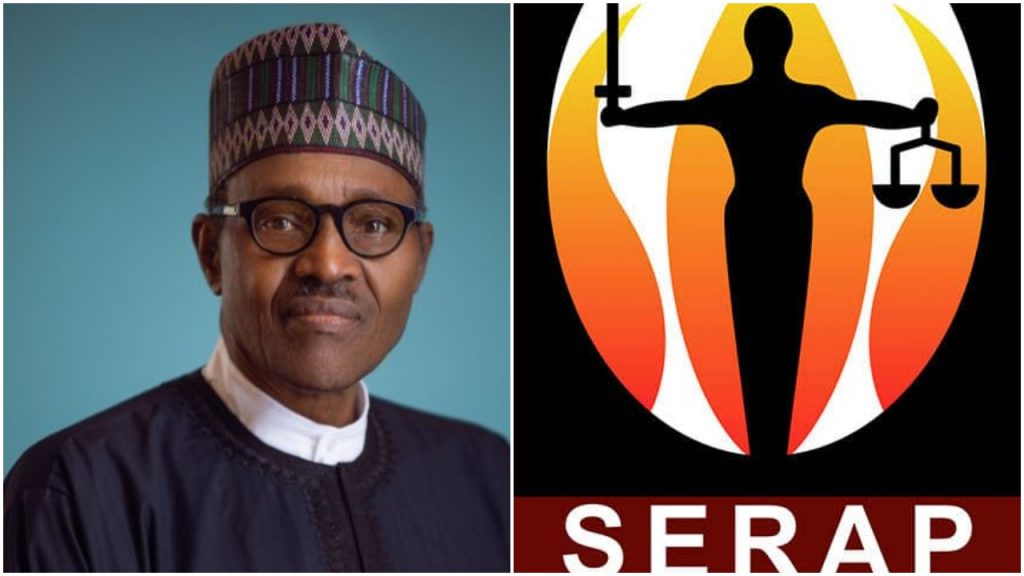
Socio-Economic Rights and Accountability Project (SERAP) has filed a lawsuit against President Muhammadu Buhari over “the failure to thoroughly, effectively and transparently investigate spending on all social safety-nets and poverty alleviation programmes and projects executed between 2015 and 2022.”
Joined in the suit as Respondent is the Attorney-General of the Federation and Minister of Justice, Abubakar Malami (SAN).
A recent report by the National Bureau of Statistics (NBS) shows damning revelations that some 133 million Nigerians are poor, despite the government reportedly spending N500 billion yearly on ‘social investment programmes.’ Half of all poor people in the country are children.
In the suit number FHC/ABJ/CS/2357/2022 filed last Friday at the Federal High Court, Abuja, SERAP is asking the court to “direct and compel President Buhari to thoroughly and transparently investigate the spending on all social safety-nets and poverty alleviation programs and projects executed between 2015 and 2022.”
SERAP is also asking the court to “direct and compel President Buhari to ensure that suspected perpetrators of corruption and mismanagement of public funds meant to take care of the poor face prosecution, as appropriate, and any stolen public funds are recovered.”
READ ALSO: SERAP urges AGF, EFCC to name, shame politicians buying PVCs from poor voters
In the suit, SERAP is arguing that, “Nigerians have the right to be free from poverty. Allegations of corruption in social safety-nets and poverty alleviation programmes pose both direct and indirect threats to human rights, and contribute to extreme poverty in the country.”
The suit filed on behalf of SERAP by its lawyers Kolawole Oluwadare, Kehinde Oyewumi, and Blessing Ogwuche, read in part: “The failure to address extreme poverty has resulted in high levels of inequality, and serious violations of economic and social rights of socially and economically vulnerable Nigerians.
“The NBS report suggests a grave violation of the public trust, and the lack of political will by the government to uphold the country’s constitutional and international human rights obligations.”
“The consequences of corruption are felt by citizens on a daily basis. Corruption exposes them to additional costs to pay for health, education and administrative services.
“Corruption undermines economic development of the country, trapping the majority of Nigerians in poverty and depriving them of employment opportunities.
“Extreme poverty is the greatest denial of the exercise of human rights, as it denies millions of Nigerians not only their economic and social rights but also civil and political rights such as the rights to life, human dignity, and political participation.
“The failure to address extreme poverty has resulted in high levels of inequality, and serious violations of economic and social rights of Nigerians, particularly the socially and economically vulnerable sector of the population.”
“Section 14(2) (b) of the Nigerian Constitution of 1999 [as amended] provides that, ‘the security and welfare of the people shall be the primary purpose of government.’”


-
 Featured1 week ago
Inside INEC’s race to prepare for Nigeria’s 2027 elections
-
 Featured1 week ago
2027: APC unveils nationwide campaign timetable, Tinubu to rally in 12 states
-
 Business5 days ago
Naira faces exchange rate gap as Dollar hits N1,380 on parallel market
-
 Business1 week ago
Court dismisses ₦170m Trade Fair contract claim, says Zenith Bank was not a party
-
 Latest1 week ago
Breaking: NNPCL raises petrol price to ₦1,405 per litre amid discount controversy
-
 Featured1 week ago
From kitchen to Supreme Court: Nigerian’s fight over alleged support for terrorists
-

 Football1 week ago
Maresca reveals Guardiola’s reaction to Man City’s 4-2 defeat to PSG
-
 Business7 days ago
NCC launches Internet Governance Working Group to tackle AI risks, boost online safety