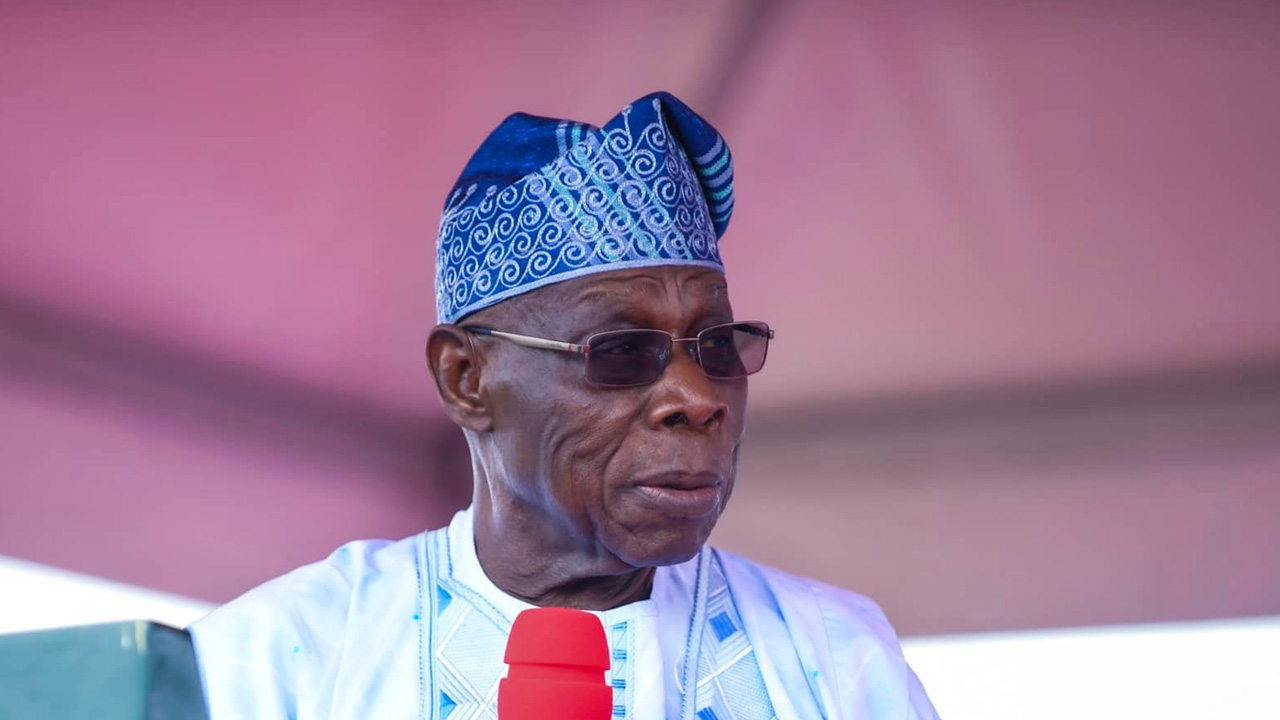
Former President Olusegun Obasanjo has said Nigeria may not have prevailed in the 1967–1970 civil war without critical assistance from neighbouring Niger Republic, noting that military supplies and logistics were channelled through the country to Nigerian troops at the warfront.
Obasanjo made the remarks during an appearance on Soni Irabor Live, a programme on News Central, where he reflected on Nigeria’s historical military and diplomatic relations within West Africa and the country’s current regional influence.
The Nigerian Civil War, also known as the Biafran War, began on July 6, 1967 and ended on January 15, 1970.
According to him, the Niger Republic played a strategic role during the conflict by serving as a transit route for materials and support that reached Nigerian forces fighting the war.
He also lamented what he described as Nigeria’s strained response to the Niger Republic following the July 26, 2023 military coup that ousted democratically elected President Mohamed Bazoum.
Obasanjo criticised the Nigerian government’s decision to cut off electricity supply to Niger and close its borders, describing the move as inconsistent with historical ties between both countries, particularly Niger’s contribution to Nigeria’s infrastructure projects such as the Kainji Dam.
He recalled that Nigeria had an understanding with the Niger Republic during the dam’s development to ensure cooperation on electricity generation and regional stability.
“Without Niger Republic, winning the civil war would have been hard. We used to get materials through Niger Republic to be ferried to our troops in the warfront,” he said.
The former military ruler also argued that Nigeria has lost much of its influence in Africa, contrasting the country’s past leadership role with its current diplomatic standing.
READ ALSO: Obasanjo reflects on Murtala’s assassination, blames security ‘naivety’ for 1976 tragedy
“Today, Nigeria is not at the table. What is happening that Nigeria is influencing or impacting upon whom?” he asked.
He further referenced Nigeria’s historical role in supporting liberation movements across Africa, including financial assistance to Angola during its independence struggle in the 1970s and backing South Africa’s anti-apartheid movement.
Obasanjo also warned that Nigeria’s handling of regional institutions such as ECOWAS reflects a decline in diplomatic influence.
“Look at the way we have handled ECOWAS, something that took us 50 years to build. Overnight, we mishandled it. We have virtually destroyed it,” he said.
Obasanjo served as Nigeria’s military head of state between 1976 and 1979, and later as civilian president from 1999 to 2007.


 News1 week ago
 Crime1 week ago
 Football1 week ago
 Health6 days ago
 Business6 days ago
 Crime6 days ago
 Health1 week ago