
Latest
Governors push for expanded security powers as State Police framework takes shape

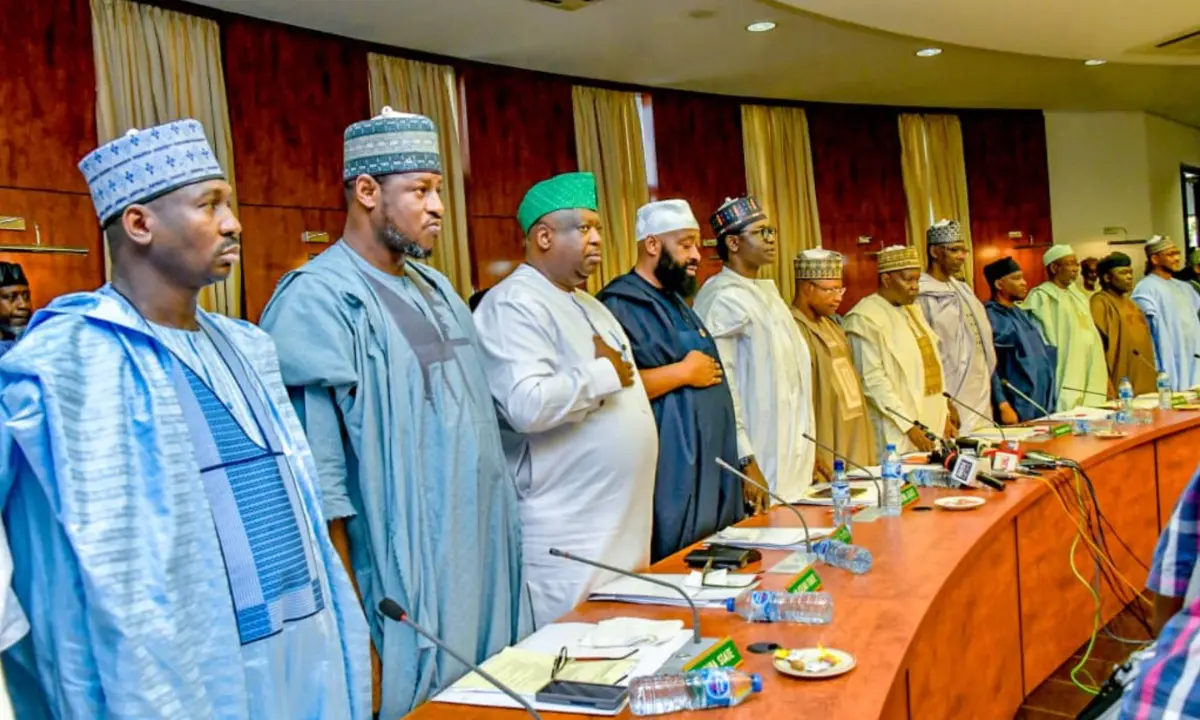
Nigeria’s 36 state governors have intensified their campaign for greater constitutional authority over security operations within their respective states, as discussions on the establishment of state police gain momentum across the country.
The governors made the demand following a high-level stakeholders’ meeting focused on creating a legal and institutional framework for decentralized policing.
Their position was outlined in a communiqué issued after the gathering, which brought together state Attorneys-General, legal experts, policymakers, and senior security officials.
The meeting, held last week, was convened to harmonise proposals aimed at establishing state police services and redefining the security architecture of the federation in response to growing concerns over insecurity and the limitations of the current centralized policing system.
A key proposal emerging from the deliberations was the need for stronger constitutional recognition of governors’ roles in coordinating security operations at the state level.
Participants argued that as chief security officers of their states, governors should be granted clearer legal authority to direct and coordinate security responses to local threats.
Stakeholders also endorsed the development of a policing model based on the principles of cooperative federalism, under which federal and state police institutions would operate side by side within clearly defined constitutional and statutory boundaries.
READ ALSO: Everything you need to know about the new State Police Bill
Under the proposed framework, the Federal Police Service would continue to exercise exclusive jurisdiction over crimes and security matters considered national in scope, including offenses that threaten national security, cross-border crimes, and other federal offences.
At the same time, newly created State Police Services would be empowered to prevent, investigate, and support the prosecution of crimes occurring within their territorial jurisdictions, particularly offenses established under state laws.
Proponents of the arrangement argue that locally controlled police forces would be better positioned to respond swiftly to community-based security challenges.
The framework also contemplates the transfer, restructuring, or sharing of certain existing policing assets, commands, and facilities to support the effective take-off and operation of state police institutions once established.
To enhance state participation in national policing oversight, stakeholders proposed the inclusion of a rotating representative of State Attorneys-General on the National Police Council.
The recommendation is aimed at ensuring that states have a stronger voice in policy formulation, strategic planning, and oversight of policing activities nationwide.
Funding emerged as another major issue during the discussions, with participants stressing that the success of state policing would depend heavily on guaranteed and sustainable financing mechanisms.
Stakeholders called for explicit constitutional provisions that would secure predictable funding streams for state police services, warning that inadequate financial support could compromise operational effectiveness and public confidence in the new security structure.
“Without predictable financial support, state police services could face operational difficulties that would undermine their effectiveness,” participants noted during the meeting.
The latest proposals represent another significant step in the ongoing national conversation on state policing, a reform that has gained increasing support among governors and security experts who argue that Nigeria’s evolving security challenges require a more decentralized and locally responsive law enforcement system.
If adopted through constitutional amendments, the proposed framework could mark one of the most far-reaching reforms of Nigeria’s policing architecture since independence, fundamentally redefining the relationship between federal and state authorities in maintaining law and order.


-
 Comments and Issues3 days ago
Can President Tinubu Revive Nigeria’s Moribund Refineries?
-
 Business4 days ago
Tinubu knocks Atiku’s subsidy plan, says proposal shows ‘ignorance’ of economy
-

 Business3 days ago
TikTok, ByteDance agree to $400m settlement in US children’s privacy case
-

 Entertainment6 days ago
Poco Lee faces rape allegation as unverified UK arrest report spreads online
-
 Latest7 days ago
Tinubu files: US Judge grants four-day extension in FOIA disclosure battle
-
 Featured7 days ago
Beyond Osun 2026: What Adeleke’s re-election reveals about Nigeria’s road to 2027
-
 Featured4 days ago
Economic Reality vs Party Machinery: What will drive Nigeria’s 2027 election?
-

 Football4 days ago
EPL 2026/27: Experts back Arsenal for title as Haaland, Rice lead individual award picks