
Editorial Opinion
Under the Uniform: The urgent need for mental health, substance abuse screening for officers

By Elizabeth Nta
The primary responsibility of any police force is clear: to protect lives, safeguard property, and uphold civil liberties. Yet across Nigeria, growing public concern suggests a widening gap between this mandate and lived reality. For many citizens, encounters with law enforcement no longer evoke reassurance, but anxiety, fear and uncertainty.
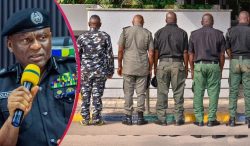
In recent weeks, several viral incidents have intensified these concerns. On 20–21 May 2026, Assistant Superintendent of Police Newton Isokpehi was captured on video threatening to shoot and kill anyone who filmed him on duty.
Speaking in Pidgin English from a commercial bus, the Anambra State officer was swiftly identified, arrested and placed before an internal disciplinary panel, which also subjected him to drug testing. He subsequently issued a public apology, claiming his remarks were born of frustration after 26 years of service.
Days earlier, on 9 May 2026, a viral video from Ekiti State showed a police sergeant at the Ikole-Ekiti Divisional Headquarters behaving erratically in a camouflage uniform, with many observers alleging drug influence.
READ ALSO; Lagos Police foil kidnap attempt, neutralise four suspects in gun battle
The officer, subsequently identified as Sergeant Osayingbemi Temitope, tested positive for amphetamine and tobacco. He confessed to illicit drug use and was dismissed from the force following the conclusion of internal disciplinary proceedings.
When individuals entrusted with firearms and state authority display volatile or unpredictable behaviour in public, it raises a pressing institutional question: whether underlying psychological stressors and possible substance misuse are being adequately identified and addressed within the Nigeria Police Force (NPF).
The Unseen Crisis: Trauma, Stress and Armed Authority
Policing in Nigeria remains one of the most psychologically demanding public service roles. Officers operate under difficult conditions marked by limited welfare support, high operational pressure, long working hours and constant exposure to violent or traumatic environments.

While many officers continue to serve with discipline under these constraints, experts in occupational psychology note that prolonged exposure to such stressors can accumulate over time, affecting emotional regulation, decision-making and behavioural stability. Without structured mental health intervention, this strain may manifest in burnout, aggression or impaired judgement in high-pressure situations.
Recent incidents have renewed focus on these concerns. On 26 April 2026, 28-year-old musician Oghenemine “Mene” Ogidi was shot and killed in Effurun, Delta State, by ASP Nuhu Usman, now dismissed, a former SARS operative who was not assigned to the patrol but attended the scene independently. Ogidi had been restrained and tied to the ground after a parcel allegedly containing a firearm was found at a park, and he was pleading for his life when the officer opened fire. The killing was captured on video and sparked widespread public outrage. ASP Usman has since been dismissed from the force and is being prosecuted for murder.
Reports from Edo State (April 2026) documented an alleged assault involving multiple uniformed officers, while in Lagos (April 2026), a viral video showed a man in police-branded attire accused of threatening passengers during a confrontation in a commercial bus. Both incidents remain subject to ongoing verification.
READ ALSO; Police brutality under spotlight as Akwa Ibom Court verdict echoes other extrajudicial killing cases
Individually, these incidents vary in context and confirmation status, but collectively they contribute to a growing public concern about the use of force, restraint, and behavioural control in enforcement encounters.
Constitutional Clarity: Recording Public Encounters and Accountability
A recurring point of tension in recent incidents involves citizens recording interactions with law enforcement officers. Under Section 39 of the 1999 Constitution of the Federal Republic of Nigeria (as amended), citizens are guaranteed freedom of expression, which encompasses the right to seek, receive and share information.
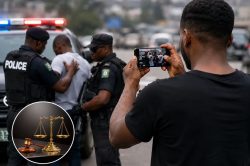
A Federal High Court ruling delivered on 17 March 2026 in Warri, Delta State, before either of the incidents above occurred, explicitly affirmed that this constitutional protection extends to the recording of police officers performing official duties in public spaces, and declared any attempt to prevent or punish such recording unlawful.
The NPF itself has reiterated this position. In its statement on the Isokpehi case, the Force declared: “Recording police activities remains a legitimate tool for public accountability and transparency and should not, in itself, attract harassment or intimidation from police personnel.”
At its core, this principle reflects a broader accountability mechanism: the use of documentation as evidence and public record in situations where misconduct is alleged.
The Shadow of #EndSARS: A Reform Conversation Still Unfinished
Nigeria has previously confronted the consequences of unresolved tensions between citizens and law enforcement.
In October 2020, the #EndSARS protests emerged nationwide following sustained allegations of abuse, extortion and brutality linked to the disbanded Special Anti-Robbery Squad (SARS). What began as peaceful demonstrations escalated into a national crisis marked by widespread unrest and loss of life.
Following the protests, reform commitments were announced, including improved oversight mechanisms and recommendations for psychological evaluation of officers before deployment.
READ ALSO; Police brutality under spotlight as Akwa Ibom Court verdict echoes other extrajudicial killing cases
azHowever, recurring incidents in the years since, including the discovery in 2026 that ASP Nuhu Usman, a former SARS operative, had been transferred across at least five postings over conduct issues yet remained armed and operational, suggest that implementation of those commitments has been inconsistent.
A Path Forward: Evaluation, Welfare and Institutional Support
A sustainable reform approach requires preventive systems that go beyond disciplinary action and focus on continuous support for officer fitness and welfare. Consideration should be given to:
- Mandatory psychological evaluation beginning at recruitment, including Mental State Examination (MSE) before firearm deployment.
- Routine reassessment cycles for active officers, including scheduled psychological reviews.
- Compulsory substance screening integrated into ongoing service monitoring, not limited to entry-level testing.
- Structured mental health support systems, including counselling services, trauma response units and internal wellness frameworks.
- Improved welfare conditions aimed at reducing occupational stress and operational burnout.

These measures reflect a shift towards preventive accountability, combining fitness assessment with institutional care systems. Critically, the NPF’s own response to the Ekiti incident, ordering psychological and medical evaluations before proceeding with discipline, suggests there is already institutional recognition that such assessments are both appropriate and necessary.
Conclusion
The concerns raised here are not an indictment of the entire Nigeria Police Force. Many officers continue to serve with professionalism under demanding and often dangerous conditions. The swift arrest of ASP Isokpehi, the dismissal of Sergeant Temitope and the prosecution of ASP Usman demonstrate that the institution can act decisively when public pressure demands it.
However, recurring incidents of alleged misconduct point to a deeper structural challenge that cannot be addressed through reactive discipline alone. A modern policing system must combine accountability with continuous psychological evaluation, welfare support and preventive safeguards.
Mandatory mental health assessments and routine substance screening should therefore be viewed not as punitive measures, but as essential tools for protecting both officers and the citizens they are sworn to serve.
Ultimately, rebuilding public trust will depend not only on responding to misconduct when it occurs, but on strengthening the systems designed to prevent it in the first place.


-

 Football4 days ago
Saka: England still carry World Cup scar
-

 Business5 days ago
CBN reduces MPR by 350bps to 23% in major monetary policy shift
-

 Latest23 hours ago
Pastor Chris Oyakhilome announces mother’s passing at 88 [VIDEO]
-

 Comments and Issues6 days ago
Sometimes, goodwill finds us through the people we love
-

 Business1 week ago
Jetour takes T1 adventure SUV experience to Abuja, targets growing Nigerian market
-

 Latest2 days ago
Arsenal eye €70-80m move for Real Madrid star
-

 Football1 week ago
Nigeria vs Colombia: Falconets battle for U-20 World Cup semi-final ticket
-

 Crime2 days ago
Police arrest suspect, launch manhunt for 2 others over Delta Education Director’s death