
Business
Tinubu speaks on Nigeria’s high interest rates

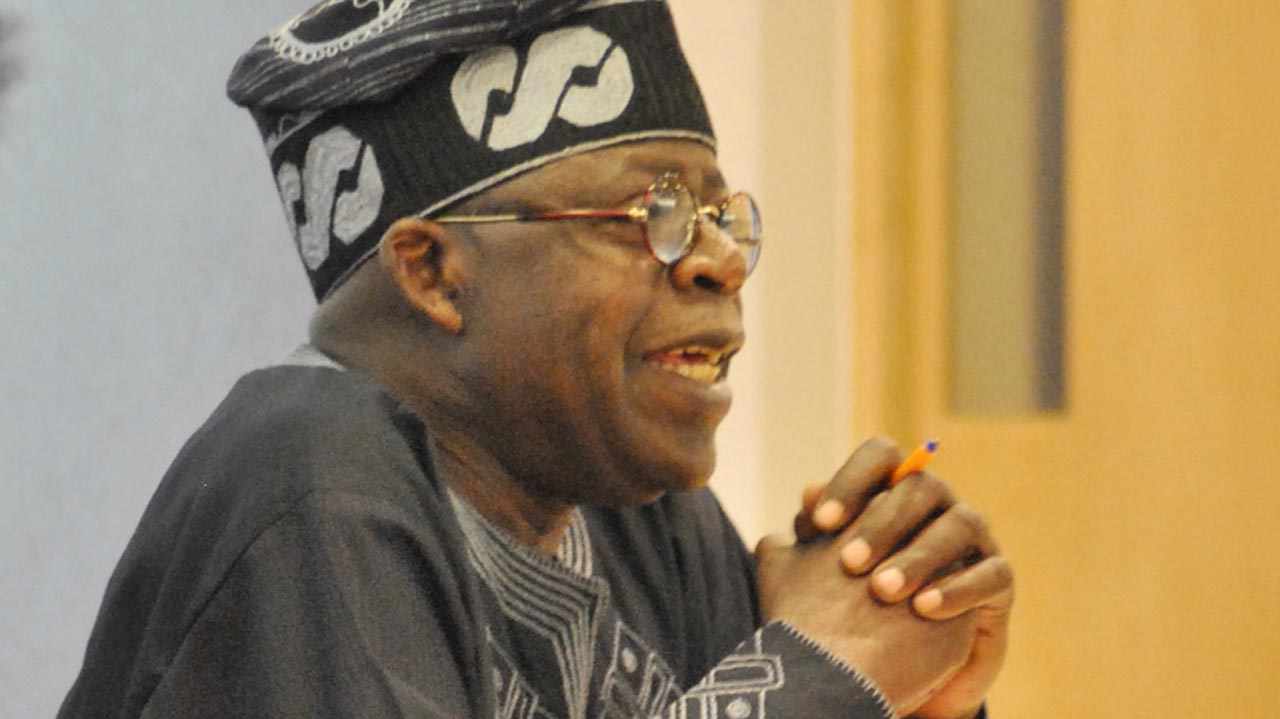
The national leader of the ruling All Progressive Congress (APC) Sunday afternoon issued a statement in which he made a case for the imperative of lowering the prevailing interest rates in the country by the central bank in order to strengthen the economy against the COVID-19 pandemic.
In the statement, Tinubu said the CBN’s high interest rate policy penalises domestic investment and consumer borrowing, noting that it reduces both aggregate domestic supply and, to a lesser degree, aggregate domestic demand.
“In the short run, high rates seem to attract foreign capital and boost the economy while giving it discipline against inflation. In the longer-term, all of this is untrue. High rates give us the worst of both worlds. They hinder domestic investment and incomes while pushing up inflation and exposing an ever-increasing share of our financial system to foreign manipulation and dependence.
He said the CBN has demonstrated its financial agility by establishing a number of special financing programs for various industries and sectors of the economy.
These programs, he said exposed important contradictions in the CBN’s position. “The special schemes are an implicit admission that normal rates stifle investment borrowing and thus suppress the economy. They would not be required if the general interest rate was at a proper level.”
“The current interest rate in Nigeria prohibits most normal business investment. Thus, the productive sector stagnates as innovation and creative endeavour are discouraged. Employment and aggregate demand are dragged down. The economy becomes a slave to a negative, impoverishing dynamic.”
According to him, the high interest rate financial model runs contrary to the ideals of a progressive democracy to which Nigeria aspires. A nation cannot become a genuine democracy while access to credit remains under a semblance of authoritarian lock-and-key.
“We have become too reliant on foreign borrowing. In our case, we have created a highly imbalanced and imperfect economy. On one hand, high rates are used to scare domestic investment borrowing thus undermining income, production and consumption. On the other hand, high interest rates are used to attract foreign creditors who must be repaid with an increasing percentage of our intake of dollars.
“If we went to a freely floating exchange rate, the naira would devalue. This means our currency is overvalued in terms of our trade with the outside world. This overvalued exchange rate is buoyed by high interest rates.
He argued that in a well-functioning economy, import levels should shape the exchange rate, instead of the exchange rate determining the import level.










-
 Latest6 days ago
Israel marks 3 years since October 7 Hamas attack amid Gaza strikes, election debate
-

 Energy5 days ago
Fuel Battle: Dangote, marketers and government clash over petrol imports
-

 Energy7 days ago
Petrol, diesel prices rise 86% in 2026 as costs hit fresh highs
-

 Energy1 week ago
Has Iran lost control of the Strait of Hormuz? Oil flows rebound as war disruptions persist
-

 Football6 days ago
Nigeria’s World Cup exit under spotlight as FIFA’s DR Congo files emerge
-

 Latest6 days ago
US Court set to rule on release of FBI, DEA records on Tinubu
-

 Business6 days ago
Nigerian investors at a crossroads as fixed-income yields slide
-

 Business7 days ago
LoveWorld Trade and Investment Forum to Convene Business Leaders in Accra