
News
Onnoghen closes on appointment as CJN, cleared of corruption allegations

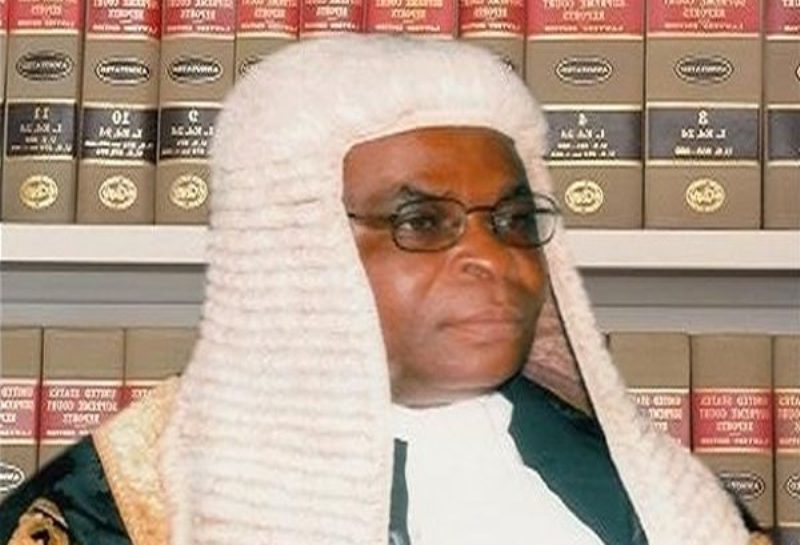
The Acting Chief Justice of Nigeria (CJN) Walter Onnoghen may be inching towards eventual appointment as Chief Justice of Nigeria, having been cleared by the Department of State Services (DSS) of all allegations bordering on corruption.
To this end, Natinal Daily gathered that the Presidency may send his name to the Senate for confirmation any moment from now.
The nomination may either be sent by President Muhammadu Buhari or Vice President Yemi Osinbajo, depending on when the President’s vacation ends. He has asked for an extension.
A security report on Justice Onnoghen is said to have been centred on “the fact that he is reform-minded and suitable for the anti-corruption agenda of the Buhari administration”.
The Presidency is believed to have received the report.
A government source said: “All hurdles against the nomination of Justice Walter Onnoghen as CJN have been resolved. He has been absolved of all allegations against him.
“As a matter of fact, the nomination was delayed as a result of the need to address these allegations. Now, Justice Onnoghen has been given a clean bill of health.
“Every allegation was investigated and proofs indicated that Onnoghen has no case to answer. The government went to this extent to ensure that the holder of the office of CJN is above board.”
The source dismissed the insinuations that the delay in nominating Justice Onnoghen had to do with his being a Southerner.
“There were issues against him and it became imperative to get to the roots of these allegations,” he said, adding: “More importantly, the outcome of the security checks rated Onnoghen as ‘reform-minded and suitable for anti-corruption agenda of Buhari administration’.
Justice Onnoghen’s appointment as Acting CJN will end on February 10.
Onnoghen underwent security checks by the Department of State Services (DSS) and other agencies in the light of the ongoing probe of some judges of the Supreme Court.
Another government source added: “These agencies sent independent confidential assessment to the President on the credibility and competence of Justice Onnoghen.
“Some of the allegations bordered on observations made on Onnoghen in 1994 by a Judicial Reform Panel which was headed by late Justice Kayose Eso (JSC).
“The panel, which was raised by the late Head of State, Gen. Sani Abacha, indicted 47 judges and recommended their dismissal or retirement from the bench.
“Members of the National Judicial Council (NJC) however rose in favour of Justice Onnoghen by producing evidence that Justice Bola Babalakin Review Panel, set up ex-President Olusegun Obasanjo, cleared Justice Onnoghen in 1999.
“They said it was on the basis of the clean bill of health that the NJC strongly recommended the confirmation of Onnoghen as the Chief Justice of Nigeria.”
The source also said further checks revealed that Justice Onnoghen had been incorruptible.
The source added: “Onnoghen was also rated as a conscientious judge and one of the three justices who wrote dissenting judgement on the 2007 Presidential Election in favour of the then candidate of the then All Nigeria Peoples Party (ANPP), Gen. Muhammadu Buhari.
“The other judges were Justice Oguntade and ex-CJN Mariam Aloma Mukhtar.
The tenure of the immediate past CJN, Justice Mahmud Mohammed, ended on November 10.
Both the Federal Judicial Service Commission (FJSC) and the National Judicial Council (NJC) recommended Justice Onnoghen to President Muhammadu Buhari as the Chief Justice of Nigeria (CJN).
But the President appointed Justice Onnoghen as Acting CJN, a development which drew much criticism.
The appointment of CJN is always in accordance with Section 231 of the 1999 Constitution, but subject to confirmation by the Senate.
The section says: “The appointment of a person to the office of Chief Justice of Nigeria shall be made by the President on the recommendation of the National Judicial Council subject to the confirmation of such appointment by the Senate.
“A person shall not be qualified to hold the office of CJN or of a Justice of the Supreme Court, unless he is qualified to practice as a legal practitioner in Nigeria and has been so qualified for a period of not less than 15 years.
“If the office of Chief Justice of Nigeria is vacant or if the person holding the office is for any reason unable to perform the functions of the office, then until a person has been appointed to and has assumed the functions of that office, or until the person holding the office has resumed those functions, the President shall appoint the most Senior Justice of the Supreme Court to perform those functions.
“Except on the recommendation of the NJC, appointment pursuant to the provisions of subsection(4) of this section shall cease to have effect after the expiration of three months from the date of such appointment and the President shall not reappoint a person whose appointment has lapsed.”












-

 Latest5 days ago
Cole-Alegbe unveils memoir, urges leaders to harness technology for lasting impact
-

 Business1 week ago
X3M Ideas donates 50 Walkie-Talkies to strengthen security operations in Onigbongbo
-

 Business3 days ago
Nigeria records N12.59trn trade surplus in Q2 2026 — NBS
-

 Business3 days ago
Nigerian Breweries’ H1 profitability strengthens as revenue hits N804bn
-

 Business5 days ago
Jetour G700 PHEV Storms Abuja as Jetour Nigeria Takes Luxury Mobility Showcase to FCT
-

 Business7 days ago
Rising crude prices threaten fresh petrol price hike in Nigeria
-

 Business1 week ago
Naira breaks below N1,330/$, hits strongest level in over two years
-

 Business6 days ago
Multinationals exit Nigeria as economic pressures reshape business landscape