
Business
Cost of shipping goods into Nigeria among highest, lawmaker

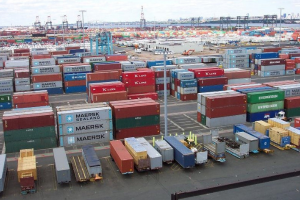
The senator representing Anambra South, Ifeanyi Patrick Ubah, has lamented the high cost of shipping goods into Nigerian ports, describing it as being among the highest in the world.
Senator Uba raised the alarm in his presentation at the plenary, calling for the senate to engage with the maritime industry stakeholders to find a solution to the high cost of shipping goods in the country.
He said, “A close look at charges in other countries shows fees charged by shipping/cargo companies from China: Ghana $3,200 from China; Cotonou $3,000 from China; and Nigeria $8,500 from $3,200 a few months ago. This has caused unjust hardship to Nigerians as an importer’s transfer expenditure to both traders and consumers.”
In his presentation, Ubah noted that while Nigeria is an import driven economy with excessive dependence on imports for consumption and capital goods, the shipping sector is key in facilitating the continuity of economic activities by ensuring supply chains to industries, transportation of essential goods, including energy and food supplies, and transportation of vital medical and protective equipment in Nigeria.
According to the lawmaker, vessels coming to Nigeria ports queue longer before berthing when compared to other countries due to various charges; adding that, “the cost of shipping goods into Nigerian ports is amongst the highest in the world”.
He expressed worry that a report on overseas cargo and freight costs by an online platform, Mover DB, shows that the cost of shipping both 20-foot and 40-foot containers to Lagos is among the highest globally.
Ubah lamented that the charges are so high that importers in most cases abandon their cargoes in the port, thereby leading to revenue loss and declining efficiency of the ports.
He noted further that in May 2017, Vice President Yemi Osinbajo, who was Acting President at the time, signed an Executive Order directing 24-hour operations at the Apapa port and outlawing unofficial charges at the ports.
Ubah pointed that despite Osinbajo’s order aimed at improving the ease of doing business and reducing costs at the ports, “available statistics suggest that these unjustifiable charges and extortions by shipping agencies and law enforcement officers at the ports have continued to date”.
He said excessive shipping charges would strangulate Nigerian shippers, warning that if nothing is done to defend Nigeria from such economic sabotage, the development is capable of leading to inflation in the country.


-

 Latest5 days ago
Full List: Meet the 2026 Nobel Prize winners across six categories
-

 Football5 days ago
Premier League Matchweek 7: Five Fixtures That Could Shape the Weekend
-

 Latest4 days ago
Umahi defends Lagos-Calabar highway route changes amid public outcry
-
 Business4 days ago
Dangote Refinery IPO: 70% Subscription claim meets fourfold demand assertion as investors seek clarity
-
Business4 days ago
Dangote Refinery IPO Extension: Was the 70% subscription report overhyped?
-

 Latest3 days ago
UCTH faces morgue crisis as 50 unclaimed corpses await mass burial
-

 Featured4 days ago
El-Rufai, ADC governorship candidate’s court appearance puts Kaduna opposition politics in focus
-

 Business2 days ago
BREAKING: Nigeria’s Inflation Rate Drops to 14.63% in September