
Business
Naira depreciates against Dollar at parallel market


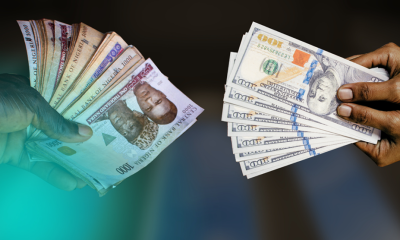
The naira, on Wednesday, depreciated to N1,300 per dollar at the parallel section of the foreign exchange (FX) market.
The current FX rate signifies a 3.17 percent drop from the N1,260 traded on April 22.
Currency traders, known as bureau de change (BDC) operators, quoted the buying rate at N1,260 and the selling price at N1,300 — leaving a profit margin of N40.
At the official window, the naira fell to N1,308.52 against the dollar — a 0.64 percent decline from the N1,300.15 traded on April 23.
READ ALSO: Naira plummets to dollar at official market
According to the FMDQ Exchange, a platform that oversees official FX trading in Nigeria, the naira recorded a high of N1,367 and a low of N1,098.
With the current record, the official window rate still surpasses that of the parallel market by N8.52.
The Central Bank of Nigeria (CBN), on April 23, reduced the FX rate for dollar allocations to BDC operators.
The financial regulator, in a circular signed by Hassan Mahmud, director of trade and exchange department, said it sold $10,000 at the rate of N1,021/$ to each BDC.
On April 8, CBN also sold FX to the BDCs at the rate of N1,101/$, compared to the N1,251 the apex bank offered to the parallel market operators on March 25 and the N1,301 announced on February 27.


-

 Featured4 days ago
BREAKING NEWS: Shouts of joy rock the world as Pastor Chris opens final Healing Streams edition for 2026
-

 Football4 days ago
Man United shortlist Emery, Nagelsmann as potential replacements for Carrick
-

 Business4 days ago
Hoodlums raid JED Benue office, abduct 10 staff over power dispute
-

 Football4 days ago
Aston Villa ready to freeze out Garnacho to avoid £43m Chelsea transfer
-
 Business1 week ago
Naira faces exchange rate gap as Dollar hits N1,380 on parallel market
-

 Latest4 days ago
Akpabio tasks Tompolo-backed movement with spreading Tinubu’s renewed hope message
-

 Business4 days ago
EV adoption: Roxettes seeks cheaper financing, local manufacturing incentives
-
 Business3 days ago
How Ethiopian Airlines is challenging Africa’s aviation narrative through self-reliance