
Crime
Outcry over Supreme Court’s death sentence in Sunday Jackson case: Justice or Judicial Rigidity?

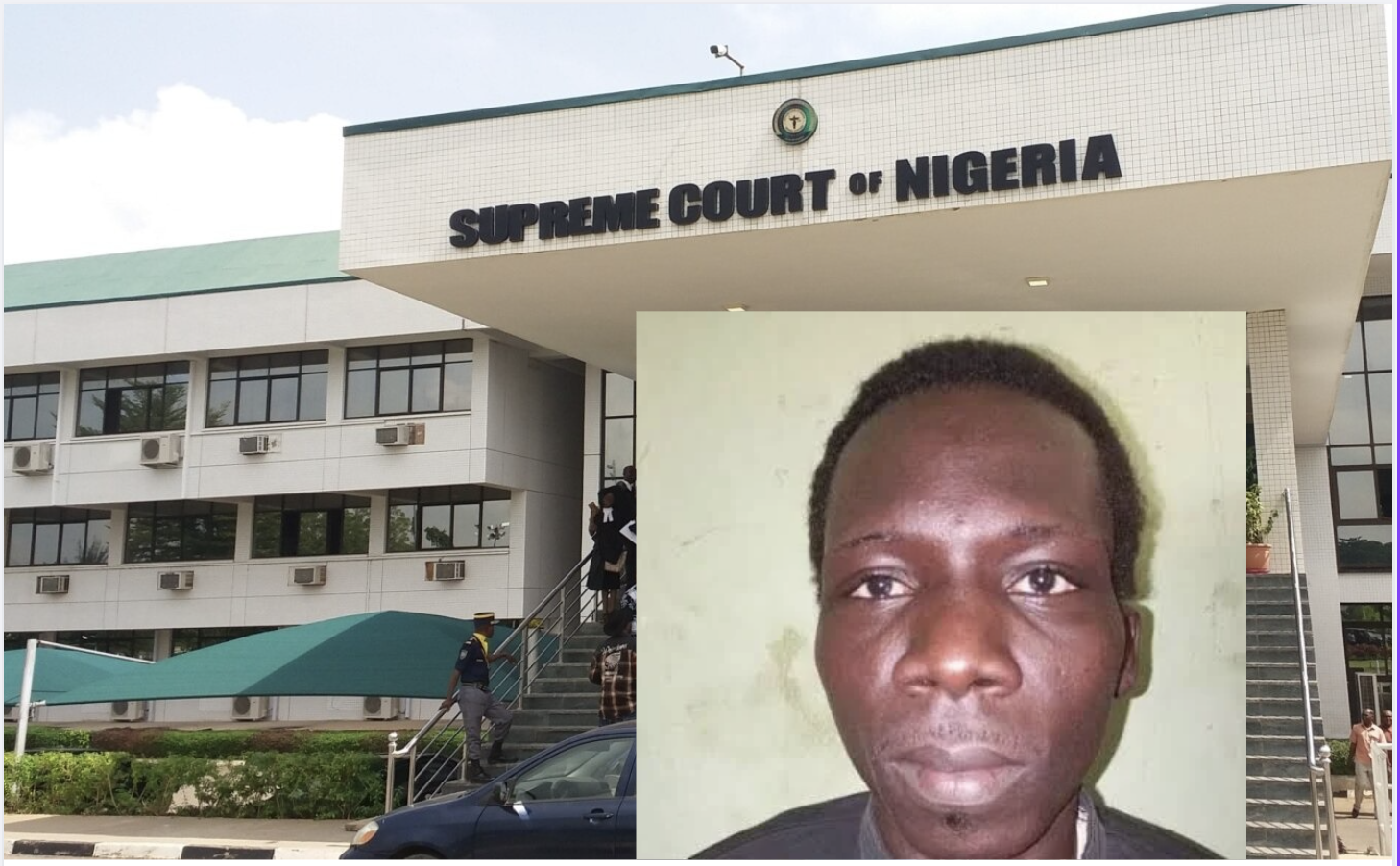
A storm of public outrage and legal debate has erupted across Nigeria following the Supreme Court’s controversial ruling in the case of Sunday Jackson v.
The State (SC/CR/1026/2022). Delivered on March 7, 2025, the apex court upheld the conviction and death sentence of Sunday Jackson—a young farmer from Adamawa State—for killing a Fulani herdsman, Ardo Bawuro, in what he claimed was self-defence.
Legal practitioners, civil society actors, and human rights advocates have widely criticized the judgment as procedurally flawed, morally unjust, and legally rigid, arguing that it disregards the chaotic nature of violent self-defence situations and failed to apply relevant statutory protections, particularly the doctrine of excessive self-defence.
A Farmer Caught in a Deadly Encounter
The incident took place in 2018 in Kodomti, Numan LGA of Adamawa State, a region scarred by persistent, often deadly, clashes between pastoralist herders and sedentary farming communities.
According to the case facts, Sunday Jackson had gone to harvest thatching grass on his farm when he was confronted by Bawuro, who accused him of involvement in the killing of his cattle.
A violent altercation ensued. Jackson claimed Bawuro attacked him with a dagger. In the struggle, Jackson disarmed the herdsman and, fearing for his life, stabbed him multiple times in the neck. Bawuro died from his injuries.
Jackson fled the scene but was later arrested and charged with culpable homicide punishable by death under Section 221 of the Penal Code.
READ ALSO: David Mark condemns attacks by suspected herdsmen in Benue, urges justice and vigilance
A Controversial Legal Journey to the Apex Court
Despite his plea of self-defence, both the trial court and the Court of Appeal rejected Jackson’s argument and found him guilty of murder. The Supreme Court, in its final ruling, affirmed the decisions of the lower courts. However, the reasoning offered has sparked intense backlash.
The apex court acknowledged that Jackson was initially under threat and did not provoke the attack. However, it held that once he had disarmed Bawuro, the imminent danger ceased, and he should have fled rather than retaliated with deadly force. By failing to retreat, the court ruled, Jackson’s force was “excessive and unnecessary.”
This interpretation, legal experts say, misapplies the principles of self-defence in real-world scenarios.
“This is a case where the Supreme Court created a theoretical space between danger and safety that simply does not exist in violent encounters,” said a senior legal analyst in Abuja. “Expecting someone in the midst of a knife fight to calmly assess when the threat ends is legally neat but humanly unrealistic.”
Constitutional Breach and Procedural Lapses
The judgment also raises serious procedural concerns. Notably, it was delivered 167 days after final addresses—well beyond the 90-day limit set by Section 294(1) of the 1999 Constitution. Legal commentators argue this delay not only breaches constitutional provisions but could compromise the judgment’s validity in such a high-stakes capital punishment case.
READ ALSO: Fresh Herdsmen Attacks Leave Several Feared Dead, Villages Razed in Benue
“When a man’s life is on the line, due process is not a formality—it is a constitutional obligation,” said human rights lawyer Maryam Musa. “This delay, in itself, is sufficient ground for a miscarriage of justice.”
Missed Opportunity to Apply Doctrine of Excessive Self-Defence
Perhaps most troubling for legal scholars is the Supreme Court’s refusal to invoke Section 222(2) of the Penal Code, which allows for a reduction of murder to manslaughter where a person uses excessive force in self-defence. Courts in previous cases, including Okonkwo v. State (1998) 4 NWLR 143, have recognized that individuals acting in genuine fear may use disproportionate force in life-threatening situations.
Instead, the court applied a rigidly objective standard, ignoring evidence of Jackson’s fear and panic, and the fact that the fatal blows occurred in the heat of a life-or-death struggle.
Wider Implications for Justice and Rule of Law
The implications of this judgment stretch far beyond Sunday Jackson’s case. It raises pressing questions about the responsiveness of the Nigerian legal system to the complex, often brutal, realities faced by ordinary citizens—particularly in regions plagued by violence and insecurity.
“Jackson’s case is symbolic,” said a legal academic at the University of Lagos. “It tells Nigerians that even in the face of imminent death, they may be punished for defending themselves—unless they do it with courtroom precision in the middle of chaos.”
In an already fragile justice system, critics argue that this judgment deepens public cynicism about the judiciary’s role as the last hope of the common man. The Supreme Court, as the ultimate interpreter of the law, sets precedent for all lower courts. If its rulings are seen as out of touch, politically influenced, or procedurally compromised, it shakes the foundation of public trust in the rule of law.
A Life in the Balance
As of now, Sunday Jackson awaits execution, his fate hanging on the signature of the Adamawa State governor. His story has become a rallying cry for legal reform advocates, who are calling for a review of self-defence laws, better training for judges on violence dynamics, and a more humane, context-sensitive approach to justice.
“This judgment should be remembered not just as a legal misstep, but as a moral failure,” a prominent civil society leader said. “If this is justice, then justice has lost its soul.”


-

 Trending Stories1 week ago
Davido, Wizkid, Burna Boy or Asake: Who is having the biggest 2026 so far?
-

 Football1 week ago
Premier League releases 2026/27 festive fixtures, 7 matches set for Boxing Day
-

 Crime6 days ago
Anambra Police arrest mother over alleged child sexual exploitation
-

 Business5 days ago
Jetour Nigeria, dealers take dashing, other models to Abuja Experience
-

 Business6 days ago
Dangote Refinery IPO shifts spotlight to corporate governance, investor protection
-

 Business3 days ago
Dangote IPO rush crashes Bamboo login as investors flood platform
-

 Business2 days ago
Abuja gears up for Jetour T2’s rugged-luxury experience
-

 Business3 days ago
Nigeria Business Outlook: Dangote IPO, markets, inflation and naira in focus this week