
Business
Nigeria’s 2026 debt servicing hits $11.6bn as Tinubu decries global financial inequity

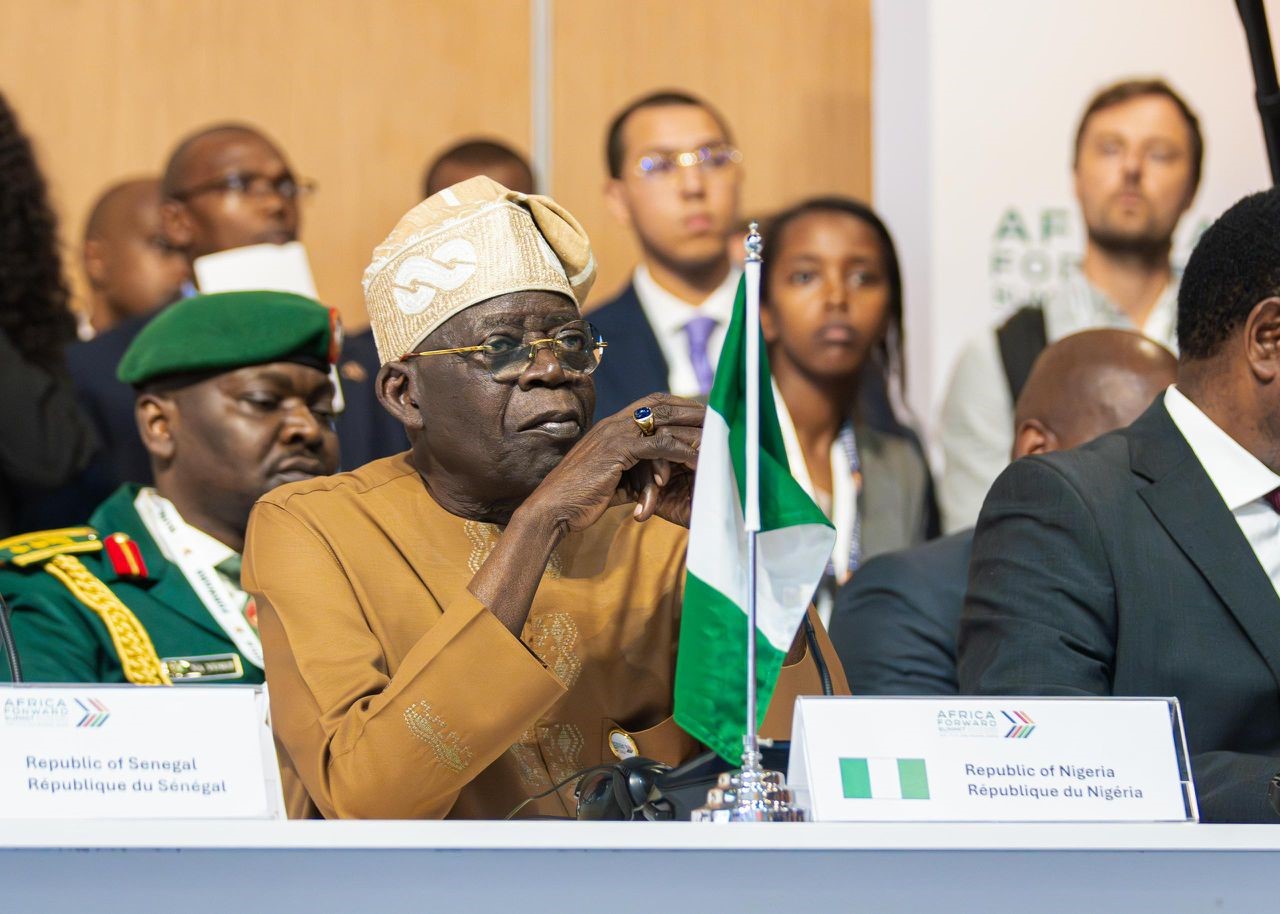
President Bola Tinubu has disclosed that Nigeria will spend an estimated $11.6 billion on debt servicing in 2026, warning that nearly half of the country’s projected revenue next year will go toward repaying loans under the current global financial system.
Tinubu made the remarks on Tuesday at the Africa Forward Summit in Nairobi, Kenya, according to a statement issued by his Special Adviser on Information and Strategy, Bayo Onanuga.
The president lamented the heavy fiscal burden imposed by debt repayments, arguing that funds channeled toward servicing obligations could otherwise be invested in critical sectors of the economy.
“Every single dollar that leaves our treasury to pay punitive interest rates is a dollar that did not go into our steel sector, our textile mills, our agro-processing, or our digital industries,” Tinubu said.
“It is a dollar that did not train a young Nigerian engineer or provide affordable power for our factories.”
According to him, the structure of the global financial architecture continues to disadvantage African countries by imposing higher borrowing costs compared to developed economies.
Tinubu argued that African nations are persistently categorized as high-risk borrowers, regardless of reforms undertaken to improve fiscal stability.
“Our industrial base is being starved of the blood it needs – long-term, affordable finance – while creditors and rating agencies treat African sovereigns as permanent high-risk borrowers, regardless of our fiscal performance,” he said.
READALSO: Tinubu approves Nigeria’s bid to host 2026 CAF Awards, General Assembly
He questioned how African manufacturers could compete globally when borrowing costs on the continent are five to ten times higher than in Europe, Asia, or North America.
“How can we build cross-border industrial value chains under the African Continental Free Trade Area when our infrastructure projects face a financing gap deepened by the very institutions meant to bridge it?” Tinubu asked.
“The answer is plain – we cannot. The international financial architecture, as currently constituted, is an instrument of industrial disarmament for Africa.”
Despite the challenges, the president highlighted what he described as bold, homegrown reforms implemented by his administration to stabilise the economy.
These include the removal of petrol subsidies, exchange rate unification, banking sector recapitalisation, and Nigeria’s exit from the Financial Action Task Force (FATF) grey list.
“These reforms were sovereign choices, not external conditions. They have delivered a declining debt-to-GDP ratio, now projected at 32.3 percent in 2026, stronger external reserves of $45.5 billion, and a return of investor confidence,” Tinubu said.
Economic analysts say Nigeria’s projected $11.6 billion debt servicing bill reflects both accumulated borrowing and the impact of higher global interest rates.
A Lagos-based macroeconomic analyst noted that while the debt-to-GDP ratio may appear moderate relative to some advanced economies, the real concern lies in revenue generation.
“The issue for Nigeria is not just the size of the debt but the cost of servicing it relative to government revenue. When nearly half of revenue goes into debt repayment, fiscal space for capital projects becomes constrained,” he said.
Another development finance expert argued that Tinubu’s criticism of the global financial system mirrors concerns shared by several African leaders.
“There is growing consensus that risk pricing for African sovereigns is often disconnected from actual economic fundamentals. However, domestic reforms must continue to improve revenue mobilisation and reduce reliance on borrowing,” she added.
Tinubu stressed that Nigeria is not seeking aid or charity but rather a financial system that enables Africa to industrialise and compete fairly in the global marketplace.
“We are not asking for charity. We are asking for a system that intentionally enables Africa to industrialise, to process its own minerals, refine its own crude oil, manufacture its own pharmaceuticals, and compete fairly,” he said.


-
 Health4 days ago
ISRT 2026: Global experts converge in Lagos to advance cancer care across Africa
-

 Football4 days ago
Ballon d’Or 2026: The key rules shaping the race for football’s biggest prize
-

 Entertainment7 days ago
Miss World 2026: Four Continental winners battle for automatic top 20 spot (VIDEO)
-

 Business4 days ago
Versat Automobile to launch Chery’s EXEED premium brand in Nigeria
-

 Entertainment6 days ago
Miss World 2026: Meet 24 African Contestants Flying Continent’s Flag in Vietnam(VIDEO)
-
 Comments and Issues5 days ago
Digital Rights and the 2027 Poll in Nigeria
-
 Energy5 days ago
Petrol Price War: Where are Nigerians getting the cheapest fuel?
-

 Football4 days ago
Yaya Touré makes history as Slovan Bratislava reaches Champions League league phase