
Featured
Rising hardship: Obasanjo questions Tinubu’s preparedness for economic reforms

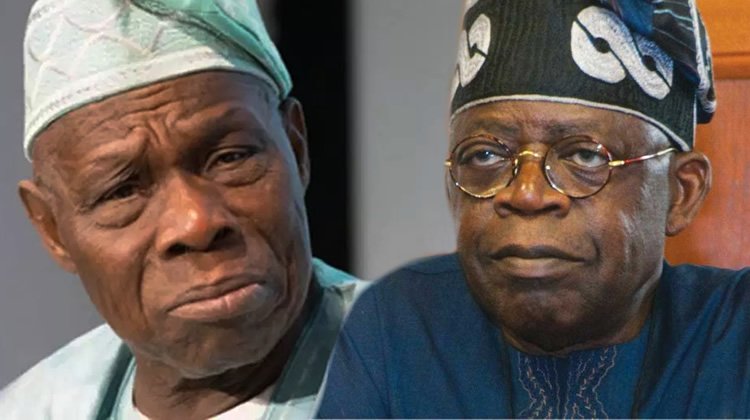
Former President Olusegun Obasanjo has criticised President Bola Tinubu’s handling of petrol subsidy removal, questioning why measures to protect Nigerians from the economic shock were not put in place before the policy was implemented.
The former president questioned President Bola Tinubu’s preparedness for Nigeria’s economic reforms, arguing that the government removed petrol subsidies without first establishing adequate measures to protect citizens from the resulting hardship.
Obasanjo made the remarks during an interview with News Central Television, where he faulted the timing and implementation of the subsidy removal, saying a responsible government should anticipate the consequences of major economic decisions and put protective measures in place before exposing citizens to their effects.
He argued that the administration should have studied the likely economic shock, established adequate buffers and introduced a phased approach to prevent ordinary Nigerians from bearing the full burden of the policy.
According to reports of the interview, Obasanjo said: “A serious leader studies the shock before he acts. He stocks buffers. He phases the pain so that ordinary people do not suffer at once.”
He also questioned the government’s response to the hardship, arguing that the search for palliatives after announcing subsidy removal reflected inadequate preparation.
His criticism comes more than three years after Tinubu announced the end of petrol subsidy payments during his inauguration on May 29, 2023.
The President defended the decision as necessary to address the financial burden of the subsidy regime, promising that resources previously spent on subsidising petrol would be redirected towards infrastructure, healthcare, education and job creation.
In a national broadcast on July 31, 2023, Tinubu acknowledged that the reforms had imposed hardship on households and businesses. He also admitted that there had been an unavoidable delay between subsidy removal and the implementation of measures intended to cushion its effects.
The President said the government had saved more than N1 trillion within slightly over two months of ending the subsidy regime, promising that the resources would be used more directly for Nigerians.
However, the extent to which those savings have translated into improved living conditions remains a major question surrounding the reforms.
The Federal Government’s own assessment of the reforms provides an indication of the financial resources generated since subsidy removal.
According to figures published by the Federal Ministry of Finance in August 2026, estimated subsidy savings across the federation amounted to N15.8 trillion between June 2023 and December 2025.
Of this amount, the Federal Government accounted for approximately N5.43 trillion, while state governments received N6.52 trillion and local governments received N3.88 trillion.
The ministry also reported that states received approximately N9.17 trillion in additional allocations compared with the monthly revenue-sharing levels before subsidy removal, while local governments received an additional N6.66 trillion over the same period.
These figures indicate a significant increase in resources available to the different tiers of government.
However, increased allocations do not automatically translate into improved living conditions. Their impact depends on how governments deploy the additional resources towards public services, infrastructure, employment opportunities and social protection.
The Federal Ministry of Finance also acknowledged that the Federal Government’s additional expenditure pressures reached approximately N30.64 trillion, exceeding its estimated incremental resources of N20.4 trillion.
The ministry attributed these pressures to increased wage costs, external debt servicing, infrastructure spending, electricity support and other public obligations.
While the government maintains that the reforms reduced the fiscal burden and borrowing requirements, the figures raise questions about the effectiveness of public spending and how citizens can assess the benefits.
One of the central issues raised by Obasanjo’s criticism is whether the government adequately protected vulnerable households before implementing the policy.
Although the Tinubu administration subsequently announced several interventions, including cash transfers, transport support and other social protection measures, concerns have persisted over their reach, timing and effectiveness.
In February 2024, the Federal Government announced the resumption of cash transfers targeting 12 million vulnerable households, with each beneficiary expected to receive N25,000 monthly for three months.
The programme was intended to reach at least 60 million Nigerians.
However, questions about the transparency and delivery of social interventions have continued.
A November 2024 report, citing figures from the Office of the Accountant-General of the Federation’s Open Treasury Portal, found that Federal Government spending on social protection as palliatives between January and September 2024 stood at N128.5 billion, compared with N165 billion during the corresponding period in 2023.
The reported decline of approximately N37 billion raised further questions about whether government spending on direct relief was keeping pace with the economic difficulties confronting households.
The central issue is not whether the government announced interventions, but how many eligible Nigerians actually received assistance, how consistently the support was delivered and whether the amounts were sufficient to offset rising living costs.
The economic consequences of the reforms have also been reflected in Nigeria’s inflation figures.
According to the National Bureau of Statistics’ October 2026 Consumer Price Index report, headline inflation declined to 14.06 per cent from 14.63 per cent in September, marking a fifth consecutive month of moderation.
However, food inflation remained significantly higher at 19.13 per cent year-on-year.
More importantly, the consumer price index increased from 146.4 points in September to 147.0 points in October, indicating that the general price level continued to rise.
The distinction is important because a declining inflation rate does not mean that prices have returned to previous levels. It means prices are increasing at a slower annual rate.
For households already struggling with higher food, transportation, electricity and other essential costs, slower inflation does not automatically restore lost purchasing power.
An October 2026 analysis by researchers at the University of Oxford’s Open Political Economy Analysis Platform similarly concluded that although Nigeria’s subsidy reform delivered important fiscal gains, its costs reached households faster than the benefits.
The researchers argued that sustaining the reforms would require making fiscal gains more visible to citizens, improving social protection and ensuring that the government demonstrates greater accountability in the management of public resources.
The Tinubu administration has consistently defended the economic reforms, arguing that they were necessary to address longstanding structural weaknesses and improve the country’s financial position.
On November 17, 2026, Minister of Solid Minerals Development Dele Alake defended the President’s economic policies during an interview on TVC News, acknowledging that subsidy removal and foreign exchange reforms had caused hardship but insisting that they were necessary.
Alake argued that previous administrations had avoided difficult decisions despite the financial burden of the old subsidy regime.
He also pointed to increased government revenue, improvements in health insurance coverage and the ability of state governments to meet salary obligations as evidence of the reforms’ benefits.
The minister maintained that the economic adjustment had brought temporary difficulties but would ultimately place the country on a more sustainable path.
Nevertheless, the government’s defence has not removed the central question of how the financial gains from the reforms are being translated into measurable improvements in the lives of ordinary Nigerians.
Obasanjo’s latest criticism has brought renewed attention to a fundamental question about the Tinubu administration’s economic strategy: whether the government adequately considered the social consequences of its decisions before implementing them.
The debate is no longer limited to whether petrol subsidies should have been removed, but whether the government had a credible plan to protect households, support businesses and ensure that the benefits of the resulting fiscal changes reached ordinary citizens.
With state and local governments receiving substantially higher allocations, attention is also shifting towards the responsibility of subnational administrations to demonstrate how additional public resources are being spent.
For millions of Nigerians, the ultimate measure of the reforms will not be the amount of money government agencies report saving or distributing, but whether families can afford food, access healthcare, transport their children to school and meet basic household expenses.
As the country approaches the 2027 general elections, the question of who has benefited from the subsidy savings, how the additional allocations have been spent and whether the economic reforms have improved ordinary Nigerians’ lives is likely to remain central to the debate over the government’s performance.


-
 Featured4 days ago
Nigeria’s youth unemployment paradox: Graduates struggle as millions survive in informal jobs
-
 Business1 week ago
Fuel price: Our eyes on you, FCCPC tells oil marketers
-

 Business5 days ago
Nigerian Banks earn N521.8bn from E-banking, card fees in nine months
-
 Business1 week ago
Petrol import cost drops to N1,164 per litre as crude oil prices decline
-
 Latest1 week ago
2027 elections: Former INEC commissioner warns against ‘Rig and Die’ slogan, says violence undemocratic
-
 Latest5 days ago
Dalung claims ‘message from Buhari’s grave’ urges Nigerians to vote Atiku in 2027
-
 Latest1 week ago
2027: Donald Duke offers to step down for consensus opposition candidate
-
 Energy5 days ago
Nigeria’s power crisis deepens as ₦639bn unpaid gas debt threatens electricity supply