
Business
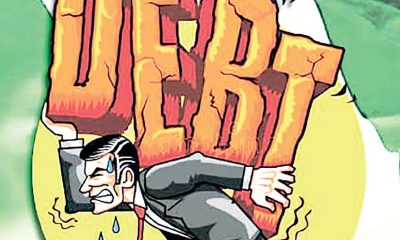
FG’s debt service to revenue ratio rises to 183% in Q1 2023

Latest data released by the Budget Office shows that the federal government’s debt service to revenue ratio rose to 183% in the first quarter 2023.
A review of the budget implementation report for the first quarter of 2023 released by the budget office indicates a total budgeted revenue of N2.16 trillion compared to an actual revenue of N1.21 trillion.
The government also generated an actual revenue of N1.48 trillion in the corresponding quarter of 2022.
Meanwhile, debt service in the first quarter of 2023 was N2.2 trillion compared to N1.6 trillion budgeted for in the first quarter of the year.
This represents a debt service to revenue ratio of 183%.
Nigeria has been grappling with acute fiscal shortfall since the ruling APC government took over failing to meet its revenue targets while increasing its debt service.
READ ALSO: Senate dismisses claims on budget padding, explains N70bn proposal
In 2022, the total debt service was N5.65 trillion, which was an alarming 97.4% of the budgeted revenue. During the same year, the federal government received a total revenue of N5.8 trillion down from N6.7 trillion received in the same period in 2021.
The government recorded a fiscal deficit of N7.5 trillion or 129% of actual revenue collected.
The trend appears to be continuing in 2023 with the government failing to meet its revenue targets but blowing past its expenditure targets. Its total expenditure (excluding GOEs) was N3.4 trillion higher than the N3.3 trillion budgeted.
However, recurrent non-debt expenditure was just N1.2 trillion compared to budgeted revenue of N1.63 trillion. The major contributory factor to the wider fiscal deficits remains the government’s rising debt service obligations.
A breakdown shows that while total debt service rose slightly to N1.3 trillion (budget N1.2 trillion).
However, Ways and Means, which is the overdraft lent to the government by the central bank recorded a debt service of N912 billion versus a budget of N300 billion.
Capital expenditure was N175 billion versus N841 billion targeted.
The government also performed poorly with its financing activities achieving just N2 trillion from domestic debts versus N2.695 trillion budgeted. Thus, it ended the first quarter of the year with a net deficit (excluding GEOs budget and project-tied loans) of N2.3 trillion.
Meanwhile, the federal government announced on Monday that it is proposing a N26 trillion budget for the 2024 fiscal year.
This compares to the N21.8 trillion budget currently running and approved under the administration of President Muhammadu Buhari.








-

 Latest6 days ago
Full List: Meet the 2026 Nobel Prize winners across six categories
-

 Football6 days ago
Premier League Matchweek 7: Five Fixtures That Could Shape the Weekend
-
 Business4 days ago
Dangote Refinery IPO: 70% Subscription claim meets fourfold demand assertion as investors seek clarity
-

 Latest5 days ago
Umahi defends Lagos-Calabar highway route changes amid public outcry
-
Business5 days ago
Dangote Refinery IPO Extension: Was the 70% subscription report overhyped?
-

 Latest3 days ago
UCTH faces morgue crisis as 50 unclaimed corpses await mass burial
-

 Featured5 days ago
El-Rufai, ADC governorship candidate’s court appearance puts Kaduna opposition politics in focus
-

 Business3 days ago
BREAKING: Nigeria’s Inflation Rate Drops to 14.63% in September