
Business
Nigeria’s debt burden deepens as Tinubu seeks fresh N10.79trn foreign loan

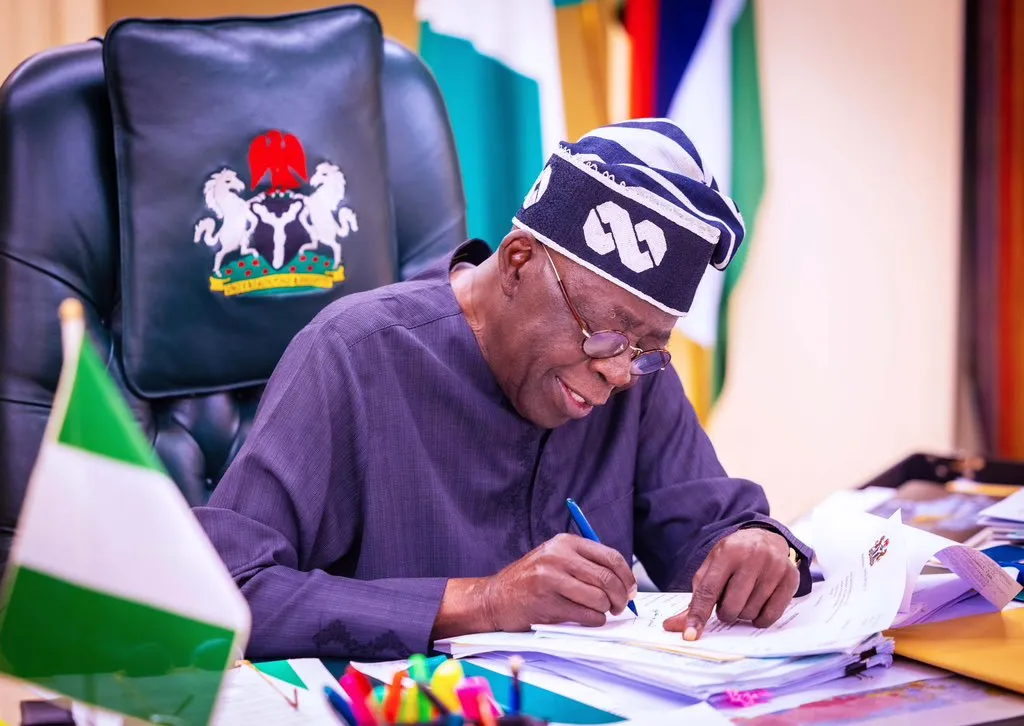
President Bola Tinubu’s latest request for approval to raise $7.7 billion in external loans has renewed concerns about Nigeria’s mounting debt obligations, the cost of servicing government borrowing and the pressure on public finances, as economists warn that fresh loans must translate into productive investments to prevent a deepening debt burden.
The President has asked the Senate to approve N10.79 trillion, equivalent to $7.707 billion, in external borrowing to finance part of the Federal Government’s 2026 budget deficit.
The request, conveyed in a letter addressed to Senate President Godswill Akpabio and read during plenary on Wednesday, November 4, comes as Nigeria’s public debt stock stands at N166.79 trillion.
The latest proposal represents another major financing decision for an administration whose borrowing requirements have continued to attract scrutiny over the country’s revenue capacity and the economic returns on borrowed funds.
According to the letter, the 2026 Appropriation Act provides for N29.2 trillion in new borrowing, comprising N18.4 trillion from domestic sources and N10.79 trillion from external sources.
Tinubu said the external component would be raised through a combination of funding options, including concessional and commercial loans from multilateral and bilateral institutions, facilities from the International Monetary Fund, bridge financing, syndicated loans and Eurobond issuance.
The President indicated that the government would place greater emphasis on Eurobonds because of the relatively shorter time required to complete the process and the possibility of raising larger amounts at competitive costs.
However, the final interest rates, repayment periods and other conditions would depend on market circumstances when the funds are priced.
READ ALSO; Amid debt criticism, Tinubu defends fresh loans, unveils $1trn growth strategy
Following the presentation, Akpabio said the new request superseded an earlier proposal seeking approval for $20.52 billion and €1.045 billion under the 2026–2027 supplementary external borrowing plan.
He described the latest communication as more explicit about the government’s borrowing requirements and referred it to the Senate Committee on Local and Foreign Debts for consideration and a report.
The timing of the request is significant, given the latest figures from the Debt Management Office showing that Nigeria’s total public debt rose to N166.79 trillion as of June 30, 2026, from N159.35 trillion at the end of March.
The increase of N7.44 trillion within three months represents a 4.7 per cent quarterly rise, while the debt stock is 9.4 per cent higher than the N152.4 trillion recorded in June 2025.
Domestic debt accounted for N91.59 trillion, representing 54.91 per cent of the total, while external obligations stood at N75.2 trillion.
The Federal Government alone accounted for N152.77 trillion of the debt stock, leaving states and the Federal Capital Territory with N14.01 trillion.
The figures also show the scale of the increase since Tinubu assumed office. Nigeria’s public debt stood at N87.38 trillion as of June 30, 2023, meaning the latest figure is about 90.9 per cent higher.
Chief Executive Officer of the Centre for the Promotion of Private Enterprise, Dr Muda Yusuf, has repeatedly warned that Nigeria’s debt-service obligations are restricting the government’s fiscal space.
In his assessment of the 2026 budget, Yusuf noted that nearly N15 trillion had been earmarked for debt servicing against projected revenue of about N34 trillion, meaning a substantial share of expected government income would be committed to existing obligations before funding new projects.
He warned that debt servicing is a first-line charge and that any shortfall in revenue could push the ratio higher, potentially forcing the government to borrow again to meet its obligations.
Similarly, Chief Economist at SPM Professionals, Dr Paul Alaje, has urged the government to ensure that borrowed funds are channelled into productive capital projects rather than recurrent expenditure.
Alaje argued that Nigeria’s borrowing has expanded considerably over the years without corresponding growth in economic output. He maintained that loans should finance infrastructure such as roads and railways, which can improve productivity, stimulate economic activity and generate returns capable of supporting repayment.
For Nigeria, the challenge is no longer simply securing access to foreign financing. It is ensuring that every additional loan strengthens productive capacity, expands government revenue and reduces the need for repeated borrowing.


-
 Business2 days ago
OPay explains how Nigerians can access FG’s N50,000 monthly cash relief
-

 Sports6 days ago
Senegal opens Dakar 2026 Youth Olympic Games, Africa’s first Olympic event
-

 Football1 week ago
U-17 Women’s World Cup: Flamingos Beat Mexico to Reach Quarter-Finals
-

 Latest6 days ago
FG Announces N50,000 cash support for vulnerable Nigerians under new relief programme
-
 Business6 days ago
NNPC’s N66-per-litre petrol discount set to end October 31
-
 Latest5 days ago
INEC recognises Pantami for Gombe, keeps Kano NDC candidate off final list
-

 Latest6 days ago
Netanyahu, Eisenkot face coalition deadlock as Israel struggles to form new government
-
 Latest6 days ago
NDC Chieftain tells Atiku to drop presidential ambition over son’s support for Tinubu