
Latest
Tinubu defends subsidy removal amid economic hardship

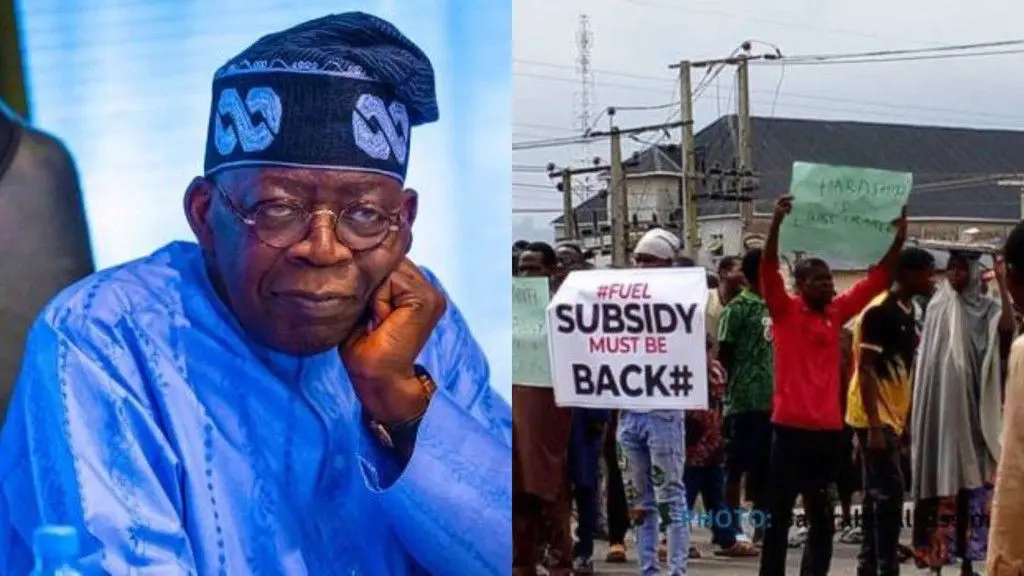
President Bola Tinubu has reiterated his stance on the controversial removal of the petrol subsidy, asserting he has no regrets about the decision despite the economic challenges and hardship it has caused for many Nigerians.
Speaking during his first presidential media chat on Monday, Tinubu framed the subsidy removal as a crucial step to safeguard the country’s financial future.
“Nigeria was spending its future and was not investing,” Tinubu declared. “We were just deceiving ourselves. That reform was necessary. Why should you have expenditures that we don’t have revenue for?”
The president emphasized that continuing the subsidy would have perpetuated financial irresponsibility, leaving future generations to bear the brunt.
“There is no way you give out fuel and allow all the neighbouring countries to benefit as though we are Father Christmas. I don’t have any regrets whatsoever about removing the subsidy,” he added. “It is necessary. We cannot spend our future generation’s investments upfront.”
READ ALSO: Northern political realignment to reshape opposition to Tinubu
While the removal of the petrol subsidy has been hailed as a bold fiscal reform, it has led to a significant rise in the cost of living. Fuel prices have more than tripled, triggering inflation and pushing many households deeper into economic distress.
Nigerians have expressed mixed reactions to the decision, with some applauding the president’s resolve to tackle longstanding inefficiencies in the petroleum sector, while others lament the lack of adequate cushioning measures to mitigate the impact on the populace.
Economic analysts have described the subsidy removal as a necessary, albeit painful, step toward achieving fiscal stability.
Dr. Ifeoma Akintola, an economist and lecturer at the University of Lagos, explained, “The subsidy was unsustainable, consuming a significant portion of the country’s revenue without corresponding benefits. Removing it frees up resources that can be redirected to critical sectors like education, healthcare, and infrastructure.”
However, she stressed the importance of implementing supportive policies to ease the burden on citizens.
“The government must prioritize palliative measures such as transportation subsidies, job creation programs, and investments in renewable energy to cushion the economic blow.”
READ ALSO: Showunmi unveils alternative to APC, Tinubu, advocates people-driven leadership for 2027
For many Nigerians, the decision feels abrupt and poorly managed. Esther Ogunjimi, a market trader in Lagos, described her struggles since the subsidy removal: “Everything has become so expensive, from food to transportation. We are suffering, and we need help.”
Others, like tech entrepreneur Ahmed Lawal, see it as a long-overdue reform. “The subsidy was a drain on our economy, benefiting a few at the expense of the majority. If managed well, this could be the beginning of real progress for Nigeria.”
President Tinubu’s government has promised to invest savings from the subsidy removal into developmental projects and social programs.
However, the effectiveness of these initiatives will be closely watched as the nation grapples with rising inflation and economic inequality.


-
 Business3 days ago
OPay explains how Nigerians can access FG’s N50,000 monthly cash relief
-

 Sports1 week ago
Senegal opens Dakar 2026 Youth Olympic Games, Africa’s first Olympic event
-
 Latest7 days ago
FG Announces N50,000 cash support for vulnerable Nigerians under new relief programme
-
 Business7 days ago
NNPC’s N66-per-litre petrol discount set to end October 31
-

 Latest7 days ago
INEC recognises Pantami for Gombe, keeps Kano NDC candidate off final list
-

 Latest1 week ago
Netanyahu, Eisenkot face coalition deadlock as Israel struggles to form new government
-

 Latest7 days ago
NDC Chieftain tells Atiku to drop presidential ambition over son’s support for Tinubu
-

 Crime7 days ago
Doris Ogala remanded as Court adjourns bail hearing to November 6