
Business
Take urgent steps to halt Nigeria’s rising debt, stakeholders urge FG

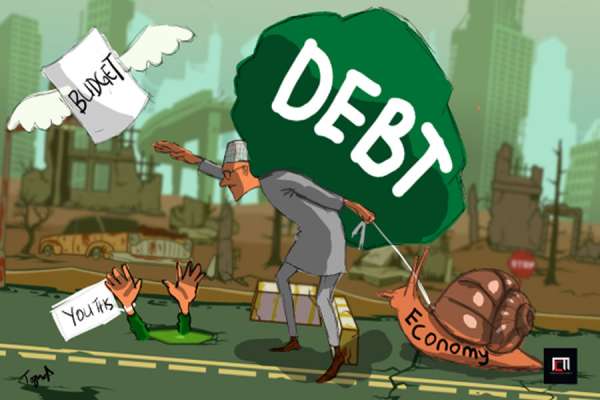
Some stakeholders in the country’s economic sector have advised the Federal Government to take steps to halt the rising national debt stock as it is fast becoming unsustainable.
The stakeholders spoke in separate interviews with the News Agency of Nigeria in Abuja on Tuesday.
They advised the Federal Government to look inwards and device creative means of generating revenue rather depending on borrowings.
NAN reports that the Debt Management Office (DMO) recently announced that the country’s total debt stock as at December 2021 was N39.55 trillion.
The DMO had also said that the debt stock was likely to hit N45 trillion in 2022, as the government planned to borrow additional N6.30 trillion to finance the 2022 budget deficit.
Patience Oniha, the Director-General of the DMO, had explained that the overall deficit in the 2022 budget was N6.30 trillion, representing 3.46 per cent of the country’s Gross Domestic Product (GDP).
Oniha explained that the debt stock was made up of the domestic and external debt stocks of the Federal Government, the 36 state governments and the Federal Capital Territory.
She said that the country did not really have a debt problem, but a revenue problem, adding that the government was already taking practical steps to improve revenue and reduce borrowings.
A breakdown of Nigeria’s public debt stock shows that 37.82 per cent is external, while the balance of 62.18 per cent is domestic.
However, with the country’s national debt in relation to Gross Domestic Product (GDP) at 35.51 per cent, some analysts suggested that the debt situation was still within reasonable limits.
According a study conducted by the World Bank, a Debt-to-GDP ratio that exceeds 77 per cent for an extended period of time may result in an adverse impact on economic growth.
Recently, Pastor Enoch Adeboye of the Redeemed Christian Church of God, raised concern about the country’s rising debt profile.
In one of his sermons, Adeboye complained that more than 90 per cent of Nigeria’s revenue from crude oil sales was used to pay interest accruing on debt.
He warned that the country’s debt service-to-revenue ratio might pose danger for decades.
A financial expert, Mr Ibrahim Aliu, advised the Federal Government to device creative means of generating revenue and move the country’s economy away from perpetual dependence on debt.
Aliu advised that any further borrowings by the country should be strictly expended on productive ventures that could grow the economy.
“The Federal Government should ensure that borrowings are minimal and that future borrowings are effectively expended for real economic growth,’’ he said.
Mr Sule Adebayo, a Chartered, Accountant, said that in spite of the low Debt-to-GDP ratio, the revenue that went into debt servicing was still on the high side.
He urged the Federal Government to take necessary steps to improve on its revenue and reduce its dependence on loans.
According to Dr Tope Fasua, an economist, the government will need to optimise revenue generation to cut down on borrowings.
Fasua urged the private sector to always cooperate with the government in its revenue drive rather that antagonising such initiatives.
“The private sector kicks anytime government proposes a tax increase, no matter how insignificant. It has turned itself into an enemy of government, ” he said.
He, however, disagreed with the DMO that Nigeria had a “revenue problem” and not a debt problem, while urging government to get its expenditure priorities right.
“We have a debt problem, we have a revenue problem and we have an expenditure problem.
“Right now we are just borrowing one way. We even borrow to service previous borrowings, ” he said.












-

 Featured2 days ago
BREAKING NEWS: Shouts of joy rock the world as Pastor Chris opens final Healing Streams edition for 2026
-

 Football3 days ago
Man United shortlist Emery, Nagelsmann as potential replacements for Carrick
-
 Business6 days ago
Naira faces exchange rate gap as Dollar hits N1,380 on parallel market
-

 Business3 days ago
Hoodlums raid JED Benue office, abduct 10 staff over power dispute
-

 Football3 days ago
Aston Villa ready to freeze out Garnacho to avoid £43m Chelsea transfer
-

 Business3 days ago
EV adoption: Roxettes seeks cheaper financing, local manufacturing incentives
-

 Business1 week ago
NCC launches Internet Governance Working Group to tackle AI risks, boost online safety
-

 Latest2 days ago
Akpabio tasks Tompolo-backed movement with spreading Tinubu’s renewed hope message