
News
Lagos Building Collapse: One dead, two rescued as questions mount over safety enforcement

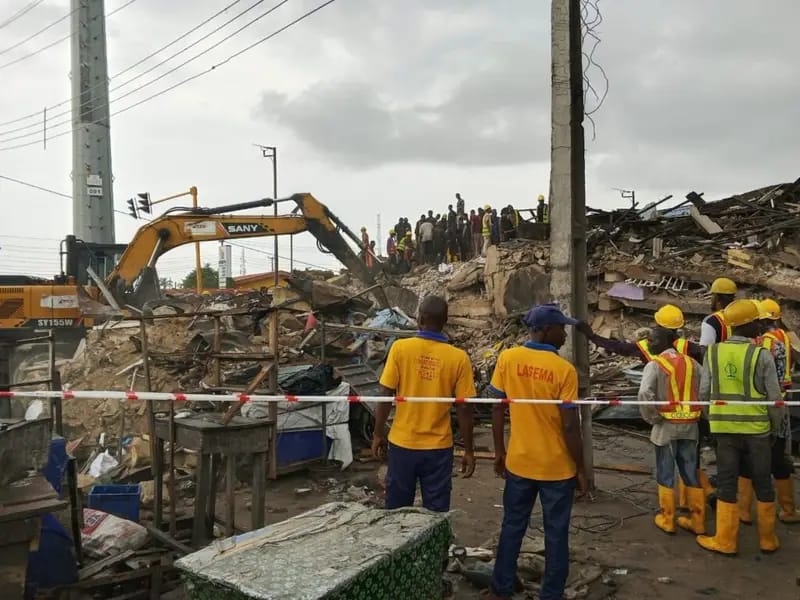
One person has died and two others were rescued after a two-storey building undergoing manual demolition partially collapsed in the Aboru area of Alimosho Local Government Area of Lagos State.
The incident occurred at about midnight on Thursday at No. 42, Governors Road, Aboru, according to the Lagos State Emergency Management Agency (LASEMA).
LASEMA said its Alpha Eagle Response Team was dispatched to the scene following a distress call. Two adult males were rescued alive, while the body of another adult male was recovered from the debris.
The agency said the rescue operation involved personnel from LASEMA, the Lagos State Fire and Rescue Service and the Lagos State Ambulance Service.
The latest incident has once again raised concerns about the safety of construction and demolition activities in Lagos, a city that has recorded a number of deadly building collapses in recent years.
Building collapses in Lagos are not usually caused by a single factor. Experts and industry stakeholders have repeatedly identified issues including structural defects, poor-quality construction materials, inadequate supervision, non-compliance with approved building plans and weaknesses in regulatory enforcement.
The latest incident is different from many previous collapses because the structure was reportedly undergoing manual demolition when it gave way. This raises additional questions about whether demolition activities are being properly planned, supervised and carried out by qualified professionals.
The Real Estate Developers Association of Nigeria (REDAN), Lagos chapter, recently attributed recurring building collapses to problems including regulatory compromise, weak enforcement of building standards and institutional failures. The association called for criminal prosecution of those responsible for serious breaches rather than relying only on demolition of defective structures.
The Lagos State Government has also previously blamed some collapses on the failure of property owners and occupants to comply with safety regulations and directives concerning distressed buildings.
Following the June 2026 collapse of a three-storey building at Alakija, Lagos Commissioner for Information and Strategy Gbenga Omotoso said the affected structure had previously been declared unsafe and sealed by the government, but occupants allegedly returned to the premises.
The Aboru incident comes less than three months after a major building collapse at Alakija, along the Lagos-Badagry Expressway.
That three-storey structure collapsed on June 25, killing nine people and leaving 27 others rescued, according to a subsequent update from LASEMA.
The frequency of such incidents has kept pressure on agencies responsible for building control and emergency management to improve enforcement and prevent dangerous structures from becoming tragedies.
In July, the Lagos State Building Control Agency (LASBCA) evacuated occupants and commenced the controlled demolition of a distressed building at Akinyele Bus Stop, Abesan Estate, after structural experts determined that it posed an imminent danger to lives and property. The agency said the intervention followed a report from a resident.
That case demonstrated the importance of identifying and dealing with unsafe structures before they collapse.
Emergency agencies have often been able to rescue survivors after collapses, but preventing such incidents remains the bigger challenge.
The repeated occurrence of structural failures raises questions about the entire building-control process—from planning approval and soil investigation to structural design, material quality, supervision, construction and eventual demolition.
There are also questions about accountability. When a building is found to be unsafe, authorities must ensure that evacuation and enforcement orders are followed and that those responsible for violating safety requirements are held accountable.
For residents, the latest incident is another reminder that visible signs of structural distress or unsafe construction should not be ignored.
For Lagos authorities, however, the continuing collapses present a broader test: whether regulations can be enforced consistently enough to prevent dangerous buildings and unsafe construction practices from claiming more lives.
The Aboru collapse may have resulted in one death and two rescues, but it has once again brought the larger question into focus: how many more lives must be lost before building safety enforcement becomes genuinely preventive rather than reactive?


-

 Latest5 days ago
Cole-Alegbe unveils memoir, urges leaders to harness technology for lasting impact
-

 Business1 week ago
X3M Ideas donates 50 Walkie-Talkies to strengthen security operations in Onigbongbo
-
 Business3 days ago
Nigeria records N12.59trn trade surplus in Q2 2026 — NBS
-

 Business3 days ago
Nigerian Breweries’ H1 profitability strengthens as revenue hits N804bn
-

 Business5 days ago
Jetour G700 PHEV Storms Abuja as Jetour Nigeria Takes Luxury Mobility Showcase to FCT
-

 Featured2 days ago
Peter Obi, Makinde and the 2027 elections: Can unity really challenge APC?
-
 Business1 week ago
Rising crude prices threaten fresh petrol price hike in Nigeria
-
 Business6 days ago
Multinationals exit Nigeria as economic pressures reshape business landscape