
Latest
Oseni challenges Wike over 2019 victory, Rivers 2023 results

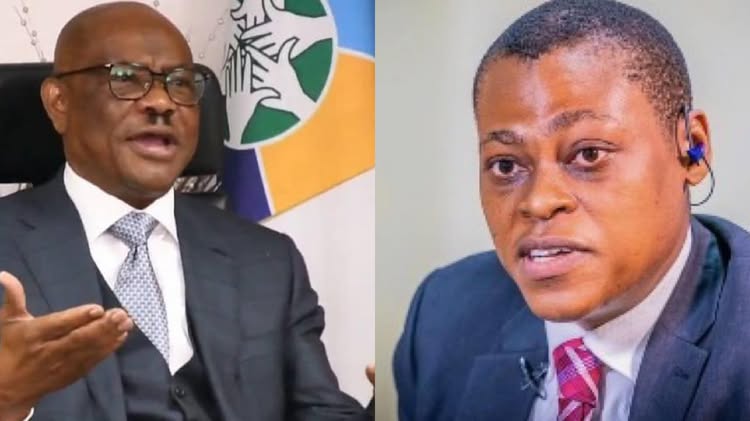
Arise TV anchor Rufai Oseni has challenged politicians who claim personal credit for delivering electoral victories, arguing that such assertions risk reducing the votes of millions of Nigerians to the influence of individual political actors.
Oseni’s comments were directed particularly at Federal Capital Territory Minister Nyesom Wike, whose political influence and claims about electoral structures have become increasingly prominent ahead of the 2027 political cycle.
The broadcaster questioned Wike’s 2019 Rivers State governorship victory, asking why the collation of results was suspended before the Independent National Electoral Commission eventually declared him winner.
“Mr Wike, let’s x-ray your 2019 governorship victory. Why was the counting of that election stopped midway?” Oseni asked.
The 2019 Rivers governorship election was indeed protracted. INEC suspended collation on March 10 following reports of violence and later resumed the process. Wike was declared winner on April 3 with 886,264 votes against 173,859 scored by African Action Congress candidate Biokpomabo Awara.
However, Oseni used the episode to question what politicians mean when they boast of having a political “structure” capable of delivering elections.
He also cited a BBC investigation into the 2023 presidential election in Rivers State. The BBC found significant discrepancies between polling-station tally sheets it examined and the officially declared figures.
READ ALSO; Wike–APC governors’ rift exposes Tinubu’s 2027 power struggle
Its analysis suggested that Peter Obi received more votes in Rivers than the official result showed, while Bola Tinubu’s official tally was substantially higher than the BBC’s own polling-station count.
The BBC, however, also cautioned that its investigation did not cover every polling station: some results were missing or incorrectly uploaded, while about five per cent of the polling-station images were too blurred to read.
Oseni questioned whether such discrepancies should prompt Nigerians to look more closely at the relationship between political structures, electoral administration and officially declared results.
“So what is this same structure that they say they have, that they won based on? What is it?” he asked, questioning whether political structures could extend beyond conventional grassroots mobilisation.
He further challenged the tendency of politicians to claim that they personally “delivered” votes for presidential candidates.
According to him, elections should ultimately reflect the choices of voters rather than the perceived political ownership of influential individuals.
Oseni also questioned Wike’s claim to political popularity, asking why, if he possessed such broad support, he did not defeat former Vice-President Atiku Abubakar in the PDP presidential primary ahead of the 2023 election.
The question goes to the distinction between controlling political structures and securing direct support from voters. Wike finished second to Atiku in the 2022 PDP presidential primary, while Atiku emerged as the party’s candidate.
Oseni also invoked the experience of former PDP National Chairman Vincent Ogbulafor, who famously predicted in 2008 that the PDP would rule Nigeria for 60 years. The PDP subsequently lost federal power in 2015 after the APC defeated the party in the presidential election.
The broadcaster also cited former Kaduna State Governor Nasir El-Rufai as an example of how political relevance can change after an election cycle, questioning whether individuals who play prominent roles in securing political victories can automatically retain the same influence afterwards.
His broader argument was that political power is temporary and that politicians should be cautious about assuming that electoral influence belongs permanently to them.
“Human beings are transient. You are on top today, you are not there tomorrow, and life moves on,” Oseni said.
The debate over Wike’s political influence comes as Nigeria’s political actors begin positioning themselves ahead of 2027. Wike remains a major figure in the political conversation, while his cross-party political relationships and support for President Bola Tinubu have continued to generate debate over the meaning and reach of his political structure.
For Oseni, however, the central issue extends beyond Wike.
He argued that Nigerians should scrutinise electoral processes and insist that announced results accurately reflect votes cast at polling units.
“Because somebody gets an election result, INEC gets to announce them and they get returned, doesn’t mean that that’s the will of the people,” he said.


-
 Trending Stories1 week ago
Davido, Wizkid, Burna Boy or Asake: Who is having the biggest 2026 so far?
-
 Football1 week ago
Premier League releases 2026/27 festive fixtures, 7 matches set for Boxing Day
-

 Crime6 days ago
Anambra Police arrest mother over alleged child sexual exploitation
-

 Business5 days ago
Jetour Nigeria, dealers take dashing, other models to Abuja Experience
-

 Business6 days ago
Dangote Refinery IPO shifts spotlight to corporate governance, investor protection
-

 Business3 days ago
Dangote IPO rush crashes Bamboo login as investors flood platform
-

 Business2 days ago
Abuja gears up for Jetour T2’s rugged-luxury experience
-
 Business4 days ago
Nigeria Business Outlook: Dangote IPO, markets, inflation and naira in focus this week