
Featured
47 Days Through the Sahara: Nigerian journalist exposes dangers on the route to Europe


A 47-day undercover journey by Nigerian investigative journalist Fisayo Soyombo along one of West Africa’s major irregular migration routes has offered a firsthand account of the dangers confronting migrants who travel from Nigeria through Niger and the Sahara Desert towards Libya and, ultimately, Europe.
Soyombo, founder of the Foundation for Investigative Journalism (FIJ), travelled undercover as a migrant from Kano in northern Nigeria through Niger before continuing across the Sahara towards Libya. His three-part investigation, published in September 2026, traces a route through locations including Magaria, Zinder, Agadez and Dirkou in Niger, before continuing through Al Gatrun and Sabha to Tripoli in Libya.
The investigation documents the journey from the perspective of someone experiencing the route rather than simply reporting from outside it. According to Soyombo’s account, migrants travelling through the network face prolonged journeys in extreme desert conditions and exposure to trafficking networks and criminal exploitation.
His findings include accounts of starvation, physical assault, abduction, torture, sexual violence and deaths. The investigation also describes conditions in which migrants can become dependent on smugglers and facilitators to move from one stage of the journey to another.
For many West Africans seeking to reach Europe through the Central Mediterranean route, Niger serves as an important transit country.
Soyombo’s investigation followed the movement of migrants from Kano towards Niger, passing through cities such as Magaria and Zinder before reaching Agadez.
Agadez has long been associated with migration towards Libya and Algeria because of its location on historic trans-Saharan routes. From there, migrants can be transported further north towards Dirkou and the Libyan border.
The International Organization for Migration (IOM) describes Niger as a major transit country for migrants moving from West Africa towards Libya and Algeria, with some subsequently attempting to reach Europe through the Mediterranean.
IOM’s Niger flow-monitoring data also show that migration through the country remains substantial. In March 2026, its monitoring points recorded 384,564 individuals moving through observed locations, with 41 per cent of movements classified as outgoing and 39 per cent incoming. Outbound movements towards Libya increased sharply compared with the previous month.
Beyond Agadez and other northern Nigerien towns, the journey enters some of the most inhospitable terrain on the migration route.
The Sahara presents migrants with extreme heat, long distances, limited access to water and medical care, and the possibility of becoming stranded when vehicles break down or routes change.
Médecins Sans Frontières has documented the risks faced by migrants travelling through Niger’s desert regions, including dehydration, accidents, violence and exploitation. The organisation has previously reported that migrants travelling through the Ténéré Desert can be forced to walk long distances when vehicles fail or when they are abandoned.
The danger is not limited to the harsh environment. Attempts to avoid security controls and criminal networks can push migrants onto more isolated routes.
An IOM report on migration trends in Niger found that the emergence of informal bypass routes has exposed migrants to additional risks because the routes pass through remote and dangerous desert areas that are difficult to monitor.
The popular image of irregular migration often focuses on the dangers of crossing the Mediterranean Sea. But Soyombo’s investigation demonstrates that the journey can become life-threatening much earlier.
The IOM says more than 17,000 migrant deaths have been recorded in Niger since records began in 2014, with most of the deaths involving people attempting to cross the Sahara. The organisation cautions that the actual number could be considerably higher because deaths occurring in remote parts of the desert are difficult to document.
The desert therefore represents a deadly barrier in its own right.
Migrants can face dehydration, hunger, extreme temperatures, vehicle accidents and abandonment. Those who become separated from their groups or stranded far from settlements may have little chance of obtaining assistance.
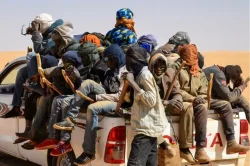
MSF has similarly documented cases involving people who were abandoned in remote desert areas after being expelled from neighbouring countries. In some cases, migrants have had to walk considerable distances to reach the nearest settlement.
Reaching Libya does not necessarily mean that the most dangerous part of the journey is over.
IOM’s recent research on migrant vulnerability identifies risks at different stages of the journey, including exploitation by facilitators, violence, detention and other forms of abuse.
In its assessment covering migration routes into Libya, IOM found that a large majority of land arrivals surveyed reported relying on migration facilitators, primarily for transportation.
The dependence on facilitators can leave migrants vulnerable because they often have limited information about the people transporting them, the exact route or the conditions they will encounter.
Soyombo’s investigation similarly describes a system in which migrants can be required to pay different actors as they move through successive stages of the journey.
The risks documented along the route raise a fundamental question: why do people continue to undertake such dangerous journeys?
There is no single answer.
IOM says people moving through Niger have different motivations, including economic opportunities, seasonal work, family circumstances and forced displacement. Some are fleeing conflict or persecution, while others are seeking better economic prospects.
The March 2026 IOM monitoring report found that migration movements in Niger remained predominantly regional and economically motivated, with economic opportunities continuing to influence mobility.
For some migrants, the possibility of reaching Europe is weighed against the economic and social difficulties they face at home.
That calculation can make warnings about the dangers of the Sahara less effective when migrants believe remaining behind offers fewer opportunities.
Migration routes through Niger have also changed in response to government policies, border controls and security conditions.
IOM has reported that increased patrols and restrictions have encouraged some migration networks to use alternative routes. These routes can be more isolated and dangerous, making it harder for authorities or humanitarian organisations to locate migrants who are in distress.
In 2026, IOM continued to describe Niger as a country located at the crossroads of major migration routes, while also highlighting the effects of insecurity, climate shocks and economic pressures on mobility.
The situation also changes as migrants are expelled or returned from Algeria and Libya. IOM says many returnees arrive in Niger in precarious conditions and require humanitarian assistance.
Soyombo’s investigation provides a rare firsthand perspective on a journey that is often reduced to statistics about migration and deaths.
By travelling the route undercover, his reporting illustrates the physical conditions, uncertainty and dependence on informal networks that migrants can encounter before they even reach Libya.
His account does not mean that every migrant experiences precisely the same journey. Routes, facilitators, weather conditions, security situations and individual circumstances vary considerably.
But several of the dangers described in the investigation desert exposure, exploitation, violence, abandonment and vulnerability to trafficking — are consistent with risks documented independently by organisations such as IOM and MSF.
The investigation therefore places a human face on a migration route whose dangers are already reflected in humanitarian and migration-monitoring data.
For Nigerians and other West Africans considering irregular migration through Niger, the central message from the evidence is that the journey to Europe does not begin with the Mediterranean crossing. The risks begin much earlier — sometimes thousands of kilometres from the sea, in the cities, trafficking networks and vast desert corridors leading from West Africa


-

 Latest1 day ago
Pastor Chris Oyakhilome announces mother’s passing at 88 [VIDEO]
-

 Football5 days ago
Saka: England still carry World Cup scar
-

 Comments and Issues6 days ago
Sometimes, goodwill finds us through the people we love
-

 Latest3 days ago
Arsenal eye €70-80m move for Real Madrid star
-

 Business6 days ago
CBN reduces MPR by 350bps to 23% in major monetary policy shift
-

 Business1 week ago
Jetour takes T1 adventure SUV experience to Abuja, targets growing Nigerian market
-

 Football1 week ago
Nigeria vs Colombia: Falconets battle for U-20 World Cup semi-final ticket
-

 Crime3 days ago
Police arrest suspect, launch manhunt for 2 others over Delta Education Director’s death