
Features
NAF Crash: Beyond the tragedy, will Nigeria finally fix military aviation safety?

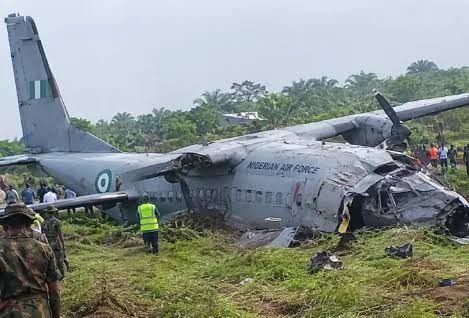
The crash of a Nigerian Air Force ATR-42 aircraft in Ondo State has renewed questions about the safety, maintenance and funding of Nigeria’s military aviation fleet, even as investigators begin work to determine what caused the accident.
NAF 931 crashed in the Igbokoda area of Ondo State on October 5 while travelling from Benin City to Lagos on a routine mission. The Nigerian Air Force later confirmed that all 25 people aboard — five crew members and 20 passengers — died.
President Bola Tinubu declared three days of national mourning and directed the Air Force to conduct a thorough investigation into the circumstances surrounding the crash, with the stated aim of preventing similar incidents in the future.
For now, however, investigators have not established what caused the aircraft to go down.
What happened to NAF 931?
The aircraft disappeared from radar at about 9:13 a.m. on October 5 after departing Benin for Lagos. Its wreckage was subsequently located around Igbokoda, near a naval base.
The ATR-42 was operated by the Nigerian Air Force for missions including intelligence, surveillance and reconnaissance, maritime surveillance and the transportation of personnel. The aircraft was among two ATR-42-500MP aircraft acquired for the Air Force under a contract signed in 2007.
Witnesses in the area reported hearing a loud sound before the crash, but such accounts cannot by themselves establish whether the aircraft suffered a mechanical failure, human error, adverse conditions or another problem.
The Air Force has urged the public to avoid speculation while its investigation continues.
Maintenance questions emerge
The accident has nevertheless brought military aircraft maintenance back into the national conversation.
The African Democratic Congress has called for an audit of funds allocated for the maintenance of Nigerian Air Force aircraft. Citing official budget figures, the party said that as of December 2025, ₦34.71 billion had been budgeted for NAF aircraft maintenance, but only ₦4.5 billion had been released.
The ADC also compared the figure with funding for the Presidential Air Fleet, saying ₦20.27 billion of its ₦20.74 billion maintenance allocation had been released during the same period. The party argued that the disparity warrants scrutiny of government spending priorities.
The opposition party has specifically called for the maintenance history of NAF 931 and other military aircraft to form part of the investigation.
But the funding figures, even if confirmed, do not establish that inadequate maintenance caused the Ondo crash. The cause remains unknown, and investigators will need to examine the aircraft’s maintenance records alongside other technical and operational evidence before drawing conclusions.
The aircraft’s maintenance history
Separate reporting has raised additional questions about the history of NAF 931.
A FactCheckHub review citing aviation records reported that the aircraft spent almost four years at Rheinland Air Service in Mönchengladbach, Germany, for maintenance beginning in January 2021. Records reportedly showed that components, including its right engine, had been removed while it was at the facility.
The existence of a lengthy maintenance period, however, should not be interpreted as evidence of a defect or maintenance failure. Older aircraft can undergo major maintenance and component replacement as part of normal aviation practice.
What investigators will need to establish is when the aircraft returned to service, what work was carried out, whether all required inspections were completed and whether any unresolved technical issues existed before its final flight.
What investigators must establish
A credible investigation will have to go beyond identifying the immediate event that caused the aircraft to crash.
Investigators are likely to examine the aircraft’s maintenance and service records, engine and component history, flight crew qualifications and actions, air traffic communications, weather conditions and the aircraft’s operational history.
The final moments of the flight will also be important. Air traffic controllers reportedly lost contact with the aircraft shortly after it departed Benin, meaning investigators will need to establish what happened between take-off and the loss of communication.
Where available, flight-recording equipment and recovered aircraft components could provide critical evidence.
The investigation must also determine whether any warning signs were missed and whether maintenance, procurement, training, operational procedures or institutional oversight played any role.
A wider problem for military aviation
The Ondo crash comes at a time when Nigeria relies heavily on its armed forces for operations against insurgents, bandits, kidnappers and other security threats.
Military aircraft are therefore not simply transport assets. They support surveillance, intelligence gathering, logistics, search-and-rescue missions and the movement of personnel.
Keeping those aircraft airworthy is consequently a matter of national security as well as aviation safety.
The debate that follows the Ondo crash is therefore likely to extend beyond the particular ATR-42 involved. It raises questions about how Nigeria plans, funds and supervises the maintenance of its wider military aviation fleet.
From mourning to accountability
The deaths of the 25 people aboard NAF 931 have prompted national mourning, but the long-term test will be what happens after the ceremonies end.
President Tinubu has ordered an investigation, while the Air Force has said it will provide verified updates as the process progresses.
The outcome will matter because establishing the cause of the accident is only the first step. If investigators identify shortcomings in maintenance, training, equipment, procedures or oversight, those findings will need to translate into concrete corrective measures.
Conversely, if the investigation finds that the crash resulted from a factor unrelated to maintenance or funding, that conclusion should also be made public.
For the families of the victims, no investigation can undo the loss. But a transparent and technically rigorous inquiry could help ensure that the tragedy produces lessons capable of saving lives.
The question facing Nigeria now is therefore not simply what brought NAF 931 down, but whether the country will use the tragedy to strengthen military aviation safety — and ensure that identified lessons are actually implemented.


-

 Latest5 days ago
US Immigration fees rise from October 16 as USCIS announces new charges
-
 Latest12 hours ago
Israel marks 3 years since October 7 Hamas attack amid Gaza strikes, election debate
-

 Business5 days ago
Nigeria’s $55bn reserves raise fresh questions over naira value
-

 Health5 days ago
Florida sues Pfizer over deceptive COVID-19 vaccine marketing
-

 Business6 days ago
Tuoyo Erikowa wins digital marketing personality of the Year at 2026 EDGE awards
-

 Crime5 days ago
From camp to captivity: How kidnappers now target NYSC Corps members on highways
-

 Featured5 days ago
2027: Can Nigeria’s opposition still unite behind a single presidential candidate?
-
 Crime4 days ago
Fulani Militia leader linked to Christian killings arrested in Plateau