
Business
Cash outside Nigerian Banks rises to N4.92trn in September

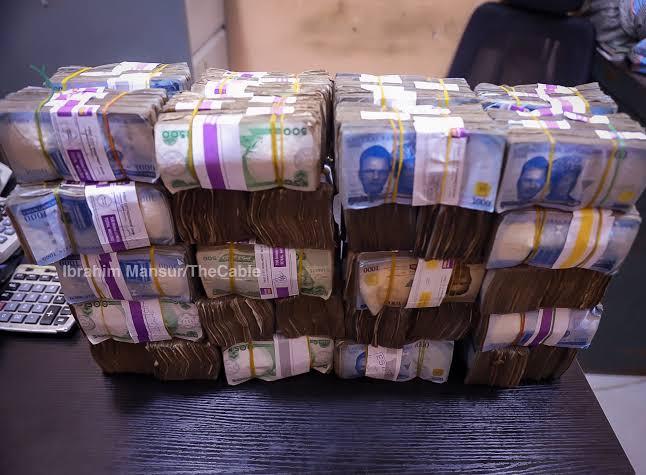
Cash held outside Nigeria’s banking system rose by N48.7 billion to N4.92 trillion in September 2026, highlighting the continued reliance on physical currency despite efforts by the Central Bank of Nigeria (CBN) to accelerate digital payments.
Latest CBN data showed that the amount increased from N4.87 trillion in August, representing a month-on-month rise of approximately one per cent.
Compared with the N4.47 trillion recorded in September 2025, cash outside banks increased by N450 billion, or about 10.1 per cent year-on-year.
The development comes as the apex bank intensifies efforts to deepen financial inclusion, expand electronic payment channels and reduce the proportion of currency held outside the formal banking system.
The latest figure, however, remains below the levels recorded during several months in the first half of 2026, when cash outside banks exceeded N5 trillion.
Data showed that the figure rose from N4.45 trillion in August 2025 to N4.47 trillion in September before climbing to N4.65 trillion in October.
It reached N5.41 trillion in December 2025 before declining to N5.25 trillion in January 2026.
Cash outside banks remained above N5 trillion in February, April and May, reaching N5.19 trillion in May before falling to N4.92 trillion in June.
The figure subsequently recovered to N4.80 trillion in July and N4.87 trillion in August before recording another increase in September.
CBN targets lower cash dependence
The increase comes against the backdrop of the CBN’s efforts to transform Nigeria’s payment system and encourage wider adoption of electronic transactions.
READ ALSO; CBN’s three-year reforms face real economy test as credit costs remain high
At the launch of the Nigeria Payment System Vision 2028 in Abuja, CBN Governor Olayemi Cardoso said the roadmap would build on the country’s progress in digital payments while accelerating the development of a more inclusive, technology-driven financial system.
The strategy includes a target to reduce cash outside banks to below 40 per cent of total currency in circulation and raise financial inclusion to 95 per cent of the adult population by 2028.
Nigeria’s digital payment ecosystem has expanded significantly over the past decade, supported by fintech companies, mobile money services, instant payment platforms and digital banking.
However, the continued growth in cash held outside banks underscores the challenges of shifting transactions towards electronic channels across different segments of the economy.
Digital payment growth not ruled out
Financial analysts note that an increase in cash outside banks does not necessarily mean Nigerians are abandoning electronic payments.
The CBN data measure the amount of physical currency held outside the banking system, rather than the frequency or value of digital transactions.
Cash demand may also be influenced by household spending patterns, informal-sector activities, business transactions and access to banking infrastructure.
Consequently, the latest increase should be assessed alongside data on electronic transfers, point-of-sale transactions, mobile payments and other indicators of financial inclusion to determine whether Nigeria’s transition towards digital payments is gaining momentum.
For the CBN, the challenge will be to ensure that electronic payment services remain accessible, reliable and affordable while addressing barriers that encourage individuals and businesses to retain physical cash.
The September figures highlight the continued importance of cash in Nigeria’s financial system, even as the apex bank pursues its target of reducing cash held outside banks and expanding formal financial services under the Nigeria Payment System Vision 2028.


-

 Featured5 days ago
Inside INEC’s race to prepare for Nigeria’s 2027 elections
-

 Latest1 week ago
UCTH faces morgue crisis as 50 unclaimed corpses await mass burial
-

 Featured5 days ago
2027: APC unveils nationwide campaign timetable, Tinubu to rally in 12 states
-

 Business7 days ago
BREAKING: Nigeria’s Inflation Rate Drops to 14.63% in September
-

 Business6 days ago
President Tinubu and the Low Transport Fares Fiasco
-
 Business5 days ago
Court dismisses ₦170m Trade Fair contract claim, says Zenith Bank was not a party
-
 Business2 days ago
Naira faces exchange rate gap as Dollar hits N1,380 on parallel market
-
 Latest5 days ago
Breaking: NNPCL raises petrol price to ₦1,405 per litre amid discount controversy