
Uncategorized
Importers abandon ‘Tokunbo’ vehicles at Tin Can port over high tariff, clearing fees

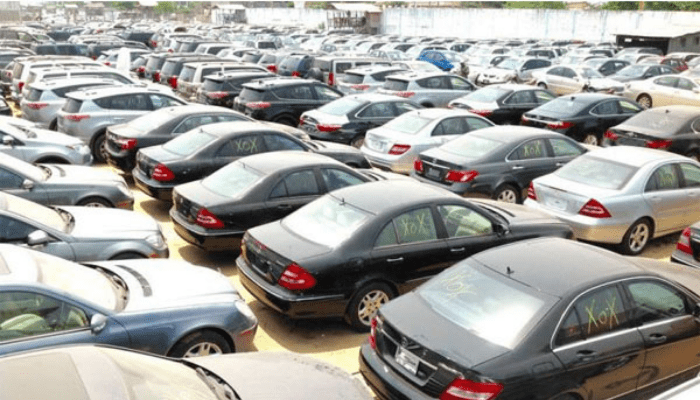
The instability and volatility of foreign exchange in Nigeria have led to a concerning trend at the Tin-Can Island Port Complex in Apapa, where numerous foreign-used vehicles popularly called ‘Tokunbo’ remain abandoned.
This situation arises as vehicle importation witnesses a drastic decline due to the same forex instability.
The surge in abandonment is attributed to the Central Bank of Nigeria’s (CBN) seven adjustments in the exchange rate for customs clearance since the start of President Bola Tinubu’s administration.
The latest adjustment on February 9, 2024, raised the exchange rate to N1,417.635 to the dollar.
Clearing agents reveal that the current cost to clear a 2022 Lexus RX 350 model stands at N20 million, while a 2006 Toyota Corolla incurs a clearance cost of N3.4 million.
This represents a significant increase, with vehicle clearance costs soaring by over 120 percent from June 2023 to the present, impacting importers’ financial forecasts.
The Public Relations Officer at the PTML command of the Association of Nigerian Licenced Customs Agents (ANLCA), Ayo Sulaiman, notes that vehicle importation has plummeted by 30 percent, with many importers abandoning vehicles at the seaports due to escalating clearance costs.
To address this decline, the Customs Service is exploring incentives to encourage importers and mitigate potential losses.
READ ALSO: Importers of dangerous Crusader soaps nabbed in Lagos
Exchange rate volatility has disrupted importers’ forecasts, prompting them to abandon vehicles at seaports when faced with unexpected costs.
Sulaiman emphasises that Nigerians are now turning to Nigerian-used vehicles as an alternative due to the challenges of affording imported used vehicles.
The General Secretary of the Tin Can Island Chapter of ANLCA, Mike Ovien, concurs that foreign exchange volatility has significantly contributed to the drop in vehicle importation.
The high duty costs associated with clearing vehicles, especially with the recent exchange rate hike to N1,417 to the dollar, have made importation financially challenging.
Importers, having budgeted for a certain clearance amount, are now confronted with increased exchange rates, compelling some to abandon vehicles in the port.
This shift in market dynamics prompts a move towards locally used vehicles, where parts are readily available and costs are comparatively stable.
Nigeria’s maritime sector is witnessing a transformation in vehicle importation patterns, driven by the impact of forex instability on clearance costs and the financial considerations of importers.





-

 Latest3 days ago
Full List: Meet the 2026 Nobel Prize winners across six categories
-
 Featured1 week ago
103 Million Voters: What does INEC’s new register say about Nigeria’s population?
-

 Football3 days ago
Premier League Matchweek 7: Five Fixtures That Could Shape the Weekend
-

 Business1 week ago
The Ministry of Commerce of Loveworld gets a $1 million boost for new investment fund at LTIF 2026 to promote Trade in Ghana
-

 Features1 week ago
Edo’s 2.5 million vote promise: Can the numbers match the politics?
-

 Latest2 days ago
Umahi defends Lagos-Calabar highway route changes amid public outcry
-

 Business2 days ago
Dangote Refinery IPO Extension: Was the 70% subscription report overhyped?
-

 Latest1 week ago
Nigeria to Ghana: Inside police hunt for Anambra kidnap suspect