
Latest
Kaduna-bound train derails near Asham, passengers escape unhurt

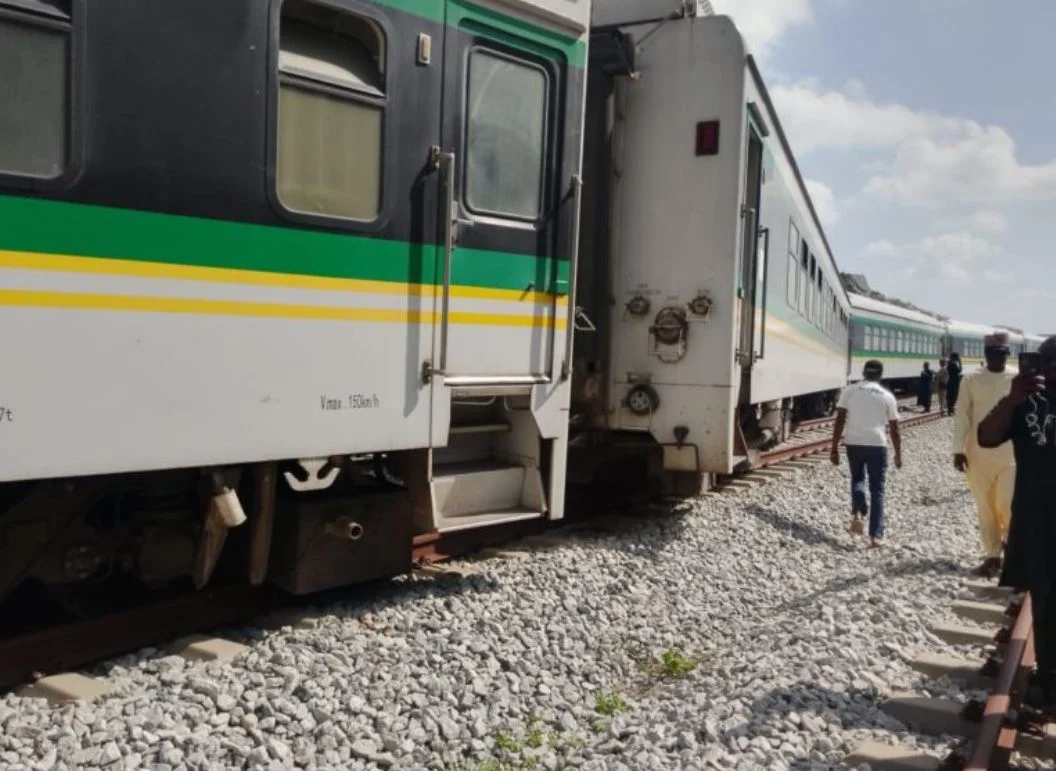
A Kaduna-bound passenger train derailed on Tuesday morning at Asham, along the Abuja-Kaduna corridor, shortly after departing Abuja at 9:45 am, sparking fresh concerns over the safety of Nigeria’s railway system.
The Nigerian Television Authority (NTA) confirmed the incident through its official X handle, posting:
“Kaduna bound train derails at Asham along Abuja-Kaduna corridor. Train left Abuja at 9:45 am.”
The state broadcaster also shared a video clip showing several coaches off the track, with passengers, including women, children, and men, struggling to crawl out of the derailed train.
In the footage, the eyewitness recording the scene narrated that she had been seated in the last coach and, upon exiting after the sudden halt, saw that some coaches had overturned while others stood damaged, with stranded passengers gathered outside.
As of the time of filing this report, the Nigerian Railway Corporation (NRC) had yet to issue an official statement on the derailment, and NTA did not confirm whether there were casualties or injuries.
The Abuja-Kaduna corridor—one of Nigeria’s busiest passenger routes—has suffered repeated setbacks from accidents and technical failures.
Only days ago, the NRC reported that a Kaduna-bound train developed a “hot axle” fault near Rigasa Station in Kaduna, disrupting services for several business class passengers.
READ ALSO: NRC warns passengers against fake booking platforms, lists official train ticket websites
Earlier in May 2024, another derailment was recorded at Jeremy Station along the same corridor.
Nigeria’s railway sector, already grappling with vandalism, poor infrastructure, and underinvestment, has seen derailments emerge as the most common form of train accident.
According to the National Bureau of Statistics (NBS) 2023 Social Statistics Report, between 2020 and 2022, Nigeria recorded 183 derailments, compared to 155 cases of locomotive failures and loss of control, 51 cases of coach detachment, 28 collisions, nine washouts, and 41 incidents linked to miscellaneous causes.
Beyond derailments, widespread vandalism—including theft of signaling equipment, sabotage of rail tracks, and destruction of critical infrastructure—continues to undermine safety and service delivery across major corridors.
The derailment comes at a time when the Nigerian Railway Corporation is battling maintenance issues across several key lines.
The Warri-Itakpe corridor, another major passenger and freight route, has been shut down for urgent repairs following repeated safety concerns.
On August 22, 2025, the NRC announced that repair works on damaged sections had reached an advanced stage, with services expected to resume soon.
The Asham derailment underscores the fragile state of the country’s railway network, raising questions about the safety of passengers and the government’s ability to deliver reliable transport infrastructure.


-

 Featured3 days ago
BREAKING NEWS: Shouts of joy rock the world as Pastor Chris opens final Healing Streams edition for 2026
-

 Football4 days ago
Man United shortlist Emery, Nagelsmann as potential replacements for Carrick
-

 Business4 days ago
Hoodlums raid JED Benue office, abduct 10 staff over power dispute
-

 Business7 days ago
Naira faces exchange rate gap as Dollar hits N1,380 on parallel market
-

 Football4 days ago
Aston Villa ready to freeze out Garnacho to avoid £43m Chelsea transfer
-

 Business4 days ago
EV adoption: Roxettes seeks cheaper financing, local manufacturing incentives
-

 Latest3 days ago
Akpabio tasks Tompolo-backed movement with spreading Tinubu’s renewed hope message
-

 Business3 days ago
How Ethiopian Airlines is challenging Africa’s aviation narrative through self-reliance