
Business
Predictable source of disinflationary pressure, says Okonjo-Iweala

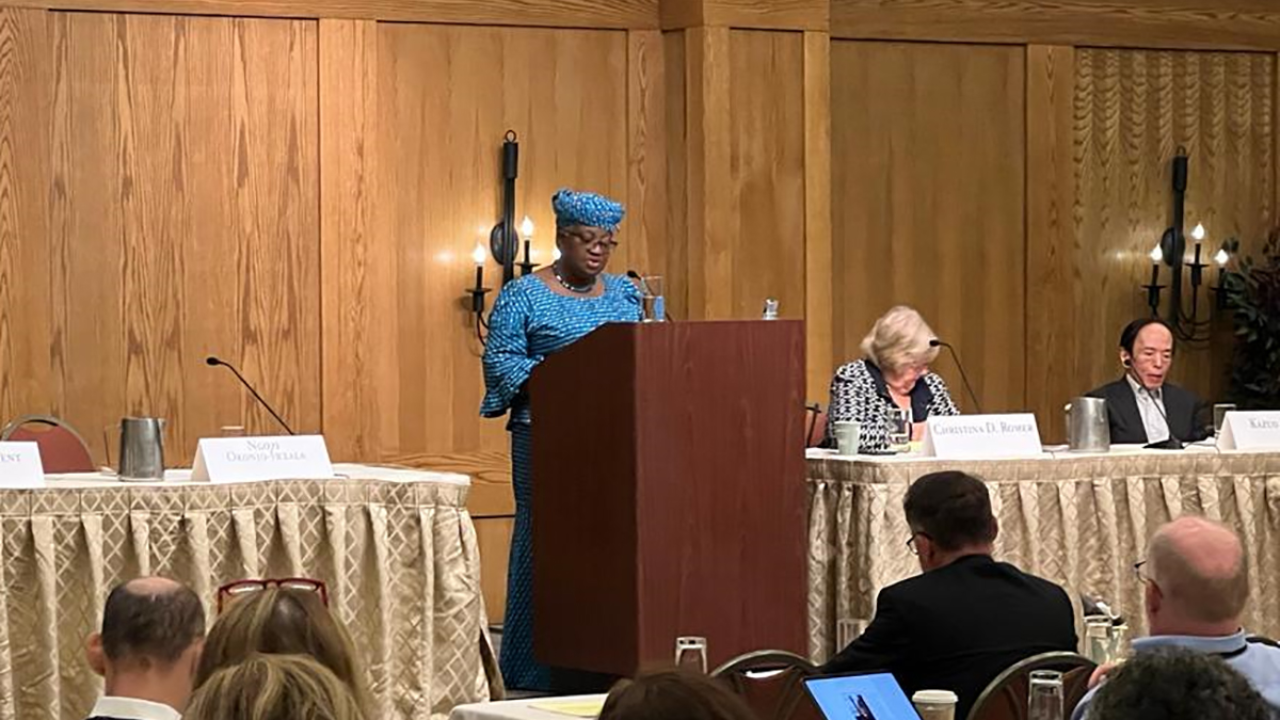
Ngozi Okonjo-Iweala, Director-General of the World Trade Organization (WTO), says predictable trade was a source of disinflationary pressure, reduced volatility, and increased economic resilience, whereas fragmentation of trade into rival blocs “would be very costly.”
Okonjo-Iweala who spoke at the recent Jackson Hole Economic Policy Symposium hosted by the Federal Reserve Bank of Kansas City, United States, said turning away from open trade will lead to greater price volatility, inflationary pressures and weaker growth prospects.
“A world that turns its back on open and predictable trade will be one marked by diminished competitive pressures and greater price volatility,” she said.
“It would be a world of weaker growth and development prospects, a slower low-carbon transition, and increased supply vulnerability in the face of unexpected shocks.”
READ ALSO: Okonjo-Iweala reacts to attack over photos with Tinubu
The WTO boss said that sustained inflation had made a comeback across richer nations, with subsequent monetary tightening exacerbating debt distress and financial instability for dozens of developing economies.
She said some policymakers had looked at the shocks, alongside rising geopolitical tensions, and concluded that globalisation needed to be rolled back.
She said WTO economists estimated that if the world economy decouples into two self-contained trading blocs that would lower the long-run level of real global gross domestic product (GDP) by at least five percent, with some developing economies facing double-digit welfare losses.
“Despite all the tensions and scepticism around trade, overall trade costs for agricultural products, manufactured goods, and services have fallen by 12% over the past twenty years,” Okonjo-Iweala said.
READ ALSO: Okonjo-Iweala under fire for allegedly cropping Tinubu out of photograph in France
“In other words, despite some higher policy costs like tit-for-tat tariffs among major trading nations and rising non-tariff barriers, trading goods and services across borders has in aggregate become cheaper, once we account for improvements in transport, communications, regulatory, transaction, and information-related costs, alongside governance factors.
“This is significant because trade cost reductions have historically been a major driver of trade growth.”
Okonjo-Iweala said there is a need to bring more countries into globalised production networks.
“This process, what we at the WTO are calling re-globalization’, offers potential to boost productivity, growth, development, and long-term price stability,” she added.






-
 Latest6 days ago
Israel marks 3 years since October 7 Hamas attack amid Gaza strikes, election debate
-

 Energy6 days ago
Fuel Battle: Dangote, marketers and government clash over petrol imports
-

 Energy1 week ago
Petrol, diesel prices rise 86% in 2026 as costs hit fresh highs
-

 Football7 days ago
Nigeria’s World Cup exit under spotlight as FIFA’s DR Congo files emerge
-
 Energy1 week ago
Has Iran lost control of the Strait of Hormuz? Oil flows rebound as war disruptions persist
-

 Latest24 hours ago
Full List: Meet the 2026 Nobel Prize winners across six categories
-

 Latest7 days ago
US Court set to rule on release of FBI, DEA records on Tinubu
-

 Business7 days ago
Nigerian investors at a crossroads as fixed-income yields slide