
Featured
Tinubu interview raises questions over Diana London’s links to US lobbying firm

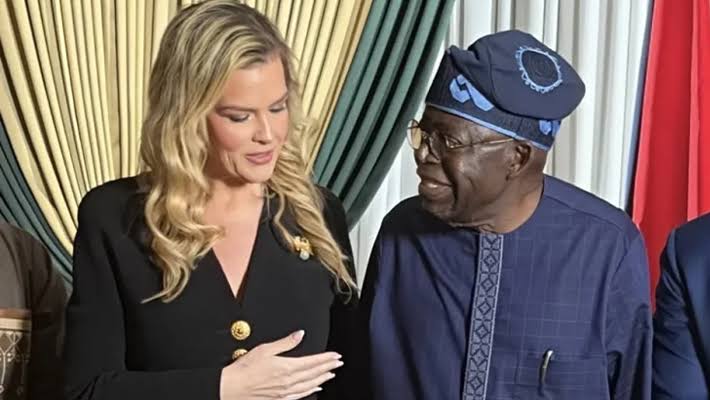
US Department of Justice records identify the American consultant as a representative working through DCI Group on behalf of Nigeria, while financial disclosures show payments to her company. However, the documents do not establish that the lobbying contract paid for her interview with President Bola Tinubu.
The American consultant who interviewed President Bola Tinubu at the Presidential Villa in Abuja was registered as a consultant working on behalf of the Nigerian Government through US lobbying firm DCI Group AZ, LLC, according to documents filed with the United States Department of Justice.
The filings, submitted under the Foreign Agents Registration Act (FARA), identify Diana London as a consultant to DCI Group and list the Republic of Nigeria, acting through Kaduna-based law firm Aster Legal, as the foreign principal she was engaged to support.
The disclosures establish a professional and financial connection between London’s company and the Nigerian Government’s lobbying arrangement in the United States. They also raise questions about the circumstances surrounding her interview with Tinubu, which took place at the Presidential Villa on November 17.
However, the documents reviewed do not specifically identify the presidential interview as a deliverable under the lobbying contract. They also do not establish that London personally received the $4.5 million paid to DCI Group.
What the US filings reveal about Diana London
A short-form registration statement filed with the US Department of Justice on December 18, 2025, identifies London as a consultant to DCI Group AZ, LLC.
The document lists her occupation as chief executive officer and names London Global Strategies, based in Delray Beach, Florida, as her business address.
It identifies the Republic of Nigeria through Aster Legal as the foreign principal she would serve in support of DCI Group.
In describing her assignment, London stated that she would assist the Nigerian Government through Aster Legal in communicating its actions to protect Christian communities and maintaining US support for efforts against jihadist groups and other destabilising elements in West Africa.
The filing also indicates that her work involved political activity as defined under the US Foreign Agents Registration Act, which covers activities such as lobbying, public relations, promotion and efforts to influence public opinion or government policy.
This is significant because it establishes that London was not simply an independent media personality with no declared relationship to Nigeria’s lobbying campaign. She had formally registered her consulting role in an arrangement representing the Nigerian Government.
The registration, however, does not by itself establish that every media activity she undertakes is part of the government contract.
How Nuhu Ribadu connects to the arrangement
The Nigerian Government’s engagement with DCI Group was arranged through Aster Legal, a Kaduna-based law firm, on behalf of National Security Adviser Nuhu Ribadu.
A contract filed with the US Department of Justice shows that Aster Legal retained DCI Group to assist the Nigerian Government in communicating its efforts to protect Christian communities and maintaining American support for counterterrorism operations in West Africa.
The agreement was signed on December 17, 2025, by Aster Legal managing partner Oyetunji Olalekan Teslim and DCI Group managing member Justin Peterson.
The contract provided for a monthly retainer of $750,000 over an initial six-month period, amounting to $4.5 million. It also contained an automatic renewal provision that could extend the arrangement for another six months, potentially bringing its total value to $9 million.
A payment record disclosed in the filing showed that Nigeria paid DCI Group $4.5 million on December 12, 2025, as an advance retainer for the initial six-month period.
Reuters, TheCable and Premium Times independently reported the arrangement after examining the US disclosures.
The records therefore support the claim that the Nigerian Government engaged DCI Group through Aster Legal in an arrangement made on behalf of the National Security Adviser. They do not, however, establish that Ribadu personally transferred money to London or her company.
How much did Diana London’s company receive?
The financial disclosures provide a further link between London’s company and the Nigerian lobbying contract.
In a supplemental statement covering the six-month period ending March 31, 2026, DCI Group reported two payments to London Global Strategies: $75,000 on December 23, 2025, and another $375,000 on the same date.
The payments were described as retainers, with the larger payment covering services from January to May 2026.
A subsequent DCI Group filing, covering the six months ending September 30, 2026, recorded another payment of $212,000 to London Global Strategies on August 4, 2026. This was classified as an expense.
Together, the disclosed payments amount to $662,000.
The records identify the payments as connected to the Republic of Nigeria through Aster Legal. They do not describe the entire $662,000 as payment for the Tinubu interview.
This distinction is important because some reports and social media posts have claimed that London personally received $4.5 million for interviewing the President.
The documents reviewed do not support that claim. The $4.5 million was the initial retainer paid to DCI Group under the wider lobbying agreement, while the $662,000 represents payments and expenses recorded for London Global Strategies.
The available filings also do not provide enough detail to establish precisely how much of the $662,000 represented London’s personal earnings, as opposed to company revenue or business expenses.
London’s response to the controversy
Following public criticism of her engagement with Tinubu, London denied receiving $4.5 million from the Nigerian Government or anyone else in the country.
In a statement posted on her X account on November 18, she said she travelled to Nigeria to interview the President for parts of a documentary and to see the country.
She described the allegations against her as a smear campaign and insisted that neither the Nigerian Government nor any other Nigerian individual had paid her $4.5 million.
Her response addressed the claim that she personally received the $4.5 million. It did not, however, erase the financial disclosures showing that her company received payments from DCI Group under the Nigeria-related arrangement.
London also deleted an earlier social media post in which she praised the security partnership between Nigeria and the United States and described Nigeria as America’s greatest ally in Africa.
ARISE News and TheCable reported the deletion and the subsequent controversy surrounding her relationship with DCI Group.
The available public records do not establish that the deleted post was removed because of the financial disclosures.
Was the Tinubu interview part of the lobbying contract?
This is the central unanswered question.
Photographs circulated on social media showed London interviewing Tinubu at the Presidential Villa, with recording equipment and Chief of Staff Femi Gbajabiamila also visible.
London subsequently described the engagement as an interview for a documentary.
But her registered relationship with DCI Group, the payments to her company and the Nigerian Government’s wider public-relations contract have raised questions about whether the interview was entirely separate from the lobbying arrangement.
The FARA documents reviewed describe the work DCI Group and its consultants were expected to undertake in communicating Nigeria’s security efforts and maintaining US support. They do not specifically list the November 17 interview with Tinubu as a contracted service.
Nor do the documents establish whether London conducted the interview independently, whether it was commissioned by another media or production organisation, or whether any part of its production was funded through the lobbying contract.
Former Vice-President Atiku Abubakar has called on the Presidency to clarify the relationship between the interview and the lobbying deal. He also demanded the release of the full, unedited recording, including any prompts or material displayed during the recording.
Atiku argued that Nigerians should be able to assess the circumstances surrounding the interview and determine whether it was a journalistic engagement or part of a wider government communications exercise.
As of the latest reports reviewed for this story, the Presidency had not publicly provided a detailed explanation of whether the interview was connected to the DCI Group contract.
Questions the Federal Government must answer
The disclosures raise legitimate questions about transparency, public expenditure and the boundaries between government lobbying and media engagement.
First, the Presidency and the Office of the National Security Adviser should clarify whether the Tinubu interview was included in the scope of the DCI Group engagement or was organised independently.
Second, the government should disclose the full contract, its renewal arrangements, payment records and the specific services delivered by DCI Group and its subcontractors.
Third, it should explain the role played by London Global Strategies, including the work covered by the $662,000 in disclosed payments and whether any of those services involved the President’s interview.
There is also a broader question about the government’s decision to spend millions of dollars on foreign public-relations and lobbying services while Nigerians continue to demand greater transparency over security spending and the management of public resources.
Hiring foreign lobbyists is not, in itself, evidence of wrongdoing. Governments routinely engage communications and lobbying firms to explain their policies and influence foreign public opinion. The issue is whether the engagements are properly authorised, transparently funded and accurately represented to the public.
In this case, the US filings establish that London worked as a consultant under DCI Group’s Nigeria engagement and that her company received payments connected to the arrangement.
What remains unproven is whether the Tinubu interview was one of the services paid for under the contract.
Until the Presidency releases the relevant contractual details and explains the circumstances of the interview, the distinction between a documentary interview and a government-funded communications exercise will remain unresolved.
For Nigerians, the issue is not simply who interviewed the President. It is whether public money was used to finance an engagement presented to the public without adequate disclosure of the interviewer’s professional and financial relationship with the government.


-
 Featured7 days ago
Nigeria’s youth unemployment paradox: Graduates struggle as millions survive in informal jobs
-
 Business1 week ago
Nigerian Banks earn N521.8bn from E-banking, card fees in nine months
-

 Energy7 days ago
Nigeria’s power crisis deepens as ₦639bn unpaid gas debt threatens electricity supply
-
 Featured6 days ago
Tinubu’s Renewed Hope: Reforms, hardship and the unanswered question of a second term
-
 Latest1 week ago
Dalung claims ‘message from Buhari’s grave’ urges Nigerians to vote Atiku in 2027
-
 Featured5 days ago
The cost of Renewed Hope: How Nigeria’s economic reforms are reshaping everyday family life
-

 Latest7 days ago
Ondo shuts ponmo processing centre after discovery of human waste
-
 Education7 days ago
Nigeria’s education crisis deepens as schools battle infrastructure deficits