
Latest
2027 elections: GOCOP urges INEC to boost transparency, tackle fake news

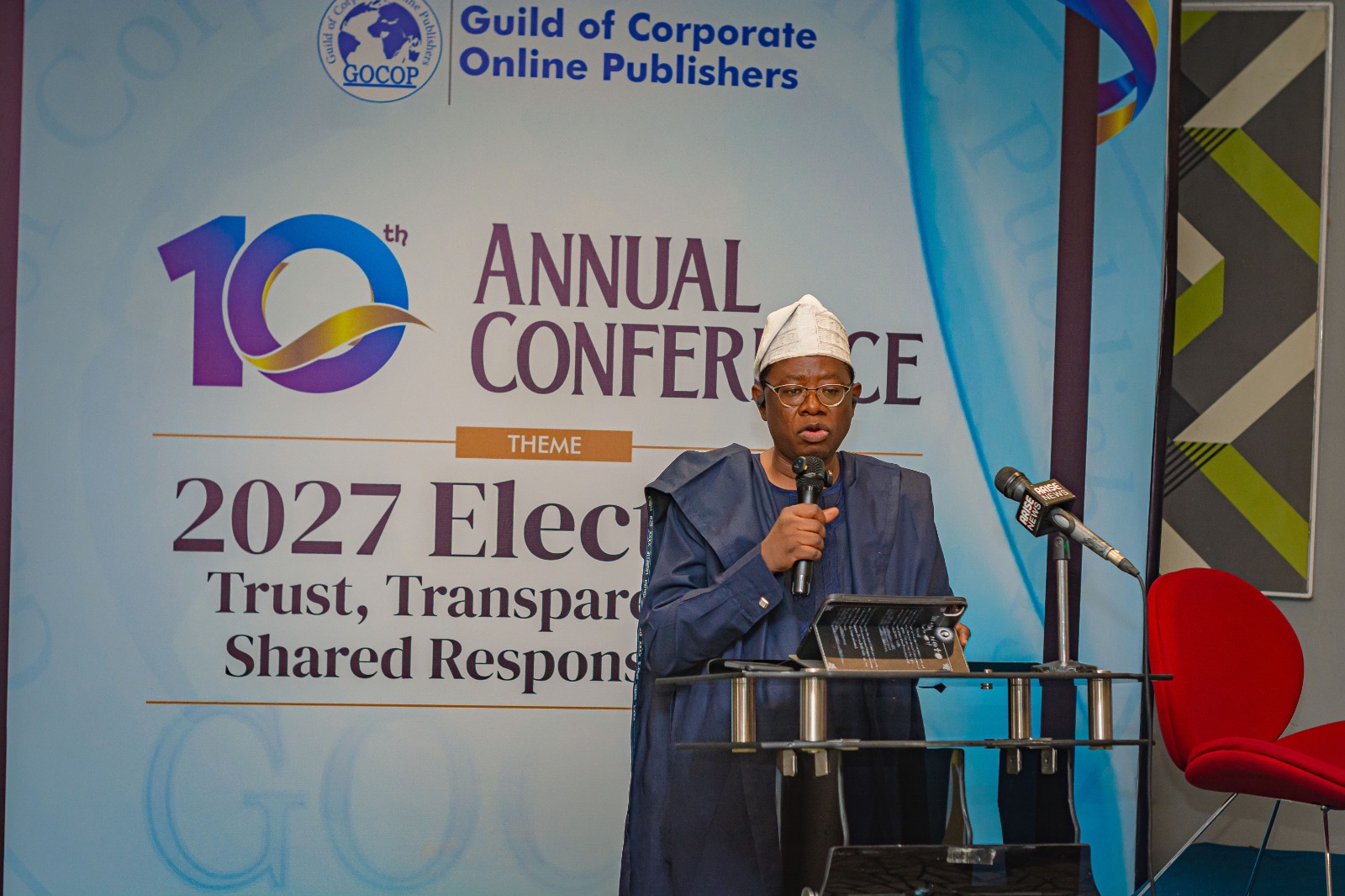
The Guild of Corporate Online Publishers (GOCOP) has urged the Independent National Electoral Commission (INEC) to strengthen transparency, combat misinformation and provide timely, verifiable information ahead of Nigeria’s 2027 general elections.
The Guild also called for the prosecution of electoral offenders, translation of electoral laws into major Nigerian languages and a judicial interpretation of the legal provisions governing media coverage of election results, exit polls and projections.
These recommendations were contained in a communiqué issued at the end of GOCOP’s 10th Annual Conference, held on October 7 and 8, 2026, at the Radisson Blu Hotel, Ikeja GRA, Lagos.
The conference, themed “2027 Elections: Trust, Transparency and Shared Responsibilities,” was chaired by former Nigerian Bar Association President, Dr Olisa Agbakoba, SAN, while INEC Chairman, Prof. Joash Ojo Amupitan, SAN, delivered the keynote address.
The event attracted media executives, publishers, academics, policymakers, security officials, civil society representatives and other stakeholders.
In its communiqué, signed by GOCOP President, Danlami Nmodu, mni, and General Secretary, Sufuyan Ojeifo, the Guild identified public trust as a major determinant of the credibility of the 2027 elections.
It observed that confidence in Nigeria’s electoral process remained low, citing a survey presented at the conference which indicated that only 38 per cent of Nigerians believed in the credibility of elections.
The Guild stressed that technology alone could not guarantee credible elections without transparent institutions and verifiable processes.
It acknowledged INEC’s preparations, including proposed structural, technological and logistical reforms, improved result-integrity systems, artificial intelligence-assisted data auditing and cybersecurity measures developed with technology partners, including Google and Microsoft.
READ ALSO; GOCOP unveils panelists for 10th annual conference on 2027 elections
However, it urged the commission to back its assurances with measurable results and timely public updates on election logistics, technology testing and result management.
GOCOP specifically called on INEC to activate its proposed Digital Media Fact-Verification Channel to enable editors to verify reports concerning polling units, security incidents and technical challenges before publication.
The Guild also encouraged INEC to sustain voter education initiatives targeting women, young people, persons with disabilities and underserved communities.
With nationwide collection of Permanent Voter Cards (PVCs) commencing on October 9, 2026, the conference urged Nigerians to collect their cards, participate in the elections and hold elected representatives accountable.
The conference warned that fake news, unverified leaks, synthetic media and artificial intelligence-generated deepfakes posed serious threats to the electoral process.
According to the communiqué, misinformation could inflame divisions, discourage voter participation and undermine confidence in election results, while subsequent corrections might not adequately repair the damage.
It urged GOCOP members and other media organisations to prioritise accuracy over speed, reject clickbait and protect election reporting from partisan and proprietorial interests.
The Guild declared that unverified polling-unit results, altered result sheets and inflammatory speculation would have no place on its platforms, warning that violations would attract sanctions under its code of conduct.
It also advised journalists to report operational delays with appropriate context and official verification rather than automatically portraying them as evidence of a systemic collapse.
While affirming the media’s constitutional role in disseminating information, the conference emphasised that freedom of expression carried a corresponding responsibility to verify claims before publication.
The communiqué further highlighted the unresolved relationship between Section 60 of the Electoral Act 2026, which governs the announcement of election results by INEC, and Section 39 of the 1999 Constitution, which guarantees freedom of expression and the right to receive and impart information.
It called on the Nigeria Union of Journalists, GOCOP and other media organisations to seek judicial clarification on the extent to which the media could lawfully report exit polls, projections and independent result tallies.
The Guild expressed concern over what it described as weak accountability for electoral offences, arguing that the limited prosecution of offenders could encourage impunity.
It urged INEC to work with relevant prosecuting authorities to investigate and prosecute electoral offenders and make the outcomes public.
The conference also welcomed a three-point pact proposed by INEC on fact-verification, editorial self-regulation and voter education. GOCOP said its Executive Council would engage the commission on implementation while safeguarding editorial independence.
On security, the Guild noted the Nigeria Police Force’s report of relatively peaceful elections since February 2026, with no shootings, which the police attributed to intelligence-led operations.
It urged the police and other security agencies to sustain lawful, intelligence-driven and non-partisan operations throughout the 2027 electoral cycle.
The conference raised concerns about the low participation and representation of women in Nigeria’s electoral process, warning that opaque consensus arrangements in political parties could further limit the number of women elected in 2027.
It called on the National Assembly to enact legislation aimed at increasing women’s participation and representation, while urging political parties to adopt open and transparent candidate-selection processes.
The Guild criticised the limited accessibility of electoral laws and guidelines, noting that Nigeria’s linguistic diversity made it necessary to communicate electoral information in languages citizens could understand.
It called on INEC to translate the Electoral Act, regulations and voter education materials into major Nigerian languages while maintaining accessible formats for persons with disabilities.
The conference also urged citizens to verify information before sharing it and to remain engaged in holding public institutions and elected officials accountable beyond election day.
In his welcome address, Nmodu had urged politicians to put the people first and ensure government policies improved citizens’ welfare.
He also charged journalists to hold both the government and opposition accountable through accurate, fair, balanced and objective reporting.
The GOCOP president called for sustained cooperation between the government, the Guild and the Nigerian Press Organisation to protect the media and safeguard the interests of publishers and journalists in the digital age.
The communiqué cited Botswana’s 2024 political transition, in which the Botswana Democratic Party relinquished power after 58 years, as an example of what trusted electoral institutions could achieve in Africa.
In conclusion, GOCOP reaffirmed that credible elections in 2027 would require the collective responsibility of INEC, security agencies, political parties, the media and citizens.
The Guild pledged that its 127 member publications would provide verified, fair and responsible coverage before, during and after the elections.


-
 Latest5 days ago
Israel marks 3 years since October 7 Hamas attack amid Gaza strikes, election debate
-

 Energy5 days ago
Fuel Battle: Dangote, marketers and government clash over petrol imports
-

 Energy6 days ago
Petrol, diesel prices rise 86% in 2026 as costs hit fresh highs
-

 Energy7 days ago
Has Iran lost control of the Strait of Hormuz? Oil flows rebound as war disruptions persist
-

 Football6 days ago
Nigeria’s World Cup exit under spotlight as FIFA’s DR Congo files emerge
-

 Latest6 days ago
US Court set to rule on release of FBI, DEA records on Tinubu
-

 Business6 days ago
Nigerian investors at a crossroads as fixed-income yields slide
-

 Business7 days ago
LoveWorld Trade and Investment Forum to Convene Business Leaders in Accra