
Latest
Lagos seals distressed building in Abesan Estate as experts warn on ageing structures(Video)

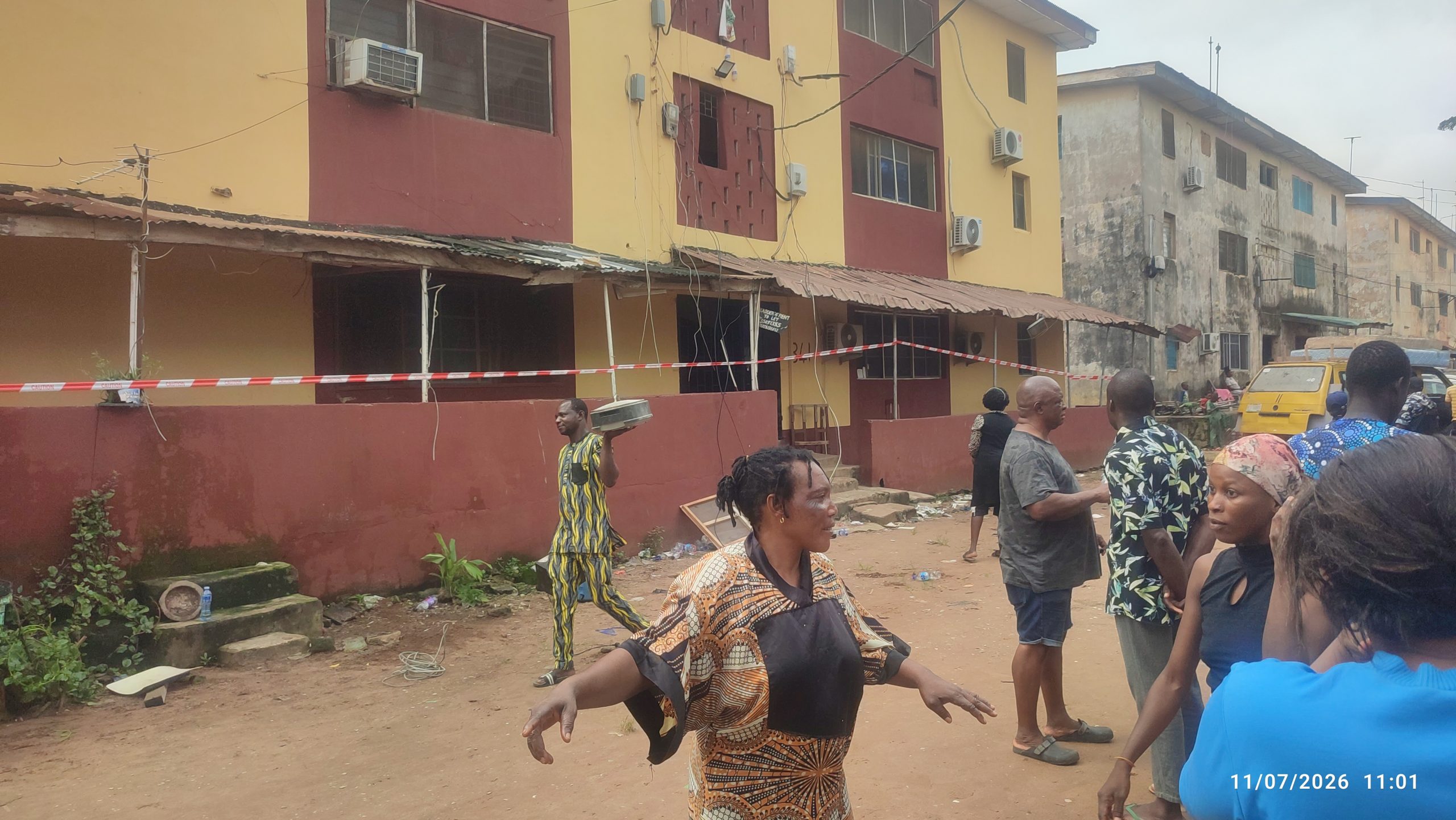
Residents of Abesan Low Cost Housing Estate in Lagos narrowly averted what could have become a major disaster on Saturday after a residential building comprising six flats developed severe structural cracks, prompting an emergency evacuation and immediate intervention by the Lagos State Building Control Agency (LASBCA).
The affected building, Block 341, Sector 21 of the estate, was sealed by LASBCA officials on July 11 after authorities determined that the building had become structurally distressed and posed a potential threat to human lives.
The incident threw residents into panic as occupants hurriedly vacated the six-flat building after noticing extensive cracks across parts of the structure early on Saturday morning.
Eyewitnesses said concerned residents immediately alerted neighbours and advised everyone living in the building to leave before officials from the Lagos State Building Control Agency arrived at the scene.
READ ALSO: Abesan Estate hosts Security Summit, Police, NDLEA, others call for increased vigilance
Upon arrival, LASBCA officials cordoned off the premises and sealed the building to prevent further occupation pending a comprehensive structural integrity assessment by government engineers.
The action, while welcomed as a necessary safety measure, left many occupants stranded, with several residents unable to retrieve their belongings after access to the building was restricted.
Reacting to the development, President of the Abesan Estate Residents Association (AERA), Shina Dare, disclosed that he received an emergency call shortly after the cracks were discovered and immediately visited the scene to assess the situation.
According to him, the extent of the visible damage justified the government’s decision to seal the property.
“I received a call early this morning and immediately visited the building. From what I saw, it was obvious that the structure is distressed. The decision by LASBCA to seal the building is a precautionary measure aimed at protecting lives,” Dare said.
He explained that the residents’ association had over the years repeatedly sensitised flat lords on the need for routine maintenance and early repair of deteriorating structures, especially within Abesan Estate where many of the buildings have existed for several decades.
“We have consistently advised residents to reinforce weakened foundations where necessary, carry out regular maintenance and promptly address visible structural defects. Unfortunately, many property owners ignore these warnings until serious problems emerge,” he added.
Dare further attributed some of the structural challenges facing buildings within the estate to widespread alterations carried out by successive owners.
According to him, many property owners have modified government-built apartments beyond their original architectural designs without obtaining proper professional supervision.
“One of the major factors contributing to the distressed condition of some of these buildings is the indiscriminate reconstruction and alteration of the original government-approved designs. In many cases, new owners have carried out structural modifications without adequate professional guidance, and this has compromised the integrity of several buildings,” he stated.
He urged residents across the estate to engage qualified structural engineers whenever signs of distress such as cracks, wall separation or foundation settlement are noticed.
Although LASBCA had yet to issue a detailed statement on the specific cause of the structural defects as of the time of filing this report, officials at the scene maintained that sealing the building was necessary to safeguard lives while technical investigations continue.
Building safety advocates have called on the Lagos State Government to intensify routine structural audits of ageing public housing estates across the state to identify distressed buildings before they become disasters.
They also urged property owners to comply with existing building regulations and promptly report any signs of structural failure to relevant government agencies.
Structural engineers have consistently warned that visible cracks, excessive settlement, bulging walls, sagging floors and unusual structural movement are early indicators that a building may be experiencing serious distress.
According to building experts, while some hairline cracks may result from normal shrinkage, wide or expanding cracks—particularly those affecting load-bearing walls, beams or columns—require immediate professional evaluation.
They also caution against unapproved structural alterations, including the removal of load-bearing walls, additional floor construction, foundation modifications and extensions carried out without engineering supervision, noting that such changes can significantly weaken older buildings.
Professionals further recommend periodic structural integrity assessments for buildings that have been in use for several decades, particularly those located in densely populated estates, to ensure they remain safe for habitation.
The latest incident has renewed concerns over the condition of ageing residential buildings in Lagos and highlights the importance of preventive maintenance, regular inspections and strict enforcement of building safety regulations.
Residents have expressed hope that the ongoing assessment by LASBCA will provide clarity on the condition of the building and determine whether rehabilitation is possible or if demolition will be required in the interest of public safety.
Safety experts say the swift evacuation of occupants and prompt intervention by government authorities may have prevented a potential tragedy, while urging residents across Lagos to report any signs of structural distress before they escalate into catastrophic building failures.


-

 Featured2 days ago
BREAKING NEWS: Shouts of joy rock the world as Pastor Chris opens final Healing Streams edition for 2026
-

 Business5 days ago
Naira faces exchange rate gap as Dollar hits N1,380 on parallel market
-

 Football2 days ago
Man United shortlist Emery, Nagelsmann as potential replacements for Carrick
-

 Business2 days ago
Hoodlums raid JED Benue office, abduct 10 staff over power dispute
-

 Football2 days ago
Aston Villa ready to freeze out Garnacho to avoid £43m Chelsea transfer
-

 Business2 days ago
EV adoption: Roxettes seeks cheaper financing, local manufacturing incentives
-

 Business1 week ago
NCC launches Internet Governance Working Group to tackle AI risks, boost online safety
-

 Latest2 days ago
Akpabio tasks Tompolo-backed movement with spreading Tinubu’s renewed hope message