
Business
Aviation crisis deepens as unions ground flights over 5% ticket charge, unionisation dispute

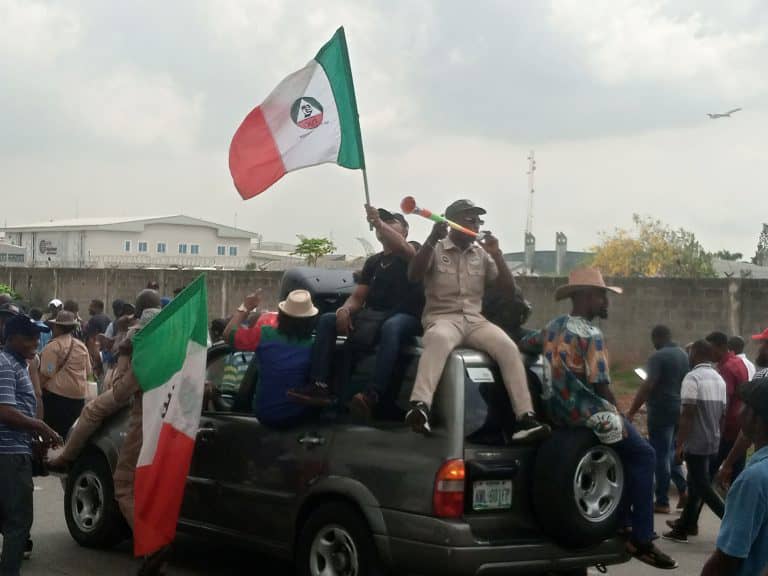
Flight operations were disrupted at major Nigerian airports on Tuesday as aviation labour unions commenced industrial action over alleged non-remittance of the statutory five per cent Ticket Sales Charge (TSC) by some airlines and concerns over alleged anti-union practices in the sector.
The action, involving the National Union of Air Transport Employees (NUATE), Air Transport Services Senior Staff Association of Nigeria (ATSSSAN) and other aviation labour groups, affected operations at the Murtala Muhammed Airport in Lagos and the Nnamdi Azikiwe International Airport in Abuja, leaving passengers stranded and forcing some airlines to suspend or disrupt scheduled services.
The unions had earlier issued notices to affected airlines, demanding the remittance of outstanding TSC funds and insisting that aviation workers must be allowed to belong to unions of their choice without intimidation, victimisation or discrimination.
The five per cent TSC is collected from passengers through their air tickets and is meant to support the operations of key aviation agencies, including the Nigerian Civil Aviation Authority (NCAA), Nigerian Airspace Management Agency (NAMA), Nigerian Safety Investigation Bureau (NSIB), Nigerian College of Aviation Technology (NCAT) and the Nigerian Meteorological Agency (NiMet).
READ ALSO: Aviation Crackdown: NCAA suspends services to Air Peace, Ibom Air, nine others
The unions have argued that continued failure by some airlines to remit the funds could undermine aviation safety oversight, air navigation, accident investigation, weather services and other critical activities across the sector.
General Secretary of ATSSSAN, Frances Akinjole, said the unions did not embark on the action lightly, insisting that repeated attempts to resolve the matter through dialogue had failed.
“It has never been in our character to stop operations. But when our lives and existence are involved, we have no other choice,” Akinjole said while explaining the decision to picket Air Peace.
He accused Air Peace of being particularly resistant to the unions’ demands, saying the airline was being targeted first because the unions considered its case a major example of the problem they were confronting.
According to the unions, their action is not simply about the payment of money but about protecting the structures that sustain Nigeria’s aviation industry and safeguarding workers’ rights.
In an earlier statement jointly signed by Akinjole and NUATE Deputy General Secretary, Odinaka Igbokwe, the unions said the expiration of successive ultimatums demonstrated that some airlines were unwilling to comply with their statutory obligations.
READ ALSO: Festus Keyamo: The empathetic architect of Nigeria’s aviation renaissance
The labour groups argued that airlines collect the TSC from passengers on behalf of aviation agencies and should therefore remit the money as required by law. They warned that withholding the funds could have consequences for the sustainability of aviation regulatory and safety institutions.
The unions also linked the dispute to workers’ welfare, saying airlines’ compliance with statutory obligations was important for the implementation of negotiated collective bargaining agreements and the broader protection of aviation employees.
However, the Airline Operators of Nigeria (AON) has disputed the unions’ characterisation of the financial disagreement.
The operators have maintained that airlines do not owe the NCAA for regulatory services, stressing that services such as aircraft inspections, crew licence validation and inspections, crew licence validation and documentation renewals are paid for before they are rendered.
AON has distinguished those payments from the five per cent TSC, which it says is a charge imposed on passengers and collected by airlines as agents.
The operators have argued that the existing system places an additional cash-flow burden on airlines already facing high fuel costs, foreign exchange pressures and other operational expenses.
They have also called for reforms that would allow the NCAA to collect statutory charges directly from passengers or through other appropriate channels rather than making airlines responsible for remitting the funds.
Passengers stranded as flights are disrupted
The industrial action immediately affected travellers, with passengers arriving at airports only to discover that scheduled flights had been suspended or blocked.
One passenger who spoke during the disruption expressed frustration after arriving at the airport on time for an early-morning flight.
“I had a flight for 7:00 AM. Against all odds, I made it right on time, only to find out that the union guys have stopped Air Peace from flying today. Everyone is stranded. It is painful,” the passenger said.
The disruption created uncertainty for passengers with business engagements, connecting flights and other time-sensitive commitments, while airlines were forced to notify affected travellers about changes to their schedules.
Air Peace confirmed that its operations had been disrupted after union members barricaded access to its departure terminals at Lagos and Abuja airports.
The airline said the blockade prevented scheduled flights from departing and significantly affected passengers travelling across its network. It apologised to affected and stranded travellers, saying the circumstances were beyond its control.
United Nigeria Airlines also announced a temporary suspension of its flight operations, citing the industrial action and saying the decision was taken to protect passengers and crew rather than compromise safety.
The airline said it would resume full operations once normalcy returned and promised to keep affected passengers informed about revised schedules.
NCAA urges unions to suspend action
Amid the growing disruption, the NCAA appealed to the aviation unions to sheathe their swords and exercise restraint pending the return of the Minister of Aviation and Aerospace Development, Festus Keyamo.
In a statement signed by the NCAA Director General of Civil Aviation, Capt. Chris Ona Najomo, the regulator said Keyamo had been actively working to resolve the dispute.
Najomo explained that the issues could have been addressed at a meeting convened by the minister the previous week, but the meeting failed to hold because airline operators did not honour the invitation.
The NCAA urged the unions, airlines and other stakeholders to return to the negotiating table, stressing that dialogue and cooperation remained the best way to resolve the disagreement.
The authority also moved to reassure passengers over the safety implications of the industrial action.
According to Najomo, “flight safety remains uncompromised,” while the NCAA continues to discharge its statutory safety oversight responsibilities.
The regulator expressed confidence that the dispute would be resolved shortly and that normal flight operations would resume as soon as practicable.
The latest development has therefore placed the Federal Government under renewed pressure to broker a settlement between the unions and airline operators, as prolonged disruption could affect passengers, airline revenues and other businesses dependent on the aviation sector.
For travellers, however, the immediate concern remains the restoration of normal flight schedules and the resolution of the dispute without further disruption to air transportation across the country.
The NCAA apologised to passengers for the inconvenience caused by the industrial action and appealed to all parties to prioritise dialogue in the interest of the travelling public and the stability of Nigeria’s aviation industry.


-
 Featured5 days ago
Inside INEC’s race to prepare for Nigeria’s 2027 elections
-

 Latest1 week ago
UCTH faces morgue crisis as 50 unclaimed corpses await mass burial
-
 Featured5 days ago
2027: APC unveils nationwide campaign timetable, Tinubu to rally in 12 states
-

 Business6 days ago
President Tinubu and the Low Transport Fares Fiasco
-

 Business1 week ago
BREAKING: Nigeria’s Inflation Rate Drops to 14.63% in September
-
 Business5 days ago
Court dismisses ₦170m Trade Fair contract claim, says Zenith Bank was not a party
-
 Business2 days ago
Naira faces exchange rate gap as Dollar hits N1,380 on parallel market
-
 Latest5 days ago
Breaking: NNPCL raises petrol price to ₦1,405 per litre amid discount controversy