
Editorial
President Buhari and the suspension of CJN Onnoghen

Published
7 years agoon
By
Publisher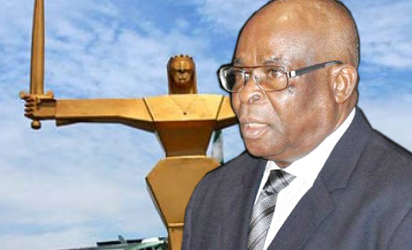
National Daily Newspaper Editorial
THE 1999 Constitution of Nigeria (as amended) is the fundamental law of Nigeria, the grundnorm, the fons et origo or the exceptio of all exceptiones of the Nigerian legal system. All other laws, including the Code of Conduct Bureau/Code of Conduct Tribunal Act, 2004, are subordinate to it. The President and Commander-in Chief of the Federation came to power after swearing on the Oaths of Office and of Allegiance in the Constitution’s Seventh Schedule. There, the President solemnly swore, under God, to “…discharge my duties to the best of my ability, faithfully and in accordance with the Constitution of the Federal Republic of Nigeria and the law,…that I will not allow my personal interest to influence my official conduct or my official decisions; that I will to the best of my ability preserve, protect and defend the Constitution of the Federal Republic of Nigeria…that I will do right to all manner of people, according to law, without fear or favour, affection or ill-will…So help me Allah.”
In view of the above, any President who flouts any of the provisions of the Constitution in defiance of the Oaths of Office and of Allegiance, commits an impeachable offence within the provision of section 143 (2) (b) of the 1999 Constitution (as amended).
The presidential election is imminent (February 16, 2019); the presidency must have entertained pathological fear (or so people rightly think) that the incumbent CJN could not be trusted to “deliver the goods” in terms of favourable judgments by the election petition tribunals, to be constituted by CJN Walter Onnoghen, for him and his party members, and so decided to remove him by hook or by crook, his Oath of Office and the enshrined provisions of the Constitution notwithstanding.
A non-governmental organization (NGO), whose Leadership reportedly had ties with the President, levelled an allegation of “under-declaration of assets” against CJN Walter Samuel Onnoghen, a serious offence under the CCB/CCT Act (2004). Onnoghen quickly jumped out to admit the offence, which he attributed to inadvertence or a “mistake”, which is sadly unknown to law as a head of defence! The charge(s) against Onnoghen started its/their journey through the nation’s formal courts. On Thursday, January 24, 2019, the Court of Appeal ordered that all proceedings concerning CJN Onnoghen should stop at the Code of Conduct Tribunal (CCT). The next day, Friday, January 25, 2019, President Muhammadu Buhari, claiming he had received an order from the CCT, decided to disregard the Judiciary and the Constitution and impetuouslysuspended CJN Onnoghen and promptly swore in Justice Tanko Mohammed in an acting capacity, acts which many discerning Nigerians and international commentators have right bedaubed a coup against the Judiciary and the Constitution of the Federal Republic of Nigeria.
Section 231 (1) of the 1999 Constitution (as amended) provides that a CJN shall be appointed by the President ONLY upon the recommendation of the National Judicial Council (NJC)SUBJECT to confirmation of such appointment by the Senate (emphasis added). It should be noted that this provision was enforced in the case of Justice Obisike Orji, who submitted himself to be sworn in by the Abia State Government without the recommendation of the NJC. President Muhammadu Buhari’s new acting CJN, Justice Tanko Mohammed, was a critical member of the panel that forced Justice Obisike Orji into retirement for that offence. Justice Tanko Mohammed submitted himself to be sworn in as acting CJN without the intervention of the NJC!
Section 292 (1) (a) clearly and irrefragably provides for the whys and wherefores of removing any judicial officer, including the CJN, and subsection (b) thereof delineates the method of removing a judicial officer. This section reinforces the timeworn principle of separation of powers (among the Legislature, the Executive and the Judiciary), a principle that was authored by Charles Secondat, Baron de Montesquieu in his book, “L’Esprit de Loi” (Spirit of the Law, 1748) and enshrined by our Constitution in its sections 4, 5 and 6. Those two sections—231 and 292—legalize the time-honoured tradition that none of the three arms of government is subordinate to the other.
The suspension of CJN Onnoghen ( a Southerner) and the hurried appointment of Justice Tanko Mohammed (from Bauchi State) as acting CJN are not just coups d’état against the Constitution, the Judiciary and the Rule of Law, popularized by Albert Venn Dicey in the 19th and 20th centuries, but the height of favouritism and nepotism with which the All ProgressivesCongress (APC)-led Administration is ingloriously associated.
Of the several reactions and comments against the noisome illegality perpetrated by the Presidency with regard to the suspension of CJN Onnoghen, the most ludicrous was the position taken by the Nigerian Bar Association (NBA) that all members of the Association should go on a beggarly two-day (instead of indefinite) strike, which the charge-and-bail arm of the Association could not even obey!
National Daily joins others in calling on President Muhammadu Buhari to reverse himself and reinstate CJN Onnoghen to his position, forthwith, while the law looks at his alleged offence. This is because section 36 (5) of the 1999 Constitution (as amended) provides that whenever a person is accused of any offence (even a self-confessed murderer dangling a blood-stained cutlass), he is presumed to be innocent until a court of competent jurisdiction proves him guilty! Besides, CJN Onnoghen may, in spite of the popular legal maxim, “Ignorantia juris quod quisque tenetur scire , neminem excusat” (A mistake in point of law is, in criminal cases, no sort of defence), plead the proviso in s.3 (d) of the CCB/CCT Act, which provides that “where the concerned makes a written admission of such breach or non-compliance, no reference to the Tribunal shall be necessary.”
Meanwhile, we applaud the action taken by the Senate in taking the Buhari-Onnoghen case to the Supreme Court to determine whether President Buhari was right in his actions, hopefully as a first step in the action recommended in section 143 (1) – (11) of the Constitution.
Verbum sat sapient est.

You may like

Atiku Urges Opposition to Reject Rivers LG Poll Results, Calls Election “Awful Absurdity”


INEC officials, politician arrested in Ogun over alleged vote-buying


HURIWA slams EFCC as Tinubu’s attack dog, Says Tambuwal’s arrest is intimidation tactic against opposition


Tension rocks ADC coalition as EFCC targets key members over corruption probes


2027 and the Explosion of Political Parties: Progress or Chaos?

INEC and the Crisis of Accountability: Can Nigeria’s democracy survive without reform?”
Trending
 Latest1 week ago
ADC accuses INEC of misinterpreting court order, demands chairman’s removal amidst growing leadership crisis

 Football7 days ago
Manchester City storm into FA cup semi-finals with 4-0 rout of Liverpool
 Business6 days ago
Soaring fuel prices worsen economic hardship for Nigerians
 Latest7 days ago
2027: Fresh details emerge on Peter Obi’s political strategy amid ADC crisis

 Health1 week ago
Study finds higher risk of heart inflammation in teens after mRNA COVID-19 vaccination

 Latest6 days ago
Inside the daring U.S. mission to rescue stranded airman in Iran
 Latest6 days ago
Breaking: Internal pressure mounts as ADC considers leadership shift to Ralph Nwosu
 Latest1 week ago
Fani-Kayode knocks Peter Obi after explosive NADECO-Abacha post