
Business
CBN holds interest rate at 23%, Naira pressures keep MPC cautious

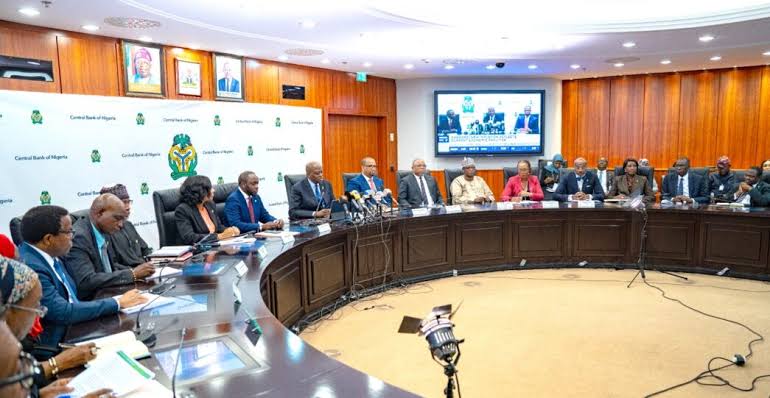
The Central Bank of Nigeria (CBN) has retained its benchmark interest rate at 23 per cent, opting to maintain its current monetary policy stance amid easing inflation, renewed pressure on the naira and concerns about the sustainability of recent macroeconomic gains.
CBN Governor, Olayemi Cardoso, announced the decision on Tuesday at the conclusion of the 308th meeting of the Monetary Policy Committee (MPC) in Abuja.
The decision means the apex bank has chosen to pause further adjustments to the Monetary Policy Rate (MPR), following its 350-basis-point reduction in September from 26.5 per cent to 23 per cent.
That September adjustment was the second reduction in the benchmark rate in 2026 and brought it to its lowest level since February 2024, when it stood at 22.75 per cent.
The latest decision was widely anticipated by analysts, who had argued that the CBN needed time to assess the impact of the September adjustment on inflation, foreign exchange stability, liquidity and the broader economy.
Professor Uche Uwaleke, President of the Capital Market Academics of Nigeria and Director of the Institute of Capital Market Studies at Nasarawa State University, had urged the MPC to maintain the existing rate, despite the moderation in inflation.
Uwaleke noted that headline inflation declined to 14.06 per cent in October from 14.63 per cent in September, while the Nigeria Overnight Financing Rate fell to 20 per cent.
However, he identified renewed pressure on the foreign exchange market as a major reason for caution.
According to him, the naira weakened from approximately N1,350 to N1,389 per dollar between September and November 23, while the country’s gross external reserves declined from $55.25 billion to $54.6 billion.
He argued that another reduction in the MPR could increase liquidity and intensify pressure on the foreign exchange market, potentially reversing some of the gains recorded in the fight against inflation.
READ ALSO; CBN’s 23% Interest Rate: What it means for borrowers, businesses and Nigeria’s economy
Uwaleke described retaining the rate as a deliberate pause that would allow the CBN to consolidate the gains from September’s policy adjustment and monitor the relationship between inflation, liquidity and interest rates.
The latest decision also comes against the background of the CBN’s effort to restore the effectiveness of monetary policy transmission, following concerns that the benchmark rate had become disconnected from prevailing market interest rates.
At its September meeting, the MPC recalibrated the Standing Facilities Corridor to +50 and -300 basis points around the MPR.
The committee also retained the Cash Reserve Requirement (CRR) at 45 per cent for deposit money banks, 16 per cent for merchant banks and 75 per cent for non-Treasury Single Account public sector deposits.
For businesses, particularly manufacturers, traders and small and medium-sized enterprises in Lagos, the decision to retain the rate leaves the immediate cost of borrowing largely dependent on how commercial banks price their loans.
Although the September reduction raised expectations of cheaper credit, business operators have continued to face financing pressures arising from high lending rates, energy costs, foreign exchange expenses and weak consumer purchasing power.
The Lagos Chamber of Commerce and Industry (LCCI), following the September reduction, welcomed the CBN’s policy adjustment but stressed that the benefits must translate into more affordable credit for businesses.
The chamber’s position reflected a wider concern among private-sector operators that a reduction in the benchmark rate would have limited value if commercial banks did not adjust their lending rates.
The Centre for the Promotion of Private Enterprise (CPPE), led by its Chief Executive Officer, Dr Muda Yusuf, also described the September adjustment as an opportunity to reduce the cost of capital, improve business cash flows, stimulate investment and support job creation.
Yusuf, however, warned that the effectiveness of the policy would depend on whether banks progressively reduced lending rates on new and existing facilities.
He also identified energy costs, logistics bottlenecks, infrastructure deficits and regulatory expenses as structural constraints that monetary policy alone could not resolve.
Similarly, the Nigeria Employers’ Consultative Association (NECA) cautioned that a lower MPR did not automatically translate into cheaper loans, pointing to the continued high CRR requirement for deposit money banks as evidence that monetary conditions remained restrictive.
The association called for stronger transmission of the policy adjustment to the real sector.
The MPC’s decision reflects the challenge confronting monetary policymakers: supporting economic activity without undermining progress in controlling inflation and stabilising the naira.


-

 Crime6 days ago
Kwara bandit deal under scrutiny as footage shows security operatives negotiating with terrorists [VIDEO]
-

 Business4 days ago
NGX loses N3trn in three days as Dangote Cement, Aradel, Banks lead sell-off
-

 Latest4 days ago
Tinubu’s 2027 re-election bid: New promises, old questions and an unfinished record
-

 Latest4 days ago
2027: Dele Momodu predicts Peter Obi will defeat Soludo’s Tinubu mobilisation in Anambra
-

 Entertainment1 week ago
2027 Grammys: Asake, Wizkid, Tems, Ayra Starr lead Nigerian nominees in African music category
-

 Latest7 days ago
2027 Elections: 66% of Nigerians feel no connection to political parties, 89% fear vote-buying – Survey
-

 Football6 days ago
Argentine teen footballer Abel Nunez dies after suffering head injury during match
-

 Football4 days ago
Infantino hails Oborevwori over Warri Stadium remodelling, eyes major FIFA events