
Football
NFF Presidency: Why football legends alone cannot fix Nigeria’s game

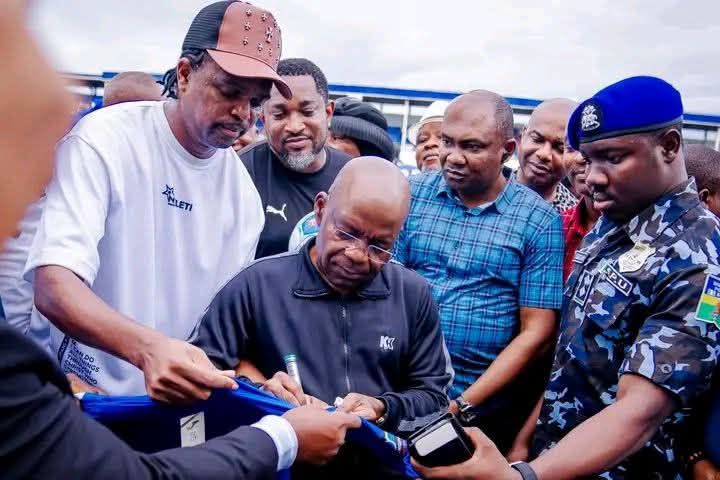
The departure of Ibrahim Gusau from the leadership of the Nigeria Football Federation (NFF) has once again triggered a familiar debate over who should take charge of Nigerian football.
Among the names generating strong public sentiment is former Super Eagles captain and African football icon Nwankwo Kanu. For many fans, the idea of a celebrated member of Nigeria’s golden football generation returning to lead the federation represents a chance to restore the glory associated with the 1994 and 1996 teams.
But beneath the nostalgia lies a more fundamental question: Does an outstanding playing career automatically qualify someone to govern Nigerian football?
The answer should be no.
Playing football at the highest level and managing a complex football institution require fundamentally different competencies. While legendary players possess invaluable experience, influence and understanding of the game, those qualities alone do not guarantee administrative, financial, technical or governance competence.
Nigeria’s repeated reliance on football pedigree as a qualification for leadership deserves closer scrutiny.
The Danger of Playing Pedigree
The experience of former Super Eagles midfielder Finidi George provides a recent illustration of the distinction between playing excellence and managerial competence.
Finidi was appointed Super Eagles head coach after an illustrious playing career and success at club level. However, his brief tenure exposed challenges in areas including tactical strategy and man-management before his departure.
The lesson should not be that former players cannot become successful coaches. Rather, it demonstrates that playing reputation cannot substitute for managerial preparation and proven coaching competence.
The same principle should apply to football administration.
Kanu’s experience as chairman of Enyimba Football Club has also generated questions about the assumption that international football fame naturally translates into administrative success.
READ ALSO; ₦12bn NFF Intervention Fund Probe Continues Despite Gusau’s Resignation – EFCC
Kanu inherited a club with a strong institutional foundation built over many years. His tenure has nevertheless been accompanied by periods of instability, domestic underperformance and administrative challenges.
Again, the argument is not that Kanu cannot become an effective administrator. It is that his credentials should be evaluated on what he has demonstrated in management—not simply on what he achieved as a player.
Football Legends Are Not Automatically Administrators
The issue extends beyond individual personalities.
Nigeria’s current football technical establishment includes several former internationals, yet the country’s football fortunes continue to be characterised by inconsistent performances and concerns over professionalism.
A recent controversy involving former Super Eagles captain Victor Ikpeba and Super Falcons captain Rasheedat Ajibade also highlighted questions about how football officials engage with players and respond to legitimate concerns about national-team preparations.
Such incidents reinforce the need for modern leadership built around professionalism, communication and institutional discipline.
There is nothing wrong with former players occupying influential positions in football.
The problem arises when legendary status becomes the primary qualification for leadership.
The World Offers a Different Model
International football provides numerous examples of successful managers and administrators whose authority was built primarily on knowledge, preparation and organisational ability rather than exceptional playing careers.
Arsène Wenger had a modest playing career in the lower divisions of French football but became one of the most influential managers in English football history. He later took on a major role in global football development at FIFA.
Arrigo Sacchi never played professional football at the highest level but went on to build one of AC Milan’s greatest teams.
His famous observation remains relevant: “I never realised that to become a jockey you needed to have been a horse first.”
Julian Nagelsmann’s playing career ended prematurely because of injury, but his analytical approach subsequently established him as one of the leading tactical thinkers of his generation, with managerial spells at RB Leipzig and Bayern Munich before taking charge of Germany.
José Mourinho also had a limited playing career in Portugal before deliberately turning his attention towards coaching, sports science, tactical analysis and psychological preparation.
READ ALSO; NFF crisis deepens as Ibrahim Gusau resigns alongside board members [VIDEO]
His career demonstrates how intellectual preparation and specialised knowledge can produce elite football leadership without an elite playing pedigree.
Running the Glass House Is a Different Job
The distinction becomes even more important when discussing the presidency of the NFF.
Modern football administration is a complex enterprise involving sports law, corporate governance, finance, sponsorship, broadcasting, infrastructure, international relations, player welfare, grassroots development and political negotiation.
The president of a national federation must be able to oversee large budgets, negotiate commercial agreements, manage relationships with FIFA and CAF, develop sustainable revenue streams and establish effective systems for national teams and grassroots football.
A decorated playing career provides visibility and credibility, but it does not automatically prepare someone to manage these responsibilities.
What Should NFF Leadership Require?
Future NFF leadership should therefore be assessed against measurable competencies, including:
Corporate and strategic leadership: A demonstrable record of organisational management, resource allocation and long-term strategic planning.
Financial management and transparency: The ability to build sustainable revenue streams, attract private-sector investment and maintain credible financial controls.
Sports law and contract management: Strong knowledge of FIFA statutes, national regulations, player welfare requirements and modern contractual frameworks.
Technical oversight: Understanding of data-driven scouting, coach development, sports science, youth academies and modern performance analysis.
Stakeholder management: The capacity to manage relationships involving clubs, players, coaches, sponsors, government agencies, supporters and international football bodies.
These should be measurable qualifications rather than assumptions based on celebrity.
Let Legends Earn Their Place
The contributions of Nigeria’s 1994 and 1996 generations cannot be overstated.
They helped establish Nigerian football as a major force on the international stage and created memories that remain central to the country’s sporting identity.
Their achievements deserve respect.
But respect for past glory should not become a substitute for competence.
A former international who has acquired formal training in sports management, demonstrated successful administration and developed the skills required to manage a modern football organisation should absolutely be considered for NFF leadership.
The same standard should apply to candidates who never played professional football.
Nigeria should choose its football administrators based on what they can deliver, not merely what they once achieved on the pitch.
The next leadership of the Glass House should be capable of reforming the federation, improving transparency, strengthening grassroots development, attracting investment and restoring confidence in Nigerian football.The conversation must therefore move beyond the question of “Which legend should lead the NFF?”
The more important question is:
“Who has the competence, integrity, experience and vision to govern Nigerian football professionally?”
Until that becomes the standard, Nigeria risks repeating the same mistakes—celebrating yesterday’s heroes while failing to build the football institution required for tomorrow.


-
 Latest6 days ago
Israel marks 3 years since October 7 Hamas attack amid Gaza strikes, election debate
-

 Energy6 days ago
Fuel Battle: Dangote, marketers and government clash over petrol imports
-

 Energy1 week ago
Petrol, diesel prices rise 86% in 2026 as costs hit fresh highs
-

 Football7 days ago
Nigeria’s World Cup exit under spotlight as FIFA’s DR Congo files emerge
-
 Energy1 week ago
Has Iran lost control of the Strait of Hormuz? Oil flows rebound as war disruptions persist
-

 Latest21 hours ago
Full List: Meet the 2026 Nobel Prize winners across six categories
-
 Latest7 days ago
US Court set to rule on release of FBI, DEA records on Tinubu
-

 Business7 days ago
Nigerian investors at a crossroads as fixed-income yields slide