
Latest
‘Subsidy restoration would return Nigeria to ‘Doom Days’–Fashola

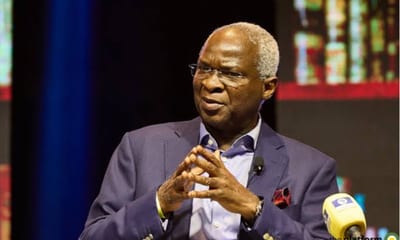
Former Minister of Works, Raji Fashola, has defended the economic policies of President Bola Tinubu, arguing that Nigerians must understand the global economic challenges contributing to the country’s current hardship before judging the administration’s performance.
Fashola said Nigeria’s economic difficulties should not be viewed in isolation, pointing to the lingering effects of the COVID-19 pandemic, the Russia-Ukraine war and the ongoing conflict in the Middle East as major factors affecting global productivity, energy supplies and food prices.
He made the remarks while responding to questions asked by Seun Okinbaloye on Channels TV, whom he urged to take a more informed and broader view of the economic situation confronting Nigeria and other countries.
According to the former Lagos State governor, the global economy is still recovering from the disruptions caused by the COVID-19 pandemic, which significantly reduced productivity across several sectors before the Russia-Ukraine war triggered additional supply challenges, particularly in gas and food commodities.
He also referenced the Middle East conflict, particularly its implications for the Strait of Hormuz, a strategic global shipping route through which a significant proportion of the world’s petroleum supply passes.
READ ALSO:Fashola denies allegation of drafting judgment for tribunal judges
Fashola suggested that the growing public awareness of the Strait of Hormuz, even among ordinary traders, underscored the extent to which international conflicts and developments in the energy market had become connected to everyday economic realities.
He argued that Nigeria’s fuel prices had already begun rising before the latest Middle East tensions, recalling that petrol sold for about N800 per litre even after the removal of the petrol subsidy.
The former minister, however, maintained that the Tinubu administration had introduced several measures intended to cushion the impact of economic reforms and improve the welfare of Nigerians.
Among the initiatives he highlighted were wage increases, the Nigerian Education Loan Fund (NELFUND), tax exemptions for low-income earners and the introduction of Compressed Natural Gas (CNG) as an alternative fuel source.
He argued that although these interventions were significant, their benefits would not materialise immediately, insisting that economic policies required time to produce measurable results.
Fashola also criticised politicians advocating a return to petrol subsidy, arguing that such proposals lacked a convincing explanation of how the government would sustainably finance the policy.
He maintained that promises to restore fuel subsidies without presenting a clear funding framework amounted to offering Nigerians a return to the economic difficulties associated with the previous subsidy regime.
“We are already going towards prosperity, and some people are talking of taking us back to doom days,” he said.
The former minister also questioned a proposal attributed to former Vice President Atiku Abubakar to provide crude oil to domestic refineries at cheaper rates as a way of reducing petrol prices.
Fashola asked where the government would obtain the supposedly cheaper crude oil, considering existing contractual and financial obligations attached to Nigeria’s crude production.
He explained that a significant portion of the country’s crude oil output was tied to legacy obligations that the Tinubu administration was attempting to manage.
He further argued that not all crude oil produced in Nigeria belonged exclusively to the Federal Government, noting that substantial volumes were controlled through joint-venture arrangements with international oil companies.
According to him, any decision to allocate crude oil at discounted rates would have to take into consideration the interests and contractual rights of joint-venture partners.
Dangote Refinery Also Faces Commercial Realities
Fashola also questioned the assumption that supplying crude oil cheaply to the Dangote Refinery would automatically translate into cheaper petrol for consumers.
He argued that the refinery’s enormous daily crude requirements made it unrealistic to assume that a limited allocation of discounted crude would be sufficient to sustain lower fuel prices.
He also pointed to the commercial considerations surrounding the refinery, particularly its relationship with shareholders, arguing that its management would have to balance domestic pricing expectations with business sustainability and market realities.
Fashola questioned whether Dangote would be expected to sell petroleum products below prevailing market prices when the refinery was operating as a commercial enterprise with obligations to its investors.
“Common, don’t let anyone fool you,” he said, urging Nigerians to scrutinise political promises about cheaper petrol and the restoration of subsidies.
His comments come amid continuing national debate over the impact of petrol subsidy removal, rising living costs, domestic refining capacity and the effectiveness of the Federal Government’s economic interventions.
While the Tinubu administration has maintained that its reforms are necessary to restore fiscal stability and encourage investment, opposition figures and critics have continued to demand policies that would deliver more immediate relief to households and businesses.
The debate over crude oil pricing, domestic refinery supply arrangements and the possibility of reducing petrol prices remains central to discussions about Nigeria’s energy security and economic recovery.


-
 Featured6 days ago
Nigeria’s youth unemployment paradox: Graduates struggle as millions survive in informal jobs
-

 Business6 days ago
Nigerian Banks earn N521.8bn from E-banking, card fees in nine months
-

 Energy6 days ago
Nigeria’s power crisis deepens as ₦639bn unpaid gas debt threatens electricity supply
-

 Latest6 days ago
Dalung claims ‘message from Buhari’s grave’ urges Nigerians to vote Atiku in 2027
-
 Featured5 days ago
Tinubu’s Renewed Hope: Reforms, hardship and the unanswered question of a second term
-

 Business1 week ago
GTCO fashion weekend: As fashion evolves, Nigerian men are rewriting the rules of style
-
 Featured4 days ago
The cost of Renewed Hope: How Nigeria’s economic reforms are reshaping everyday family life
-
 Latest6 days ago
Ondo shuts ponmo processing centre after discovery of human waste