
Business
The Solar Gold Rush: Why Nigerian businesses are betting on renewable energy

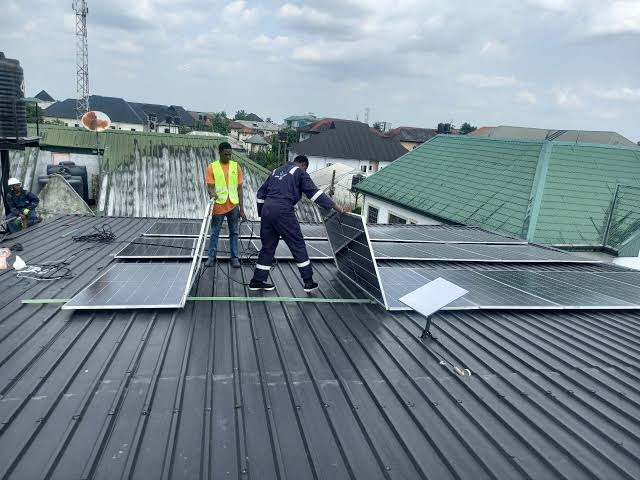
As energy costs continue to rise and squeeze profits, businesses are discovering that their greatest competitive advantage may be shining from above.
By Arthur Eriye
For decades, unreliable electricity has been one of the biggest obstacles to doing business in Nigeria. Factory managers have measured production not only by output but by how long diesel generators could run. Small businesses have watched profits disappear into fuel purchases, while banks, telecom firms, hospitals and shopping malls have spent billions of naira annually to keep the lights on.
Today, a quiet transformation is unfolding across corporate Nigeria. Rooftops of factories, office buildings, telecom towers and warehouses are increasingly covered with solar panels, gradually replacing the once-ubiquitous diesel generators.
What began as an environmental alternative has become a hard-nosed business decision.
The numbers explain why.
Although Nigeria remains Africa’s largest economy, it also has one of the world’s widest electricity access gaps. According to the World Bank, more than 85 million Nigerians lack access to electricity, while businesses connected to the national grid still grapple with unreliable power supply.
The International Energy Agency (IEA) estimates that millions of households and businesses rely on petrol and diesel generators, making self-generated electricity a significant share of Nigeria’s power consumption.
For businesses, the cost is enormous.
The Manufacturers Association of Nigeria (MAN) has repeatedly warned that energy has become one of the sector’s biggest challenges. Rising electricity tariffs, volatile diesel prices following fuel subsidy removal and exchange-rate pressures have sharply increased production costs across industries ranging from food processing and cement to textiles and pharmaceuticals. For many companies, energy is now one of the largest operating expenses after raw materials and labour.
READ ALSO: Electricity banding in Nigeria: Institutionalizing poverty and economic segregation
This reality is driving what industry experts describe as Nigeria’s “solar gold rush.” Businesses are investing in solar photovoltaic systems, battery storage and hybrid solutions that combine solar power with the national grid.
The business case is straightforward. Although installation requires substantial upfront investment, solar systems dramatically reduce fuel and maintenance costs. Depending on energy demand, many commercial installations recover their costs within a few years before delivering long-term savings that strengthen competitiveness.
The transition is already evident across several sectors.
Telecommunications companies are expanding solar-powered base stations, particularly in remote areas where diesel supply is costly and unreliable. Banks are installing solar systems across branches to reduce operating expenses while supporting sustainability goals. Manufacturers increasingly view renewable energy as a hedge against volatile energy prices, while bakeries, supermarkets, pharmacies, schools and hotels are adopting smaller solar systems to protect shrinking profit margins.
That shift has been consistently encouraged by the Director-General of the Manufacturers Association of Nigeria (MAN), Segun Ajayi-Kadir, who has argued that reducing energy costs is essential to improving the competitiveness of Nigerian manufacturers. He has repeatedly urged policymakers to create an enabling environment for investments in alternative energy sources that lower production costs and boost industrial productivity.
The shift is also creating opportunities beyond power generation. Renewable energy is driving growth in engineering, installation, battery technology, maintenance, project financing and technical training. Young engineers are building careers in solar installation, while entrepreneurs are establishing renewable energy firms serving residential, commercial and industrial customers.
For investors, the sector represents one of Nigeria’s fastest-growing opportunities. The International Renewable Energy Agency (IRENA) estimates that meeting global clean energy targets could create millions of jobs by 2030. With abundant sunshine, a growing population and a massive electricity deficit, Nigeria is well positioned to benefit if supportive policies continue.
“The economics have changed fundamentally,” says Ayodele Oni, an energy lawyer and partner at Bloomfield LP. “Renewable energy is no longer driven only by climate concerns. Businesses are adopting it because it makes financial sense. Stable and predictable energy costs improve competitiveness.”
Challenges remain.
READ ALSO: Nigeria’s power subsidy jumps to N1.94tn; Governors reject electricity act amendment
The biggest hurdle is financing. Commercial solar systems require significant upfront capital, while high interest rates and exchange-rate volatility continue to raise the cost of imported panels, batteries and inverters. Industry stakeholders believe expanding local manufacturing could lower costs while creating thousands of jobs.
Government policy is gradually moving in that direction. Nigeria’s Energy Transition Plan targets net-zero emissions by 2060 while expanding electricity access through cleaner energy. Achieving that ambition will require hundreds of billions of dollars in investment over the coming decades.
Development finance institutions are also increasing support. The World Bank, African Development Bank and other partners are funding programmes that expand electricity access through solar mini-grids and standalone solar systems.
One notable example is the Nigeria Electrification Project, which has helped solar mini-grid developers bring reliable electricity to underserved communities while stimulating local economic activity.
The impact is already visible. Manufacturing companies in Lagos report significant reductions in diesel consumption after integrating rooftop solar. Across northern Nigeria, solar-powered mini-grids are enabling agro-processing businesses to preserve produce, mill grains and refrigerate food that previously depended on expensive generators. Telecom operators are also reporting operational savings from replacing diesel-powered sites with solar-battery hybrid systems in rural communities.
Economists say the benefits extend beyond individual companies. Lower energy costs improve productivity, strengthen industrial competitiveness, reduce inflationary pressures and encourage fresh investment.
Economist Bismarck Rewane, Managing Director of Financial Derivatives Company, has consistently maintained that affordable and reliable energy is fundamental to economic growth. According to him, when businesses spend less on self-generated electricity, they are better positioned to channel resources into expansion, employment and innovation.
Reduced dependence on diesel also lowers greenhouse gas emissions, improves air quality and cuts noise pollution. Yet for most businesses, the strongest motivation is commercial rather than environmental.
Every litre of diesel saved improves cash flow. Every reduction in energy costs strengthens competitiveness.
Renewable energy has moved beyond corporate social responsibility to become a core business strategy discussed alongside profitability, investment returns and resilience.
For a country long constrained by electricity shortages, that may prove the most important shift of all.
Nigeria’s next economic transformation may not come from another oil well or gas pipeline. It may begin on factory rooftops and industrial estates, where solar panels are becoming as essential as the machines they power.
For Nigerian businesses, the renewable energy revolution is no longer a distant ambition. It is a commercial necessity—and increasingly one of the smartest investments of the decade.


-
 Business1 week ago
Dangote Refinery IPO: 70% Subscription claim meets fourfold demand assertion as investors seek clarity
-

 Featured4 days ago
Inside INEC’s race to prepare for Nigeria’s 2027 elections
-

 Featured4 days ago
2027: APC unveils nationwide campaign timetable, Tinubu to rally in 12 states
-

 Latest7 days ago
UCTH faces morgue crisis as 50 unclaimed corpses await mass burial
-

 Business7 days ago
BREAKING: Nigeria’s Inflation Rate Drops to 14.63% in September
-

 Aviation1 week ago
Germany opens online application route for student, EU Blue Card and other long-stay visas
-

 Business6 days ago
President Tinubu and the Low Transport Fares Fiasco
-
 Business4 days ago
Court dismisses ₦170m Trade Fair contract claim, says Zenith Bank was not a party