
News
Venezuela: Guaido is being squeezed harder

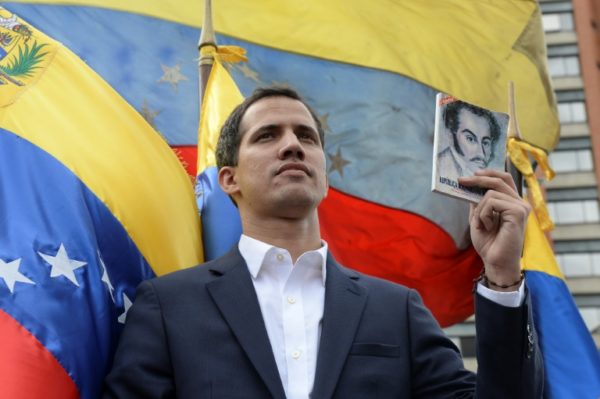
Venezuela’s Supreme Court called Monday for Juan Guaido to be stripped of his legislative immunity.
Earlier, the nation’s authorities announced a ban on him holding public office.
Recognized as Venezuela’s interim president by some 50 countries, Guaido is enmeshed in a power struggle with President Nicolas Maduro.
Neighbouring states as well as superpowers such as the US and Russia ar now taking sides.
As the political battle plays out, the country has been hit by a series of devastating blackouts that have left millions without water, prompting the government to replace the country’s energy minister and institute power rationing in a bid to address the outages.
The decision by the Supreme Court — which is controlled by Maduro loyalists — to call on the ruling Constituent Assembly legislature to strip Guaido of his immunity could open the way for the opposition chief to be prosecuted.
The court ruling cited Guaido’s violation of a ban on his travel outside Venezuela when he visited Argentina, Brazil, Colombia, Ecuador and Paraguay from late February to early March.
The move came after Venezuela’s auditor general’s office announced Thursday that it had stripped Guaido of the right to hold public office for 15 years, a decision he rejected as invalid.
Three major blackouts hit Venezuela in March, worsening already dire living and economic conditions in the country, and prompting authorities to take steps aimed at curbing the outages.
Maduro — whose government has blamed “terrorists” for alleged attacks that have damaged the country’s main hydroelectric power plant — announced that he was Igor Gavidia Leon to replace retired general Luis Motta Dominguez as energy minister.
The new minister “is an electrical industry worker with 25 years of experience, an engineer who had many responsibilities,” Maduro said.
On Sunday, Maduro announced 30 days of electricity rationing, after his government said it was shortening the workday and keeping schools closed due to blackouts.
The measures are a stark admission by the government that there is not enough electricity to go around, and that the power crisis is here to stay.
With no electricity, pumping stations can’t work, so water service is limited.
Street lights and traffic lights go dark, pumps at fuel stations stand idle, and cell phone and internet service is non-existent.
But people try to find water wherever they can: from springs, leaky pipes, gutters, government-provided tankers and the little that flows through the Guiare River in Caracas.
“We fill up from a well near here but we don’t know if its drinkable. But we’re using it,” said Erimar Vale, who lives in the capital.


-

 Latest1 week ago
Full List: Meet the 2026 Nobel Prize winners across six categories
-

 Football1 week ago
Premier League Matchweek 7: Five Fixtures That Could Shape the Weekend
-
 Business6 days ago
Dangote Refinery IPO: 70% Subscription claim meets fourfold demand assertion as investors seek clarity
-
 Latest1 week ago
Umahi defends Lagos-Calabar highway route changes amid public outcry
-
Business7 days ago
Dangote Refinery IPO Extension: Was the 70% subscription report overhyped?
-
 Featured3 days ago
Inside INEC’s race to prepare for Nigeria’s 2027 elections
-

 Latest5 days ago
UCTH faces morgue crisis as 50 unclaimed corpses await mass burial
-
 Business5 days ago
BREAKING: Nigeria’s Inflation Rate Drops to 14.63% in September