
Business
₦300,000 Minimum Wage: How much does a Nigerian family really need to survive?

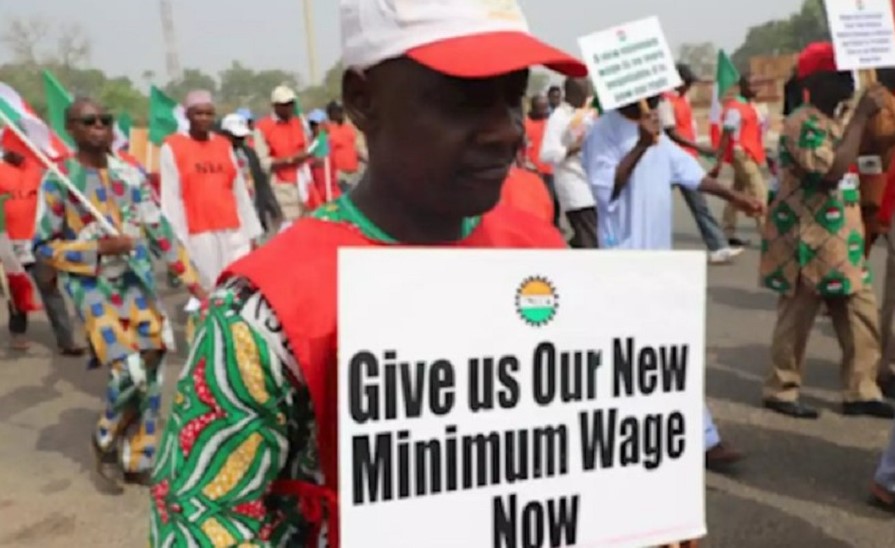
Nigeria’s debate over wages is increasingly becoming a debate about survival.
As the cost of food, transportation, housing, electricity and other basic necessities continues to put pressure on household budgets, the question facing policymakers and employers is no longer simply how much workers should earn, but how much income is required for an ordinary family to maintain a basic standard of living.
The proposed ₦300,000 monthly minimum wage has therefore become part of a wider conversation about what constitutes a realistic income for Nigerian workers.
Nigeria’s current statutory national minimum wage is ₦70,000 per month, following the 2024 agreement between the Federal Government and organised labour. The law provides for a review of the wage every three years.
But for many households, the gap between the statutory wage and the actual cost of meeting basic needs remains a major concern.
The demand for a higher wage is rooted largely in the loss of purchasing power experienced by workers.
During the 2024 minimum-wage negotiations, organised labour initially demanded ₦494,000 before eventually agreeing to the ₦70,000 minimum wage. The negotiations took place amid a sharp increase in the cost of food, transport and other essentials.
The current debate reflects the same underlying problem: nominal salaries may increase, but their value falls when prices rise faster than incomes.
A worker earning ₦300,000, for example, would still have to pay for food, accommodation, transportation, electricity, water, communication, healthcare, education and other household expenses.
For a family with children, the financial pressure can be considerably greater.
There is no single figure that can accurately represent the monthly needs of every Nigerian family.
A household in Lagos paying rent in a high-cost neighbourhood faces very different expenses from a family living in a smaller city or rural community.
Housing is one of the biggest variables. A household that owns its home or shares accommodation may spend considerably less each month than a family paying rent in a major urban centre.
Food is another major expense.
Nigeria has experienced significant increases in food prices in recent years. Research tracking the cost of preparing common meals has illustrated how rapidly food expenses have risen, with the cost of ingredients taking up a substantial share of household income.
This means that even before transportation, rent, school expenses, electricity and healthcare are considered, a significant portion of a worker’s monthly income can already be committed to feeding the household.
Consider a family of four in a major Nigerian city.
A hypothetical monthly budget might include:
- Food: ₦120,000–₦160,000
- Transportation: ₦30,000–₦50,000
- Electricity, water and cooking energy: ₦20,000–₦35,000
- Communication: ₦10,000–₦20,000
- Healthcare and medicines: ₦10,000–₦20,000
- Education and children’s expenses: ₦20,000–₦50,000
- Rent provision: highly variable and potentially much higher depending on location
Even before unexpected expenses, such a household can quickly approach or exceed ₦300,000 in monthly expenditure.
These figures should not be interpreted as an official national household budget. They are illustrative, because the actual cost of living differs substantially between households and locations.
Increasing wages can improve workers’ purchasing power, but wage policy cannot by itself resolve every problem associated with the cost of living.
If salaries rise without corresponding improvements in productivity and supply, businesses may pass higher labour costs to consumers through increased prices.
Government policies affecting food production, transportation, electricity, housing and taxation can therefore have an important influence on whether higher wages translate into genuine improvements in living standards.
For workers, however, the central concern is straightforward: a salary has little meaning if it cannot cover basic necessities.
The terms minimum wage and living wage are often used interchangeably, but they are not necessarily the same.
A minimum wage is a legally established wage floor below which covered workers generally should not be paid.
A living wage, by contrast, is intended to reflect the income required for a worker and, depending on the methodology, a household to meet basic living expenses.
This distinction is important in Nigeria’s current debate.
The ₦300,000 figure should therefore not automatically be presented as the exact amount every Nigerian family needs. Household size, location, rent, number of earners and access to services can dramatically change the calculation.
For a single worker with no dependants and relatively low housing costs, ₦300,000 could provide considerably more financial flexibility than it would for a household supporting several people.
For a family with children, particularly one paying rent and school fees in an expensive city, ₦300,000 could still be stretched very thin.
This is why the debate over the proposed wage is ultimately bigger than the figure itself.
It raises questions about what policymakers consider a decent standard of living, how wages should be adjusted when prices rise, and whether Nigerian workers should be able to meet basic needs without relying heavily on additional income, informal work or financial assistance from relatives.
Nigeria’s minimum-wage debate is unlikely to end with an agreement on one number.
The more fundamental question is whether wages can keep pace with the cost of essential goods and services.
For workers, the objective is purchasing power. For employers, the challenge is affordability and sustainability. For government, the task is balancing workers’ welfare with inflation, employment and economic growth.
As the ₦300,000 proposal enters the national conversation, one issue deserves particular attention: what does it actually cost to live decently in Nigeria today?
Until that question is answered with reliable household expenditure data covering different family sizes and regions, any single figure will remain an approximation.
But the growing demand for higher wages sends a clear message: for millions of Nigerian households, the issue is no longer simply earning more. It is whether monthly income is enough to afford the basics of everyday life.


-

 Featured1 week ago
Inside INEC’s race to prepare for Nigeria’s 2027 elections
-

 Featured1 week ago
2027: APC unveils nationwide campaign timetable, Tinubu to rally in 12 states
-
 Business5 days ago
Naira faces exchange rate gap as Dollar hits N1,380 on parallel market
-
 Business1 week ago
Court dismisses ₦170m Trade Fair contract claim, says Zenith Bank was not a party
-

 Latest1 week ago
Breaking: NNPCL raises petrol price to ₦1,405 per litre amid discount controversy
-

 Football2 days ago
Man United shortlist Emery, Nagelsmann as potential replacements for Carrick
-

 Featured1 week ago
From kitchen to Supreme Court: Nigerian’s fight over alleged support for terrorists
-

 Business7 days ago
NCC launches Internet Governance Working Group to tackle AI risks, boost online safety