
Latest
ADC’s 2027 Strategy: Who are the key players and what are their roles?

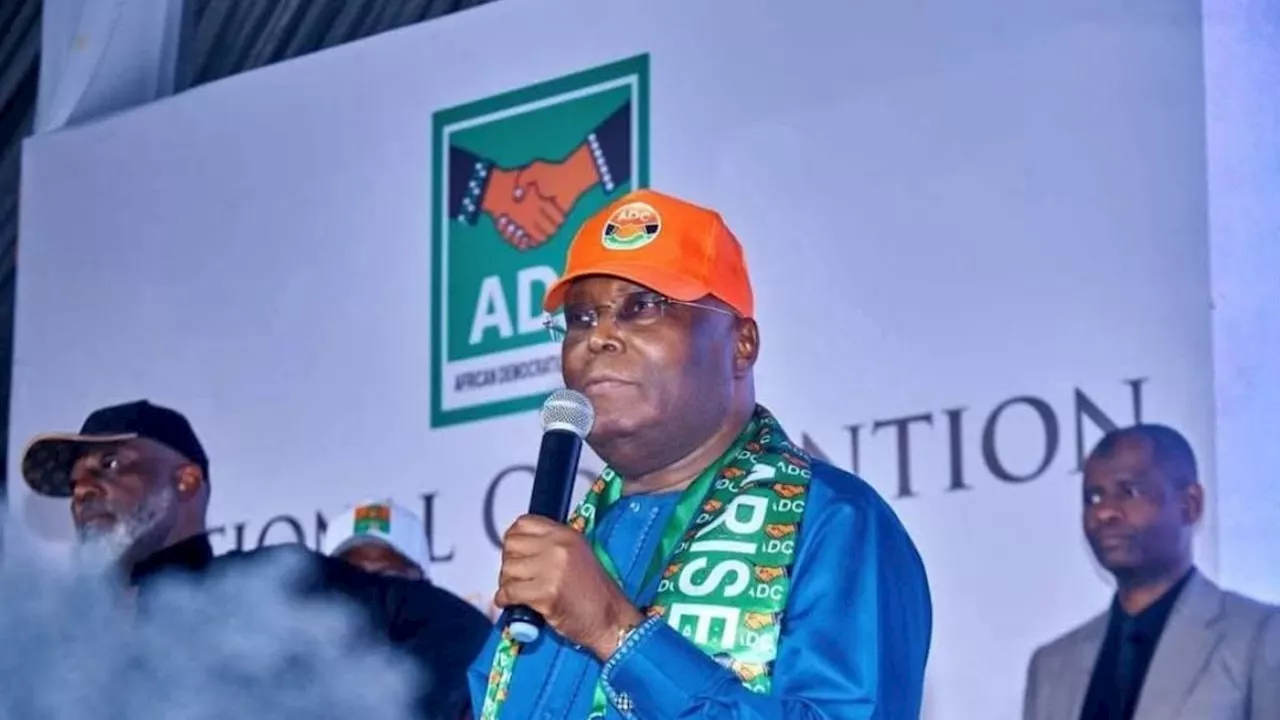
The African Democratic Congress (ADC) has moved into a more structured phase of its 2027 presidential campaign, assembling a leadership team around former Vice-President Atiku Abubakar while expanding its organisation across the states.
The party’s presidential ticket is now settled, with Atiku as the presidential candidate and former Rivers State governor and ex-Minister of Transportation Rotimi Amaechi as his running mate. The Independent National Electoral Commission (INEC) included both men on its final list of presidential and vice-presidential candidates for the January 16, 2027 election.
At the organisational level, former Senate President David Mark remains the party’s national chairman, while former Osun State governor Rauf Aregbesola is national secretary. INEC restored their recognition in May, and a Federal High Court subsequently upheld the David Mark-led leadership of the party.
The current structure gives the ADC a clearer division between party administration, presidential campaigning, policy development and political mobilisation.
Atiku, a former vice-president who has contested the presidency several times, emerged as the ADC’s presidential candidate after its May 2026 primary.
The party said he secured 1,846,370 votes, ahead of Amaechi with 504,117 and businessman Mohammed Hayatu-Deen with 177,120. Amaechi and Hayatu-Deen subsequently raised objections to the primary process, alleging irregularities.
Atiku’s campaign is increasingly centred on the economy and cost of living. He has called for a higher minimum wage and said he would review the wage from his first day in office.
He has also maintained his support for restoring a targeted petrol subsidy. In August, he said his position had not changed and proposed reducing energy and transportation costs while supporting local production and improving purchasing power.
The proposal has become a point of political disagreement. The APC Presidential Campaign Council has asked Atiku to provide details of the legal, fiscal and operational framework for such a subsidy under the existing petroleum-sector regime.
Atiku has also presented electoral reform and opposition cooperation as part of his broader political agenda. However, as of September 2026, the wider opposition is no longer operating under one presidential ticket.
Amaechi occupies the second position on the ADC presidential ticket.
The former Rivers governor and former transportation minister was Atiku’s principal challenger in the ADC primary before ultimately accepting the vice-presidential nomination. The party said his selection followed consultations with party leaders, coalition partners, youth and women stakeholders and representatives from the geopolitical zones.
The choice also keeps a prominent Southern political figure at the centre of the ADC campaign.
Amaechi brings experience at both state and federal levels. He served as governor of Rivers State and later as minister of transportation. His role in the 2027 campaign places him alongside Atiku in efforts to build the party’s national organisation.
One of the most significant recent appointments is former Kaduna State governor Nasir El-Rufai as deputy chairman of Atiku’s National Campaign Council.
El-Rufai previously served as Minister of the Federal Capital Territory and governor of Kaduna State. His assignment in the campaign is focused on high-level political coordination and engagement with stakeholders across the country.
His political position has also included a strong emphasis on restructuring Nigeria’s federal system.
In a December 2025 essay on Nigeria’s Fourth Republic, El-Rufai argued for restructuring towards what he described as true federalism. Among his proposals were state, local-government and community policing, greater state control of onshore minerals, stronger electoral institutions and reforms to the process of collating and transmitting election results.
Those views broadly overlap with the ADC’s stated emphasis on restructuring and institutional reform.
David Mark, a former Senate president, heads the ADC as national chairman.
He has been associated with the coalition since its adoption of the ADC as its political platform in 2025. Mark has framed the party’s mission around strengthening democratic institutions, addressing insecurity and economic hardship, and providing an alternative to the APC-led government.
His present role is less about the day-to-day presidential campaign than maintaining the party structure.
That includes managing internal disputes. In September, Mark inaugurated a National Reconciliation and Peace Committee to address grievances arising from the party’s primaries and rebuild confidence among members and unsuccessful aspirants.
The need for such a committee reflects some of the organisational difficulties the party has faced as it has expanded.
Aregbesola, the former governor of Osun State and former federal minister, serves as ADC national secretary.
His movement into the ADC is politically significant because he was previously a prominent figure in the APC establishment. He has become one of the party’s most outspoken critics of the Tinubu administration.
At the party’s April convention, Aregbesola criticised the Federal Government’s Renewed Hope Agenda, arguing that the administration had failed to deliver on its promises.
He has also appeared alongside Mark in the party’s state-level political activities, including campaigns and organisational engagements.
Senator Austin Akobundu, who represents Abia Central and is a retired Army colonel and former Minister of State for Defence, was appointed director-general and campaign manager of Atiku’s presidential campaign.
His role is to coordinate the various arms of the campaign and manage its day-to-day activities. The campaign has been divided into six major operational directorates, supported by 30 directors with specific assignments.
The structure is intended to give the campaign a clearer chain of responsibility as it moves from coalition politics to nationwide electioneering.
Kashim Ibrahim-Imam was appointed chairman of Atiku’s National Campaign Council.
He is a longtime political organiser and has contested for governor of Borno State. His role is principally strategic and supervisory, providing political direction to the larger campaign council.
His appointment puts an experienced Northern political figure alongside Atiku and El-Rufai in the senior campaign structure.
Veteran journalist and publisher Dele Momodu has been assigned responsibility for media and communications within the presidential campaign.
The campaign said he would coordinate operations across traditional, broadcast and digital media. His appointment adds a communications specialist to a campaign that is attempting to develop a nationwide message around the economy, governance and the cost of living.
Momodu has also publicly defended the inclusion of El-Rufai in the campaign council, particularly amid questions surrounding the former governor’s circumstances.
Mohammed Hayatu-Deen, an economist, banker and former presidential aspirant, heads the ADC campaign’s policy team.
He was one of the three candidates in the party’s presidential primary and has now joined the campaign structure after Atiku’s emergence as candidate.
The policy team also includes Professor Mohammed Sagagi and Aare Aremijoye, while former Central Bank deputy governor Kingsley Moghalu was named among its contributors. The campaign says the team is responsible for developing policy proposals addressing Nigeria’s economic and governance challenges.
The arrangement gives the campaign a formal mechanism for converting its political message into policy proposals rather than relying only on campaign speeches.
Former Edo State governor and former APC national chairman John Oyegun chairs the Campaign Advisory Council.
His presence is another indication of the range of political backgrounds represented within the ADC. Oyegun was one of the senior figures involved in the formation and growth of the APC before moving into the opposition camp.
Former Senator Ben Obi and Lawal Batagarawa serve as deputy chairmen of the advisory council, with former Ondo PDP governorship candidate Eyitayo Jegede, SAN, as secretary.
Former senator Dino Melaye has been assigned a role connected to political contact and mobilisation.
The campaign says his responsibilities will contribute to national outreach and public engagement. Melaye is a high-profile political communicator with previous experience in the Senate and in state-level politics.
His presence places a politically vocal figure within the campaign’s mobilisation machinery.
Bolaji Abdullahi, a former minister and former newspaper editor, is the ADC’s national publicity secretary and one of the most visible spokespersons for the party.
Abdullahi has repeatedly outlined the ADC’s broader political and economic positions, including its emphasis on economic recovery, restructuring, security and institutional reform.
He has also said the party’s focus has shifted from trying to create a single opposition presidential ticket to identifying areas where opposition parties can cooperate, following the departures of Peter Obi and Rabiu Kwankwaso from the ADC arrangement.
The party is presenting its 2027 campaign around several broad themes: economic recovery, institutional reform, restructuring, security, employment and improved purchasing power.
In September, Abdullahi said the ADC manifesto placed economic recovery, restructuring, security and institutional reforms among its priorities. He said the framework was intended to address insecurity, rising living costs, limited economic opportunities and what the party described as weaknesses in adherence to the rule of law.
Security is another major element of the party’s message. The ADC has repeatedly criticised the government’s handling of insecurity and has called for stronger institutional responses.
The party has also taken positions on electoral administration. In September, it urged INEC to establish clearer criteria preventing openly partisan academics and others from serving as returning or collation officers, arguing that electoral officials must be demonstrably neutral.
The ADC has attempted to convert its national coalition into a broader electoral organisation.
In September, it announced governorship and deputy-governorship candidates in 28 states for the 2027 elections.
The party has also continued to receive politicians from other parties. In September, former Ondo State PDP governorship candidate Eyitayo Jegede and his supporters joined the ADC during a visit by Atiku and National Secretary Rauf Aregbesola to Akure.
In the Northwest, the party’s seven governorship candidates signed a regional development compact focusing on insecurity, food security, education, healthcare, employment and economic integration. The document also backed Atiku’s position on reversing the removal of the petrol subsidy and proposed a ₦110,000 minimum wage for workers in the region.
These activities suggest that the ADC’s strategy is no longer limited to the presidential race; it is attempting to establish candidates and organisational structures across the country.
The ADC initially attracted several prominent opposition figures, including Atiku, Peter Obi, Rabiu Kwankwaso, El-Rufai, Amaechi, David Mark and Aregbesola.
But the arrangement subsequently fractured.
Obi and Kwankwaso left the ADC framework and now operate under the Nigeria Democratic Congress, with Obi as presidential candidate and Kwankwaso as running mate. INEC’s September final list confirms the NDC ticket alongside the ADC’s Atiku-Amaechi ticket.
That leaves the ADC with its own presidential campaign rather than the single-ticket opposition arrangement initially discussed.
In August, ADC spokesman Bolaji Abdullahi said the party believed Atiku could contest without a coalition, although he also said discussions among opposition parties were continuing around areas of cooperation.
The ADC’s expansion has also brought internal challenges.
Premium Times has reported disputes over candidate substitutions and power-sharing arrangements in states such as Jigawa.
The party responded by establishing a reconciliation and peace committee, headed by former senator Tunde Ogbeha, to engage aggrieved aspirants and stakeholders.
For the ADC, this makes internal organisation an important part of its 2027 strategy. A national campaign structure must ultimately operate alongside state and local party organisations, candidates and grassroots networks.
As of September 29, 2026, the ADC has a settled presidential ticket, a recognised national leadership, a formal presidential campaign council and candidates across a large number of states.
Its political message is focused primarily on the economy, cost of living, security, institutional reform and restructuring. Atiku has separately emphasised targeted petrol subsidies and higher wages, while El-Rufai has publicly advocated deeper federal restructuring, state and local policing and electoral reforms.
The party is also trying to combine politicians from different generations, regions and political backgrounds. The campaign council includes former and serving lawmakers, former governors and ministers, technocrats, political organisers and media professionals.
With INEC having scheduled the presidential election for January 16, 2027, the ADC now faces the practical phase of translating those people, structures and policy positions into a nationwide campaign.
The central story of the ADC’s 2027 strategy is therefore no longer simply the formation of an opposition coalition. It is the development of a functioning political organisation around an Atiku-Amaechi ticket, while the party continues to seek wider support and cooperation in an opposition field that now contains multiple presidential campaigns.


-

 Latest1 week ago
Full List: Meet the 2026 Nobel Prize winners across six categories
-
 Football1 week ago
Premier League Matchweek 7: Five Fixtures That Could Shape the Weekend
-

 Business6 days ago
Dangote Refinery IPO: 70% Subscription claim meets fourfold demand assertion as investors seek clarity
-
 Latest7 days ago
Umahi defends Lagos-Calabar highway route changes amid public outcry
-
Business6 days ago
Dangote Refinery IPO Extension: Was the 70% subscription report overhyped?
-

 Latest5 days ago
UCTH faces morgue crisis as 50 unclaimed corpses await mass burial
-
 Featured2 days ago
Inside INEC’s race to prepare for Nigeria’s 2027 elections
-
 Business4 days ago
BREAKING: Nigeria’s Inflation Rate Drops to 14.63% in September