
Featured
After Igbokoda: Families await answers as air crash investigation begins

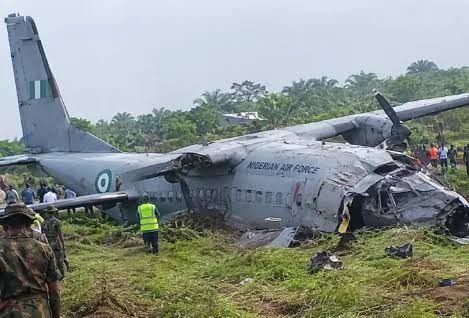
The October 5 Nigerian Air Force aircraft crash in Ondo State killed 25 people, leaving families grieving and some still waiting for the recovery of their loved ones’ remains as authorities investigate the tragedy.
For Joy and Sunday Micheal, the journey to Lagos was supposed to mark an important step towards their future together. Instead, it became their final journey.
The couple were among the 25 people killed when a Nigerian Air Force (NAF) ATR-42 aircraft crashed into a swamp near the Nigerian Navy’s Forward Operating Base in Igbokoda, headquarters of Ilaje Local Government Area of Ondo State, on October 5.
Days after the crash, their relatives were struggling to come to terms with the loss while hoping that the remains of their loved ones would be recovered so they could be laid to rest.
Sunday’s sister, Damilola, told Saturday PUNCH that the family was still mourning the couple. The wedding plans that had prompted their journey had given way to a painful wait for the recovery of their remains.
Their story captures the personal cost of a disaster that claimed the lives of military personnel and passengers, leaving families to confront sudden bereavement and uncertainty over the circumstances of their loved ones’ deaths.
The aircraft was on a routine mission from Benin City, Edo State, to Lagos when it went down near Igbokoda. Although initial official accounts gave differing figures for the number of people aboard, the Nigerian Air Force subsequently confirmed that 25 people — five crew members and 20 passengers — were on the aircraft. No survivors were found. <Cite refs={[“turn647021search6″,”turn647021search7”]}/>
The recovery operation has been complicated by the swampy terrain, where parts of the aircraft and human remains were found while the main wreckage remained submerged.
During a visit to the crash site on October 7, Ondo State Governor Lucky Aiyedatiwa said search teams had recovered human remains, clothing and aircraft fragments, but had yet to locate the aircraft’s main body. Local divers, security personnel and emergency responders continued efforts to reach the submerged wreckage.
For families waiting to bury their loved ones, the challenge has extended beyond receiving confirmation of their deaths. The recovery and identification of remains are also important steps towards mourning, conducting burial rites and finding some measure of closure.
The tragedy has also drawn attention to the lives cut short. Among the victims was Squadron Leader Ahamefule Aham Man-Ugwueje, the aircraft’s co-pilot, whose wedding had taken place only weeks before the crash. His death highlighted the personal losses behind the military’s casualty figures.
As families await answers, the Nigerian Air Force has begun efforts to recover the aircraft’s flight data recorder and cockpit voice recorder — commonly referred to as the black box and cockpit recorder.
The devices could provide crucial information about the aircraft’s final moments, including flight data and cockpit communications, helping investigators reconstruct what happened before the crash.
In a report published on October 9, Premium Times quoted Air Vice Marshal Ebimobo Ebiowe, the NAF Superintendent of Standards and Evaluation, as saying efforts were under way to recover the recorders. Their findings could help establish the circumstances that led to the aircraft’s descent into the swamp.
The Defence Headquarters has also ordered an investigation in line with President Bola Tinubu’s directive. The Nigerian Safety Investigation Bureau (NSIB) said the investigation fell within the Air Force’s responsibility but offered technical assistance, including support with flight-recorder recovery and analysis.
The cause of the crash has not been conclusively established. Until investigators analyse the available evidence, explanations based on suspected mechanical failure, maintenance problems or other possible factors remain unverified.
That distinction matters. Determining the cause will require evidence from the wreckage, recorded flight information, maintenance records and other relevant operational data rather than speculation about what might have gone wrong.
The tragedy has now prompted a wider examination of military aviation safety and the resources available to keep aircraft operational.
On October 13, the Senate called for a comprehensive audit of Nigerian Air Force aircraft and their maintenance funding, following a motion sponsored by Senator Osita Ngwu, representing Enugu West.
According to Punch, the lawmakers directed relevant committees to examine the serviceability and airworthiness of aircraft in the presidential and military fleets and scrutinise the budgetary provisions for maintenance.
The Senate also urged the Air Force and the NSIB to conduct a thorough, transparent investigation into the immediate and underlying causes of the Igbokoda crash and make their findings public.
Senator Adams Oshiomhole called for the Air Force to submit its aircraft maintenance budget provisions to the relevant Senate committee. The inquiry is expected to examine whether the funds allocated for maintenance are sufficient and whether any shortcomings contributed to the accident.
The lawmakers further urged the Federal Government to prioritise regular maintenance and the replacement of ageing military aircraft.
The proposed audit is significant because an investigation into a single crash cannot, on its own, establish whether wider weaknesses exist across the military fleet. Examining aircraft condition, maintenance procedures, operational readiness and funding could help identify risks that require attention beyond the Igbokoda incident.
However, the Senate’s concerns should not be taken as proof that inadequate maintenance or insufficient funding caused the crash. That question remains for investigators to establish.
President Tinubu declared three days of national mourning for the victims and ordered flags to be flown at half-mast across the country. He also directed the Air Force to investigate the accident and identify measures to prevent a recurrence.
The government’s response has offered an official expression of grief, but for affected families, the more difficult questions remain: What caused the aircraft to crash? Could the tragedy have been prevented? When will the remaining wreckage and human remains be recovered? And what steps will be taken to ensure that a similar disaster does not happen again?
These questions require answers grounded in evidence, not assurances alone.
A credible investigation should establish the sequence of events leading to the crash, assess the aircraft’s technical condition and maintenance history, and determine whether operational procedures or other factors played a role. Its findings should be communicated clearly, while respecting the privacy and dignity of the victims’ families.
The Senate’s proposed audit could complement that process by identifying systemic safety concerns and recommending corrective measures. But an audit will only make a difference if its findings lead to concrete action, adequate resources and effective oversight.
For the families, accountability is not an abstract debate about aircraft maintenance or military budgets. It is about understanding how their loved ones died, recovering their remains and knowing whether lessons from the tragedy will be acted upon.
The Igbokoda crash has taken 25 lives and left families confronting a loss they did not anticipate. As investigators search for evidence and lawmakers push for a broader review of military aviation, the measure of the response will ultimately lie in the answers delivered, the dignity afforded to the bereaved and the safeguards put in place to prevent another tragedy.
Until those answers emerge, the families of Igbokoda remain caught between grief and uncertainty — waiting not only to lay their loved ones to rest, but also to understand what happened on October 5.


-
 Latest6 days ago
Israel marks 3 years since October 7 Hamas attack amid Gaza strikes, election debate
-

 Energy6 days ago
Fuel Battle: Dangote, marketers and government clash over petrol imports
-

 Energy1 week ago
Petrol, diesel prices rise 86% in 2026 as costs hit fresh highs
-

 Football1 week ago
Nigeria’s World Cup exit under spotlight as FIFA’s DR Congo files emerge
-

 Energy1 week ago
Has Iran lost control of the Strait of Hormuz? Oil flows rebound as war disruptions persist
-

 Latest1 day ago
Full List: Meet the 2026 Nobel Prize winners across six categories
-

 Latest1 week ago
US Court set to rule on release of FBI, DEA records on Tinubu
-

 Business1 week ago
Nigerian investors at a crossroads as fixed-income yields slide