
Features
CBN mulls fresh capital base for Nigeria’s banks


Emefiele who unveiled his monetary policies for the next five years, specifically targeted price, exchange and inflation rates stability, to buoy economic activities through enhanced lending. He specifically said recapitalisation would also boost the ranking of Nigerian banks in the global financial market.
He said: “In the next five years, we intend to pursue a programme of recapitalising the banking industry so as to position Nigerian banks among the top 500 in the world. Banks will therefore be required to maintain higher level of capital, as well as liquid assets in order to reduce the impact of an economic crisis on the financial system.”
However, financial services operators were quick to deny the possibility of distress in the sector, saying that banks assets base and international ratings indicate that the sector is still stable and viable.
The CBN governor, who was reappointed for a second term of five years, who based his argument for recapitalisation on current economic realities occasioned by high inflation and exchange rates, recalled that it was Governor Chukwuma Soludo in 2004, who did the last recapitalisation moving the capital base from N2 billion to N25 billion.
ALSO READ:CBN provides loans to NYSC members for entrepreneurship
He continued: “I must commend those efforts because they resulted in positioning Nigerian banks not only in Africa but also being among the top banks in the world in terms of capitalisation and also helped to increase and strengthen the banks’ capacity to take on large ticket transactions and those are some of the things we badly need today. If you relate it N25 billion in 2004, exchange rate which was about N100/$, N25 billion is almost about $200 million today if you relate N25 billion at N360; you can see that it is substantially lower than $75 million. So, what we are trying to say is that the capitalisation has weakened quite substantially. There is a need for us to say that it is time to recapitalise Nigerian banks again. It is a policy thrust, which will be discussed at the Committee of Governors meeting, and of course, the framework for recapitalisation of Nigerian banks will be unfolded for the whole world to know.”
Also, as part of the new vision, he said the CBN under his leadership intends to sustain “the pace of consultations with major stakeholders, particularly, with the organised private sector as this would act as a barometer for measuring the progress being made in the implementation of their policies, adding that their assessment of the outcome of the deliberations so far in the past indicated that with concerted efforts, the challenges facing the country are easily surmountable.”
On the collaboration with the public sector, he said: “Working closely with our fiscal authorities, we pledge to target a double digit growth by the next five years and at the CBN, we commit to working assiduously to bringing down inflation to single digit; while accelerating the rate of employment.”
He continued: “We would also strive to continue to sustain a positive interest rate regime to the delight of our important stakeholders. Monetary policy measures embarked upon by the CBN will be geared towards containing inflationary pressures and supporting improved productivity in the agricultural and manufacturing sectors. Working with other stakeholders, we intend to bring down the cost of food items, which have considerable weight in the Consumer Price Index basket. Our ultimate objective is to anchor the public’s inflation expectation at single digits in the medium to long run. We believe a low and stable inflationary environment is essential to the growth of our economy because it will help support long- term planning by individuals and businesses.
It will also help to lower interest rates charged by banks to businesses thereby facilitating improved access to credit, and a corresponding growth in output and employment.”
On exchange rate stability, he also offered the following commitment :” We will continue to operate a managed float exchange rate regime in order to reduce the impact which continuous volatility in the exchange rate could have on our economy. We will support measures that will increase and diversify Nigeria’s exports base and ultimately help in shoring up our reserves. While the dynamics of global trade continue to evolve in advanced economies, Nigeria remains committed to a free trade regime that is mutually beneficial; but, particularly aimed at supporting our domestic industries and creating jobs on a mass scale for Nigerians. We intend to aggressively implement our N500bn facility aimed at supporting the growth of our non-oil exports, which will help to improve non-oil export earnings.”
 |
ReplyReply allForward
|










-

 Featured1 week ago
Inside INEC’s race to prepare for Nigeria’s 2027 elections
-

 Featured1 week ago
2027: APC unveils nationwide campaign timetable, Tinubu to rally in 12 states
-
 Business5 days ago
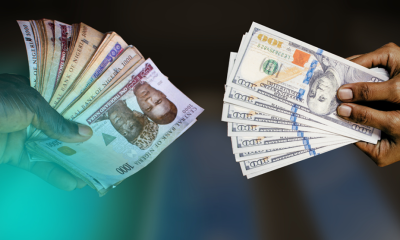
Naira faces exchange rate gap as Dollar hits N1,380 on parallel market
-
 Business1 week ago
Court dismisses ₦170m Trade Fair contract claim, says Zenith Bank was not a party
-

 Latest1 week ago
Breaking: NNPCL raises petrol price to ₦1,405 per litre amid discount controversy
-

 Featured1 week ago
From kitchen to Supreme Court: Nigerian’s fight over alleged support for terrorists
-

 Football1 week ago
Maresca reveals Guardiola’s reaction to Man City’s 4-2 defeat to PSG
-

 Business7 days ago
NCC launches Internet Governance Working Group to tackle AI risks, boost online safety