
Politics
U.S. strikes on Iran increase risk of wider war-UN chief

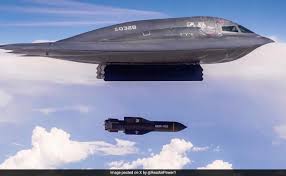
UN Secretary-General António Guterres told the Security Council on Sunday that massive overnight strikes by the U.S. on Iran’s nuclear facilities would only increase the risk of a wider war.
Guterres, at an emergency meeting convened by the Council on threats to international peace and security, said the strikes had also done “serious damage to the international order.”
It has been 10 days of airstrikes initiated by Israel aimed at crippling Iran’s nuclear programme which have led to deadly daily exchanges of missile fire between Tehran and Tel Aviv,
The UN chief, however, said that diplomacy must now prevail, stressing, “We now risk descending into a rathole of retaliation after retaliation.”
The U.S. intervention overnight in support of Israel’s military campaign targeted three Iranian facilities involved in uranium enrichment.
“We must act, immediately and decisively, to halt the fighting and return to serious, sustained negotiations on the Iran nuclear programme,” Guterres added.
He told ambassadors the citizens of the wider Middle East region could not endure yet another cycle of destruction.
Demanding a ceasefire, he also put Iran on notice that it must “fully respect” the Non-Proliferation Treaty on the development of nuclear weapons as a cornerstone of peace and security worldwide.
Iran had consistently denied the allegation from Israel and others that its ambitions were to become a nuclear-armed state, versus developing atomic energy for purely peaceful purposes.
The UN scribe stressed that Israel, the U.S. and Iran faced a stark choice, insisting that diplomacy must prevail.
“One path leads to a wider war, deeper human suffering and serious damage to the international order.
“The other leads to de-escalation, diplomacy and dialogue,” he said.
UN Assistant Secretary-General for Political Affairs Miroslav Jenča told ambassadors that the world was facing “a dangerous moment” following the U.S. bombing mission and Iran considered potential retaliation.
Jenča warned the council that the region risks being “engulfed in further instability and volatility”, with “no military solution to this conflict.”
The top UN official worried that hostilities between Iran and Israel were now into their tenth day and the humanitarian toll was mounting.
“Most of the 430 killed in Iran have been civilians,” he noted, while also citing Israeli reports of 25 dead and over 1,300 injured.
He also flagged growing threats from non-state armed groups, including the Houthis in Yemen.
Their retaliation, he said, could widen the conflict.
Iran’s parliament, meanwhile, voiced support for closing the crucial trading route through the narrow Strait of Hormuz.
“The world will not be spared from the ramifications of this dangerous conflict,” Jenča said, urging countries to act in line with international law and the UN Charter. (NAN)


-
 Latest7 days ago
Israel marks 3 years since October 7 Hamas attack amid Gaza strikes, election debate
-

 Energy6 days ago
Fuel Battle: Dangote, marketers and government clash over petrol imports
-

 Energy1 week ago
Petrol, diesel prices rise 86% in 2026 as costs hit fresh highs
-

 Football1 week ago
Nigeria’s World Cup exit under spotlight as FIFA’s DR Congo files emerge
-

 Latest1 day ago
Full List: Meet the 2026 Nobel Prize winners across six categories
-

 Latest1 week ago
US Court set to rule on release of FBI, DEA records on Tinubu
-

 Business1 week ago
Nigerian investors at a crossroads as fixed-income yields slide
-

 Latest1 week ago
Oyo APC crisis deepens as Oluyole reconciliation meeting ends in brawl