
Business
Dangote Refinery hikes diesel price amid rising global oil prices

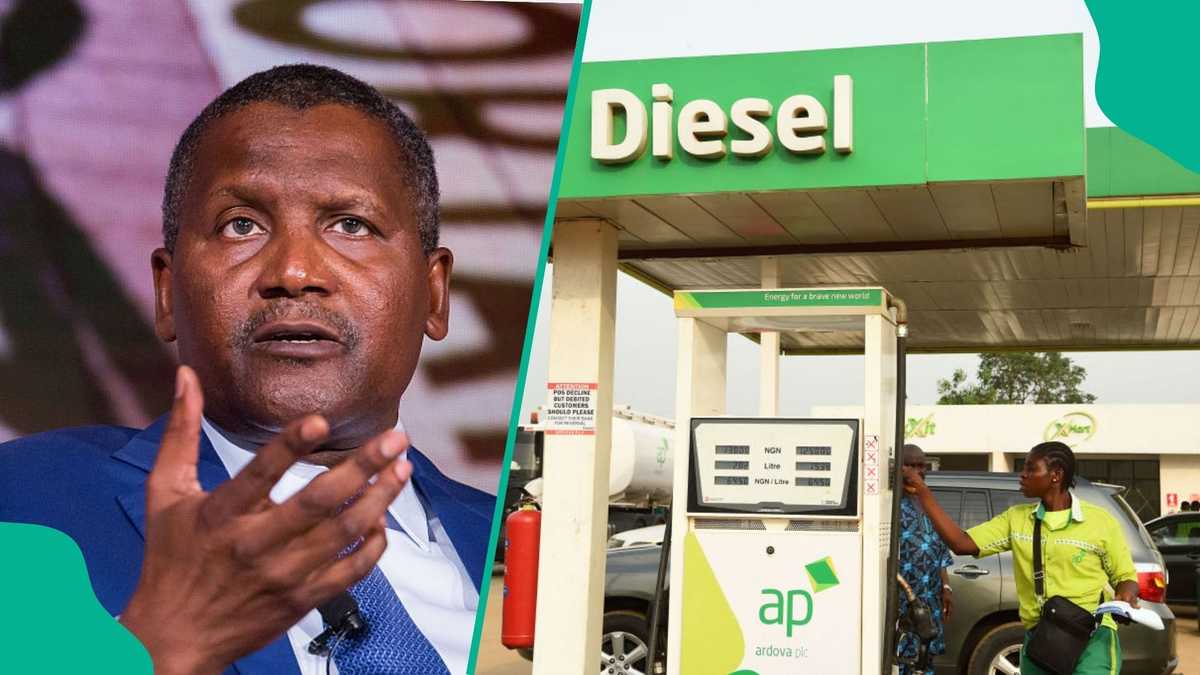
Dangote Refinery has raised the gantry price of Automotive Gas Oil (AGO), commonly known as diesel, by N100 per litre amid a surge in international crude oil prices.
A market survey conducted on Thursday showed that the refinery increased its diesel price from N1,570 to N1,670 per litre, representing a 6.4 per cent increase.
The development could trigger further increases at filling stations, where diesel currently sells for between N1,700 and N1,790 per litre in Lagos.
The refinery, which has a nameplate capacity of 650,000 barrels per day, had yet to officially confirm the latest adjustment as of the time of reporting.
The price increase reverses a reduction announced earlier this month. On August 6, Dangote Refinery cut its diesel gantry price to N1,570 per litre and reduced its Premium Motor Spirit (PMS) price to N1,165 per litre.
While the diesel price has now been reviewed upward, the refinery’s PMS gantry price remained unchanged at N1,165 per litre as of Thursday.
The latest adjustment came as global crude oil prices recorded fresh gains. Brent crude rose about two per cent to $94.13 per barrel as of 2 p.m. Thursday, while West Texas Intermediate (WTI) gained about three per cent to $87.13 per barrel.
Energy economist Bayo Abioye said the diesel price increase was not unexpected given the recent rally in international crude prices.
READ ALSO; Fuel prices drop to N1,210-N1,275 as marketers cut pump rates
He explained that diesel prices remained sensitive to movements in global crude and refined-product markets, adding that domestic refining did not completely shield local prices from international market pressures.
Abioye said the impact of crude prices on domestic diesel would also depend on Dangote Refinery’s crude supply arrangements, operating costs, exchange-rate movements and other market conditions.
He warned that higher diesel prices could increase operating costs for businesses because the product is widely used to power generators, factories, telecommunications infrastructure and logistics operations.
“Diesel is a major input cost for Nigerian businesses. Manufacturers, telecommunications companies, logistics operators and small businesses that depend on generators will all be watching this development closely,” he said.
According to him, sustained increases in diesel prices could eventually feed into the prices of goods and services through higher transportation, manufacturing and distribution costs.
Abioye, however, noted that increased local refining would continue to reduce Nigeria’s dependence on imported petroleum products, even though domestic prices remained exposed to global crude oil movements.
“Local refining reduces dependence on imported petroleum products, but it does not completely isolate Nigeria from global crude-price movements. Refiners still have to operate within an international commodity environment,” he said.


-

 Featured1 week ago
Inside INEC’s race to prepare for Nigeria’s 2027 elections
-

 Featured1 week ago
2027: APC unveils nationwide campaign timetable, Tinubu to rally in 12 states
-

 Business4 days ago
Naira faces exchange rate gap as Dollar hits N1,380 on parallel market
-
 Business1 week ago
Court dismisses ₦170m Trade Fair contract claim, says Zenith Bank was not a party
-
 Latest1 week ago
Breaking: NNPCL raises petrol price to ₦1,405 per litre amid discount controversy
-

 Football1 week ago
Maresca reveals Guardiola’s reaction to Man City’s 4-2 defeat to PSG
-

 Featured1 week ago
From kitchen to Supreme Court: Nigerian’s fight over alleged support for terrorists
-

 Business7 days ago
NCC launches Internet Governance Working Group to tackle AI risks, boost online safety