
Latest
ISRT 2026: Loveworld leads global tribute to Saul Hertz, push precision cancer care for Africa

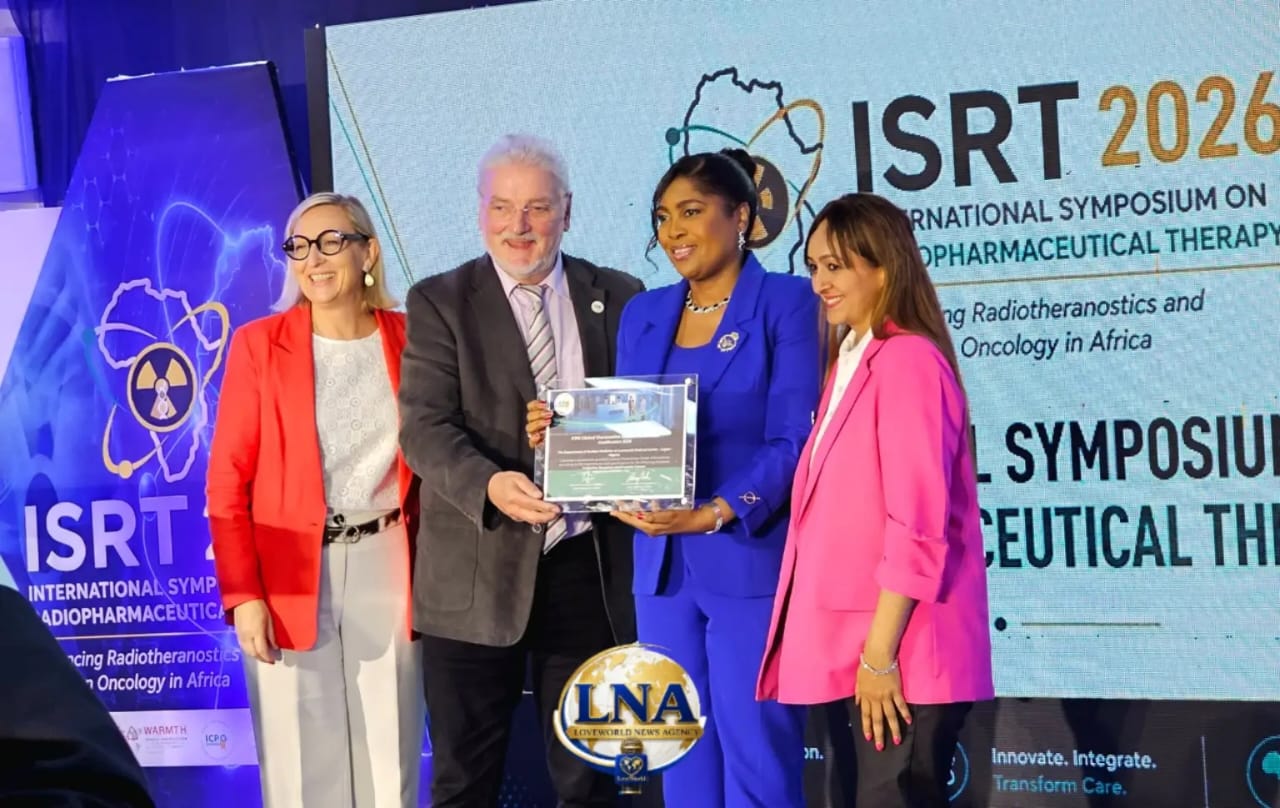
Leading experts in nuclear medicine and radiopharmaceutical therapy have honoured the pioneering contributions of Dr. Saul Hertz while calling for stronger collaboration, training and investment to expand precision cancer care across Africa.
The call was made at the 2026 International Symposium on Radiopharmaceutical Therapy (ISRT), holding from August 28 to 29 at Loveworld Medical Centre, Lagos, under the theme, “Advancing Radiotheranostics and Precision Oncology in Africa.”
A major highlight of the opening day was the ISRT 2026 Gala Dinner, held on Friday, August 28 at The Ballroom of Loveworld Medical Centre in honour of Hertz (1905–1950), whose pioneering work with radioactive iodine helped lay the foundation for targeted radionuclide therapy and modern theranostics.
Among distinguished personalities at the event were Barbara Hertz, daughter of the nuclear medicine pioneer; Dr. Deola Phillips, Executive Minister, Ministry of Healing, Health and Social Services and Chairman of Loveworld Medical Centre; Dr. Masha Maharaj; and Prof. Richard P. Baum, an internationally recognised authority in theranostics and nuclear medicine.
The dignitaries also toured the Historical Museum dedicated to Dr. Saul Hertz, providing an opportunity to reflect on his scientific journey and the evolution of nuclear medicine from its early beginnings to today’s increasingly sophisticated approaches to cancer diagnosis and treatment.
Dr. Phillips, who hosted the international gathering, stressed the importance of preserving the contributions of medical pioneers while creating the capacity required to advance their discoveries.
She noted that the achievements of pioneers such as Hertz should inspire contemporary researchers, clinicians and healthcare institutions to pursue further innovation and ensure that scientific breakthroughs translate into improved patient outcomes.
The presence of Barbara Hertz added a significant historical dimension to the programme. As curator of the Dr. Saul Hertz Archives, she travelled from the United States to Lagos to share the story and enduring legacy of her father with participants.
READ ALSO; ISRT 2026: Global experts converge in Lagos to advance cancer care across Africa
Guests were also taken through “Saul Hertz: The Origin and Future of Theranostics,” a historical presentation linking the origins of radioiodine therapy with advances in modern cancer diagnosis and treatment.
Baum, a leading expert in theranostics and nuclear medicine, offered reflections on the evolution of the field and its future possibilities, particularly in Africa.
The gala dinner also celebrated scientists, healthcare leaders, partners and other stakeholders whose work is contributing to the development of radiopharmaceutical therapy, precision oncology and patient-centred cancer care across the continent.
Beyond the celebrations, Day One of ISRT 2026 featured scientific sessions examining theranostics, molecular imaging, radiopharmaceutical therapy, prostate-specific membrane antigen (PSMA), patient selection and multidisciplinary approaches to cancer treatment.
Experts also examined Africa’s emerging theranostics landscape and discussed opportunities for expanding access to personalised cancer care.
Another major feature of the opening day was the practical Radiopharmacy and Radioligand Therapy Workshop, which exposed participants to key aspects of radiopharmaceutical production and clinical application.
The workshop covered radiolabelling processes, quality control, radiation safety, sterility, documentation and clinical pathways involved in delivering radiopharmaceutical therapies.
Dr. Philips said the practical component was designed to ensure that knowledge is not merely shared but demonstrated, understood, transferred and multiplied, thereby strengthening Africa’s capacity to establish radiopharmaceutical services that meet international standards.
The symposium brought together nuclear medicine physicians, scientists, radiopharmacists, clinicians, healthcare leaders and industry partners from Africa and beyond.
Opening addresses on Day One included contributions from Dr. Adeola Phillips, representative of Minister of State for Health and Social Welfare, Iziaq Salako, the Deputy Director of Research at the Nigerian Institute of Medical Research (NIMR), Yaba, Dr David Oladele, and representative of a global medical organisation and the Executive Minister for Humanitarian Affairs.
As ISRT 2026 enters its second day, participants are expected to continue with scientific presentations, practical learning and strategic discussions focused on accelerating the adoption of advanced radiopharmaceutical therapies and precision oncology across Africa.
The organisers said the two-day gathering is ultimately aimed at combining legacy, innovation, capacity building and international collaboration to help shape a stronger future for cancer care on the continent.


-
 Comments and Issues1 week ago
Can President Tinubu Revive Nigeria’s Moribund Refineries?
-

 Business1 week ago
TikTok, ByteDance agree to $400m settlement in US children’s privacy case
-

 Entertainment5 days ago
Miss World 2026: Four Continental winners battle for automatic top 20 spot (VIDEO)
-
 Entertainment4 days ago
Miss World 2026: Meet 24 African Contestants Flying Continent’s Flag in Vietnam(VIDEO)
-

 Business2 days ago
Versat Automobile to launch Chery’s EXEED premium brand in Nigeria
-

 Football2 days ago
Ballon d’Or 2026: The key rules shaping the race for football’s biggest prize
-
 Comments and Issues3 days ago
Digital Rights and the 2027 Poll in Nigeria
-
 Football6 days ago
Newcastle, Liverpool unite in emotional tribute to Kevin Keegan