
Featured
Peter Obi, Makinde and the 2027 elections: Can unity really challenge APC?

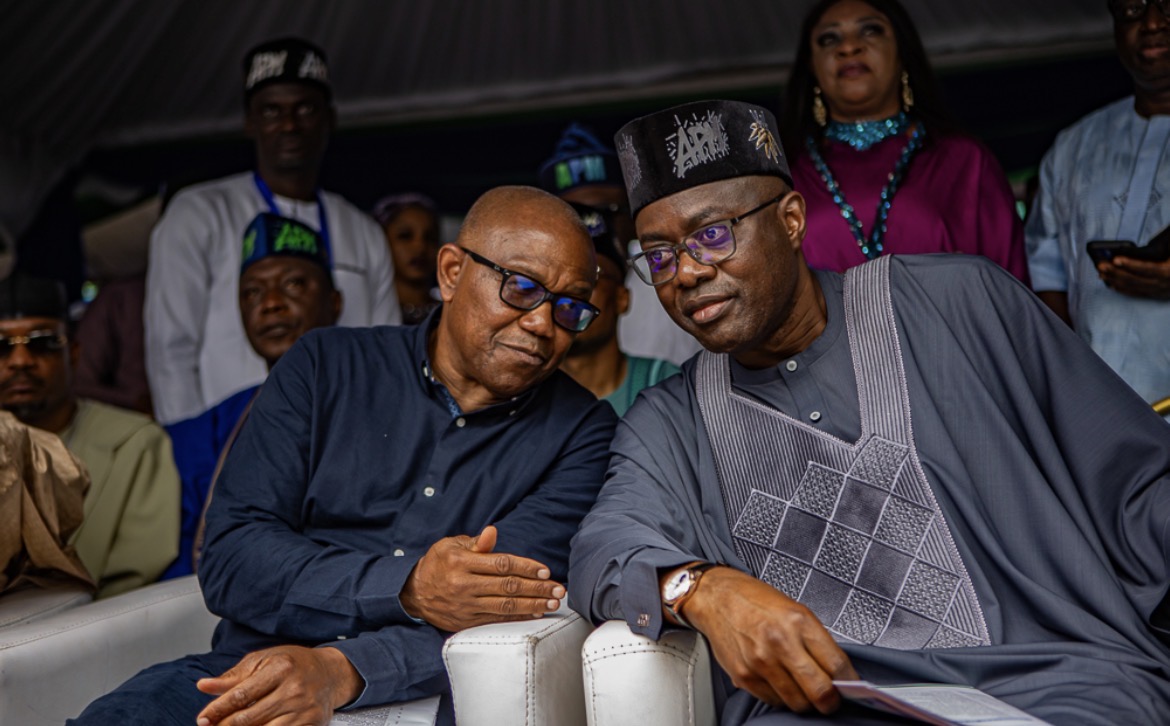
The appearance of former Anambra State governor Peter Obi at the inauguration of Oyo State Governor Seyi Makinde’s presidential campaign office in Abuja has renewed attention on the possibility of a stronger opposition alliance ahead of Nigeria’s 2027 presidential election.
Obi, the presidential candidate of the Nigeria Democratic Congress (NDC), joined other opposition figures at the event on Monday, where he called for political leaders to put aside personal interests and work together to address poverty, hunger and insecurity.
Makinde, who is contesting the presidency on the platform of the Allied Peoples Movement (APM), has also repeatedly advocated cooperation among opposition parties as a way of providing Nigerians with an alternative to the ruling All Progressives Congress (APC).
The appearance was significant because both Obi and Makinde are potential presidential contenders, meaning that any serious opposition alliance would eventually have to address the difficult question of who should lead a joint ticket.
The argument for opposition unity is straightforward.
President Bola Tinubu and the APC enter the 2027 contest with significant political advantages, including control of the federal government and a strong presence across the states.
The opposition, by contrast, has several prominent figures with established political followings but remains divided among different parties, platforms and presidential ambitions.
Obi, former Vice-President Atiku Abubakar and other opposition figures have previously explored cooperation against the APC. More recently, opposition parties have opened discussions on a possible common strategy and candidate ahead of 2027.
The potential benefit of consolidation is that votes that would otherwise be split among several opposition candidates could be concentrated behind one candidate.
But that is easier said than done.
The central challenge facing any opposition coalition is the presidential ticket.
Obi already has a substantial political base dating back to his 2023 presidential campaign. Atiku remains a major national political figure, while Makinde is seeking to position himself as another credible alternative ahead of 2027.
Other opposition politicians also have presidential ambitions.
For a coalition to work, at least some of these politicians would have to accept that they cannot all contest the presidency independently.
That could require one or more leading contenders to withdraw their ambitions and support another candidate, a politically difficult decision in an election where the presidency is the ultimate prize.
Obi’s presence at Makinde’s campaign-office launch could be interpreted as evidence that political differences have not completely closed the door to cooperation.
At the event, Obi stressed the importance of supporting whoever emerges from a free, fair and credible electoral process, reinforcing the argument that opposition figures can cooperate despite belonging to different political platforms. (TheNigeriaLawyer)
Makinde, meanwhile, used the occasion to launch his “Reset Nigeria” agenda, focusing on issues including economic management, transparency and the benefits Nigerians should derive from the country’s oil resources. (Head Topics)
Their interaction therefore sends two messages at once: opposition politicians are willing to engage one another, but individual presidential ambitions remain very much alive.
Even with widespread dissatisfaction over economic hardship and insecurity, defeating an incumbent party in Nigeria requires more than public anger.
The APC has the advantage of incumbency, substantial political structures and considerable influence at the federal and state levels.
Recent reporting has also highlighted the number of state governors aligned with the Tinubu administration, strengthening the ruling party’s political machinery ahead of the election.
For the opposition, winning would therefore require an organisation capable of translating dissatisfaction into votes across Nigeria’s regions rather than relying solely on popularity in particular areas.
A joint presidential candidate could reduce vote splitting, but that candidate would still need a strong grassroots structure, credible agents, funding and the ability to build support beyond traditional regional or ethnic bases.
Another challenge is whether the opposition can construct a coalition broad enough to satisfy Nigeria’s complex regional political calculations.
Obi’s strongest showing in 2023 came particularly from the South-East and among younger and urban voters, while Atiku has historically had substantial support in the North.
Makinde’s political influence is rooted largely in the South-West, where the APC also has significant strength.
A successful coalition would therefore need to combine these different constituencies into a national electoral coalition.
That requires more than putting prominent politicians on the same platform. They would have to agree on policy, power-sharing arrangements, campaign strategy and, most importantly, the candidate who can attract the broadest national support.
The opposition has attempted to build alliances before, but disagreements over leadership and strategy have repeatedly complicated the process.
In August, opposition groups began structured discussions aimed at developing a framework for cooperation and potentially producing a common presidential candidate. The discussions involved several parties and political actors, but prominent figures did not always appear together at the same meetings.
That history illustrates the difference between opposition cooperation and a fully operational electoral coalition.
The first involves politicians agreeing that they want change. The second requires them to agree on who will lead, how resources will be shared and how supporters of different parties will be mobilised behind one ticket.
So, can opposition unity defeat APC?
Yes, it is possible but unity alone will not guarantee victory.
A credible opposition coalition would potentially give the 2027 contest a much clearer two-sided structure and reduce the risk of opposition votes being divided among several major candidates.
However, the coalition would have to overcome serious internal contradictions.
The most important test will be whether Obi, Atiku, Makinde and other contenders can place the broader coalition ahead of their individual presidential ambitions.
They would also need to agree on a candidate capable of attracting support across Nigeria’s major voting blocs, while presenting a coherent alternative on the economy, security, jobs, energy and governance.
For now, Obi’s appearance at Makinde’s campaign-office launch is an important political signal, but it is not evidence that the opposition has already united behind a single candidate.
The real test will come when the opposition moves from speeches about unity to the much harder negotiations over who gets the ticket, what the coalition stands for and how it will challenge the APC at the ballot box.
With the 2027 election approaching, that decision could ultimately determine whether the opposition becomes a serious national alternative or remains a collection of competing political ambitions.


-
 Featured5 days ago
Inside INEC’s race to prepare for Nigeria’s 2027 elections
-

 Latest1 week ago
UCTH faces morgue crisis as 50 unclaimed corpses await mass burial
-
 Featured5 days ago
2027: APC unveils nationwide campaign timetable, Tinubu to rally in 12 states
-
 Business6 days ago
President Tinubu and the Low Transport Fares Fiasco
-

 Business1 week ago
BREAKING: Nigeria’s Inflation Rate Drops to 14.63% in September
-
 Business5 days ago
Court dismisses ₦170m Trade Fair contract claim, says Zenith Bank was not a party
-

 Business2 days ago
Naira faces exchange rate gap as Dollar hits N1,380 on parallel market
-

 Latest5 days ago
Breaking: NNPCL raises petrol price to ₦1,405 per litre amid discount controversy