
Business
CBN Governor, Emefiele speaks on MPR cut


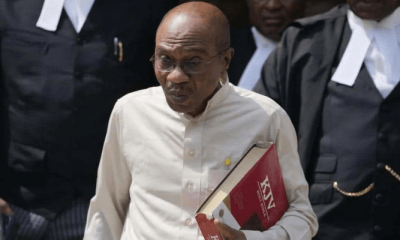
The Governor of the Central Bank of Nigeria (CBN), Godwin Emefiele, has disclosed that the apex bank would move to further cut the Monetary Policy Rate (MPR) if inflation drops to a single digit.
The CBN Governor disclosed this while speaking on Bloomberg TV in London on Tuesday.
While speaking on Bloomberg, Emefiele stated that the CBN was anticipating single-digit inflation of 9% or below before considering cutting the MPR, and according to the Governor, this would happen in the year 2020.
Emefiele’s statement reads: “How soon do I see interest rates coming down? I’m not seeing that coming this year. During the course of 2020, we may be able to see that but I can’t see that until we begin to see the numbers showing inflation is trending downward.
“Unfortunately it’s been sticky coming downwards as soon as it hit about 11%. The Monetary Policy Committee would love to see it at about 9% before beginning to aggressively think about easing.”
At the last Monetary Policy Committee (MPC) meeting held on the 20th and 21st September, the CBN Committee decided by a unanimous vote to retain the Monetary Policy Rate (MPR) at 13.5% and to hold all other policy parameters constant.
According to the MPC, the positive moderation in inflation, though slowly from 11.08% in July to 11.02% in August 2019 almost compelled the MPC to tighten the rates. However, the Committee was of the view that doing so in the midst of a fragile growth outlook would increase the cost of credit, and further contract investment and constrain output growth.
According to some experts, the CBN would mull cutting the rates at the next MPC meeting having observed how inflation responds to the recent border closures and other policy measures on importation.
MPR is the interest rate at which CBN lends to commercial banks. The MPR is the benchmark against which other lending rates in the economy are pegged and is usually used as an instrument to moderate inflation in the economy.
On the other hand, CRR simply refers to the ratio of customers’ deposits (i.e. your money in the bank) which banks are expected to hold as cash or keep with the CBN.
Liquidity ratio refers to the amount of highly liquid assets that banks should hold in order to meet their financial obligations to customers.













-

 Latest7 days ago
US Immigration fees rise from October 16 as USCIS announces new charges
-
 Latest2 days ago
Israel marks 3 years since October 7 Hamas attack amid Gaza strikes, election debate
-

 Business6 days ago
Nigeria’s $55bn reserves raise fresh questions over naira value
-

 Health6 days ago
Florida sues Pfizer over deceptive COVID-19 vaccine marketing
-

 Business1 week ago
Tuoyo Erikowa wins digital marketing personality of the Year at 2026 EDGE awards
-

 Crime6 days ago
From camp to captivity: How kidnappers now target NYSC Corps members on highways
-

 Featured7 days ago
2027: Can Nigeria’s opposition still unite behind a single presidential candidate?
-

 Crime6 days ago
Fulani Militia leader linked to Christian killings arrested in Plateau