
Business
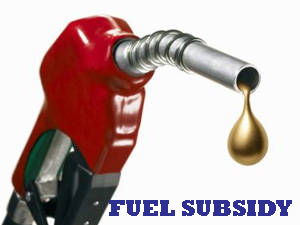
Fuel Subsidy gets N63.29 billion in 2016 budget

…as World Bank calls for removal
Contrary to expectations that President Muhammadu Buhari would remove fuel subsidy following series of complaints arising from its handling, the President did not only retain it but allocates the sum of N63.29 bn for it in the 2016 fiscal year.
According to the MTEF submitted the sum of N150 billion was earmarked for settlement of arrears of the 2015 subsidy on domestic consumption.
On the misappropriated funds, the president explained in the Medium Term Expenditure Framework that N137.90 billion will be recovered from strategic alliance contracts, while N162.43 billion will be recovered from the Nigerian National Petroleum Corporation, NNPC just as N50 billion will be recovered from other misappropriated funds.
Also, President Muhammadu Buhari may have tacitly scrapped kerosene subsidy in the country as he made no allocation for it in the Medium Term Expenditure Framework, MTEF, and Fiscal Strategy Paper, FSP, which he presented to the National Assembly.
The document indicated that the present federal administration is to borrow N1.835.88 trillion to fund the 2016 budget which stands at N6.04 trillion just as it disclosed that a total sum of N350.33 billion misappropriated funds will be recovered in 2016.
Meanwhile, World Bank’s Lead Economist, John Litwack has advised the Federal Government to remove fuel subsidy in other for the industry to develop.
Speaking at the launch of the new edition of Nigeria Economic Report,Litwack, said the best time to remove fuel subsidy is now when global crude oil price is at its lowest level, noting that the Bank foresaw continuous decline in global crude oil price.
According to Litwack, the fuel subsidy appears to have vast modest benefits for the majority of citizens, but the costs are quite high. He said there is a strong tendency for the cost of fuel subsidy to increase over time as increasing domestic demand for petrol outpaces growth in oil output or revenues.
“The $35 billion cost of fuel subsidy during 2010 – 2014 was one of the reasons Nigeria was unable to accumulate a fiscal reserve in the Excess Crude Account that could have protected the country from the recent oil price shock.”
He explained that fuel subsidy obligations were expected to reach 18 per cent of all government oil revenues in 2015, pointing out that if the current regulated price regime of N87 per litre was maintained, subsidy was projected to increase to more than 30 per cent by 2018.









-

 Football1 week ago
Banda, Chawinga make 2026 Women’s Ballon d’Or top 30 shortlist
-

 Trending Stories5 days ago
Davido, Wizkid, Burna Boy or Asake: Who is having the biggest 2026 so far?
-

 Featured1 week ago
Peter Obi, Makinde and the 2027 elections: Can unity really challenge APC?
-

 Football5 days ago
Premier League releases 2026/27 festive fixtures, 7 matches set for Boxing Day
-

 Business3 days ago
Jetour Nigeria, dealers take dashing, other models to Abuja Experience
-

 Business4 days ago
Dangote Refinery IPO shifts spotlight to corporate governance, investor protection
-

 Crime4 days ago
Anambra Police arrest mother over alleged child sexual exploitation
-
 Energy6 days ago
Brent crude tops $100: What higher oil prices mean for Nigeria