
News
Civil rights advocates, Ajiran Community storms Lagos CP office, cry for justice

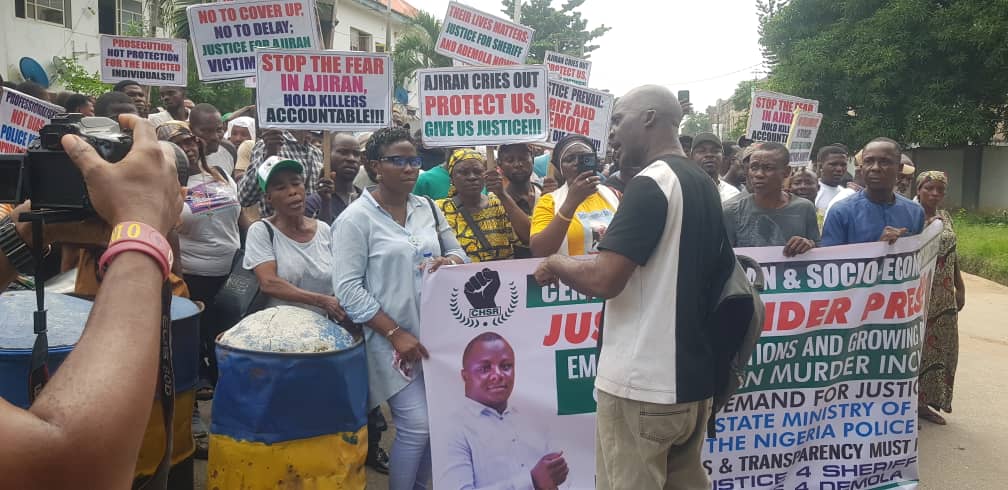
Scores of protesters from the Ajiran Community in Eti Osa with the Centre for Human & Socio-Economic Rights (CHSR) on Monday staged a peaceful walk, to the Lagos Police Command Area F to demand for justice over the gruesome murders of Sheriff Salami Agboworin and Prince Ademola Akinloye.
The peaceful protesters wielding placards with bold inscriptions to drive home their demand, walked from the front of the Lagos High Court in Ikeja to the state Police Command with a chant of Justice for the murdered.
“Ajiran cries out protect us , give us Justice” , “No cover up, no delay, Justice for Ajiran victims now”, “Their lives matter, Justice for Sheriff and Ademola now”, “Stop the fear in Ajiran, hold killers accountable!!!”.
“Let justice prevail:Sheriff and Ademola must not die in vain!!!”, “Justice must speak for Ajiran no to silence!!!”
Addressing newsmen at the CP’s office, CHSR National President Comrade Alex Omotehinse registered the group’s displeasure in what appeared as if a section of the Police got allegedly compromised, stressing that justice ought to prevail in order to ensure the projection of the right image of our justice system including the Police.
“We have been on this struggle since 2023, we observed manipulations and wrote a letter to the Attorney General of Lagos State Lawal Pedro SAN and copy the Commissioner of Police, Assistant Inspector General of Police and other top authorities, we are here today to submit the CP’s copy to him or any member of his admin.
“On the incident of killing in Ajiran, two young men were gruesomely murdered in 2023 and 2024 and the principal suspect have been apprehended and is presently undergoing investigation in the State CID Panti.
we were at court last week and we saw the action and inaction of the Delta Force, a section in Panti that is handling the matter.
“We are not impressed for what they did in court that very day and that is why we are here to call on the attention of the Commissioner of Police to call his men to order.

“Last week when the Delta Force brought the suspect, we were surprised that some member of the suspect supporters have to instruct the Delta Force officers to send out families of the victim and also force them to move their vehicles out of the court’s premises.
“This surprised us that the suspect can be dictating for the police officers in this public interest case.”
In the interest of maintaining peace, law and order in Ajiran community while the case subsists in court the Police has been urged to increase their presence there.
“Mount more security protection for the people Ajiran, due the tensed situation there.
“The outcome of this case will tell the whole world the role of the Lagos State Police Command what they do when it comes to a capital offence and how it is being handled by the police.
“They should allow justice to prevail, because this case is going to be a litmus test for our Justice system and the investigation system. We sent the letter through dispatch last week but it was rejected by the CP office that informs our massive turnout here today to submit it in public.”


-
 Latest6 days ago
Israel marks 3 years since October 7 Hamas attack amid Gaza strikes, election debate
-

 Energy6 days ago
Fuel Battle: Dangote, marketers and government clash over petrol imports
-

 Energy7 days ago
Petrol, diesel prices rise 86% in 2026 as costs hit fresh highs
-

 Energy1 week ago
Has Iran lost control of the Strait of Hormuz? Oil flows rebound as war disruptions persist
-

 Football7 days ago
Nigeria’s World Cup exit under spotlight as FIFA’s DR Congo files emerge
-

 Latest7 days ago
US Court set to rule on release of FBI, DEA records on Tinubu
-

 Business7 days ago
Nigerian investors at a crossroads as fixed-income yields slide
-

 Business1 week ago
LoveWorld Trade and Investment Forum to Convene Business Leaders in Accra