
Latest
Deadly floods sweep West Africa as Nigeria, Ghana battle rising waters

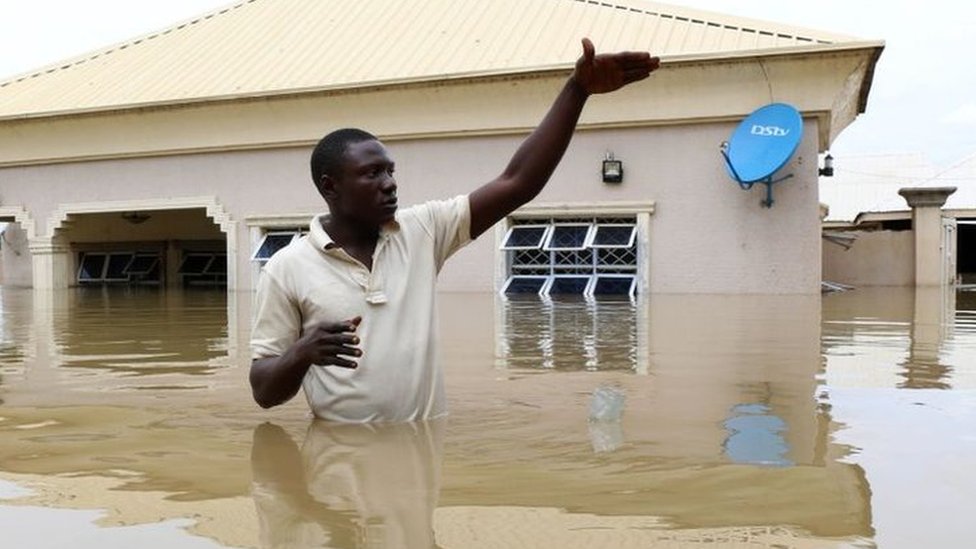
Torrential rainfall has triggered widespread flooding across Nigeria, Ghana and several other West African countries, leaving dozens dead, displacing thousands of residents and causing extensive damage to homes, businesses, roads and critical infrastructure as experts warn that climate change is intensifying extreme weather events across the region.
The flooding, which followed days of relentless rainfall, has submerged communities, paralysed transportation and disrupted economic activities, renewing concerns over the region’s preparedness for increasingly severe climate-related disasters.
In Ghana, at least 13 people were confirmed dead after heavy rains inundated large parts of the capital, Accra.
According to reports by the BBC, authorities urged residents living in flood-prone communities to remain indoors or relocate to higher ground as emergency responders battled rising floodwaters.
Reacting to the disaster, Ghanaian President John Mahama said the city received about 140 millimetres of rainfall—the highest recorded in several years.
“That aspect of the problem is beyond our control because it is driven by changing climatic conditions,” Mahama said in a statement posted on X.
Videos circulating on social media showed desperate residents stranded on rooftops and fences while floodwaters swept through neighbourhoods, with several communities also experiencing prolonged power outages.
READ ALSO: Heavy rain triggers widespread flooding across Lagos, disrupts airport operations
In Togo, persistent rainfall submerged several communities in the capital, Lomé, disrupting transportation and forcing residents from their homes.
In Côte d’Ivoire, authorities confirmed that at least 12 people were killed and five others injured after severe flooding struck Abidjan following days of intense rainfall.
Nigeria has also witnessed widespread flooding across several states following heavy rainfall that transformed roads into rivers and submerged residential communities.
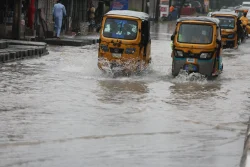
Videos shared across social media platforms showed motorists trapped in floodwaters, commuters stranded for hours and residents wading through waist-deep water while attempting to salvage household belongings.
In Lagos, one of the country’s worst-hit cities, major roads became impassable as drainage systems overflowed, crippling traffic and disrupting commercial activities.
Similar scenes were recorded across parts of Ogun, Oyo and Osun states, where prolonged rainfall flooded roads, residential estates and business districts.
Several shop owners said they had been unable to reopen their businesses as floodwaters remained in their premises.
A Lagos resident identified simply as James recounted the ordeal his family experienced overnight.
“We barely slept last night. My home was flooded, and we had to raise our mattress so it wouldn’t soak up water,” he said.
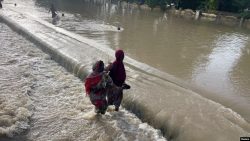
Flooding was also reported in parts of Abia, Cross River and Delta states, where overflowing drains and swollen rivers cut off access to several communities and submerged homes.
The Lagos State Government has repeatedly acknowledged that while flooding can be substantially reduced, it cannot be completely eliminated because of the state’s coastal geography and the growing impacts of climate change.
The Commissioner for Environment and Water Resources, Tokunbo Wahab, recently said the government would continue investing in drainage infrastructure, enforcing physical planning regulations, clearing drainage channels and deploying scientific data to improve flood management.
Climate scientists say the latest floods once again demonstrate Africa’s increasing vulnerability to climate change despite the continent contributing the least to global greenhouse gas emissions.
Environmental policy expert, Dr. Adebayo Adelekan, said the frequency of flooding across West Africa shows that climate adaptation has become an urgent necessity rather than a future consideration.
“What we are witnessing across Nigeria, Ghana and neighbouring countries is consistent with climate projections showing more intense rainfall events. Governments can no longer rely solely on emergency response; significant investments must be made in resilient infrastructure, drainage systems and early warning mechanisms.”
He warned that rapid urban expansion without adequate environmental planning is amplifying flood risks in many African cities.
Similarly, disaster risk management specialist, Prof. Chinedu Okafor, said the economic consequences of recurrent flooding are becoming increasingly severe.
“Flooding today is not only a humanitarian challenge but also an economic one. Businesses are shutting down, transportation networks are disrupted, agricultural production is affected and governments are forced to divert scarce resources toward emergency relief instead of long-term development.”
He stressed that stronger enforcement of building regulations, improved urban planning and restoration of wetlands would significantly reduce flood risks.
The agency warned that several southern states, including Lagos, Ogun, Oyo, Delta and Cross River, could experience severe flash floods during the rainy season.
Similarly, the Nigeria Hydrological Services Agency (NIHSA), in its 2026 Annual Flood Outlook, identified 33 states and the Federal Capital Territory as vulnerable to flooding.


-
 Business7 days ago
Dangote Refinery IPO: 70% Subscription claim meets fourfold demand assertion as investors seek clarity
-
 Latest1 week ago
Umahi defends Lagos-Calabar highway route changes amid public outcry
-
Business1 week ago
Dangote Refinery IPO Extension: Was the 70% subscription report overhyped?
-

 Featured3 days ago
Inside INEC’s race to prepare for Nigeria’s 2027 elections
-

 Latest6 days ago
UCTH faces morgue crisis as 50 unclaimed corpses await mass burial
-

 Business5 days ago
BREAKING: Nigeria’s Inflation Rate Drops to 14.63% in September
-
 Featured3 days ago
2027: APC unveils nationwide campaign timetable, Tinubu to rally in 12 states
-

 Featured1 week ago
El-Rufai, ADC governorship candidate’s court appearance puts Kaduna opposition politics in focus