
News
Heavy rain triggers widespread flooding across Lagos, disrupts airport operations

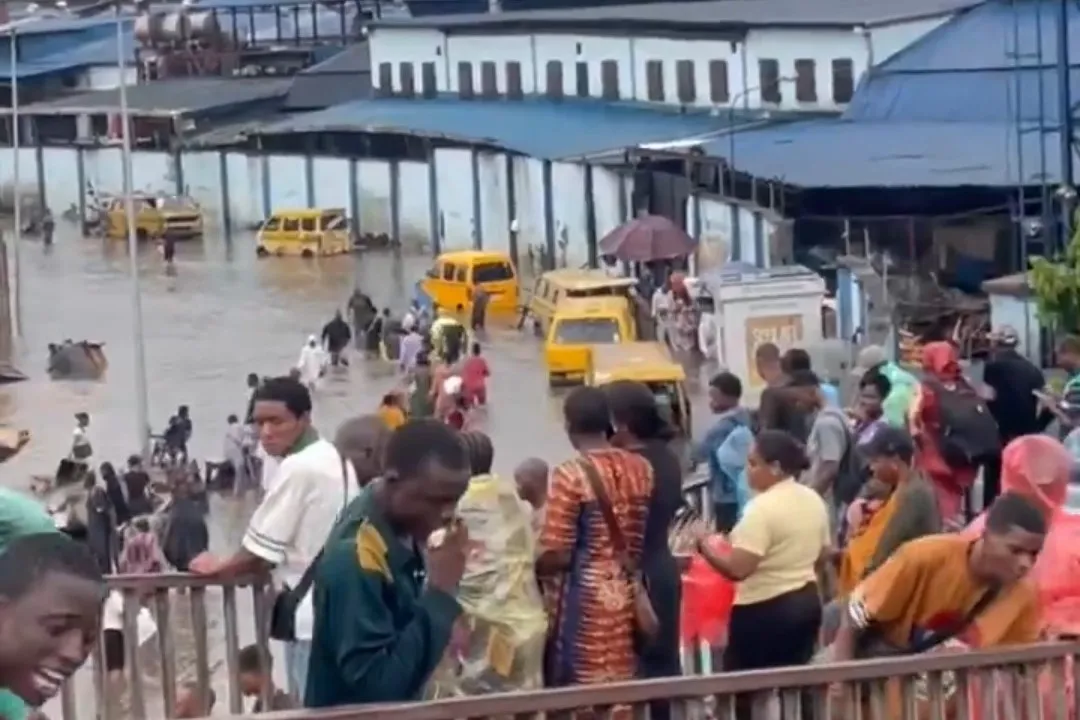
Torrential rainfall on Sunday caused widespread flash flooding across several parts of Lagos State, leaving major roads submerged, disrupting commercial activities, and forcing the temporary suspension of operations at a section of the Murtala Muhammed International Airport (MMIA).
The downpour, which lasted for several hours, stranded thousands of commuters as floodwaters overwhelmed major highways and residential areas. Many vehicles became trapped in the rising water, while residents abandoned commercial buses and continued their journeys on foot.
Among the worst-hit areas were Oshodi, Gbagada Expressway, Ilupeju Road, Obalende, Mushin, Surulere, Agege, Ikeja, Alimosho, and Egbeda, where roads were inundated and traffic movement slowed significantly.
In Mushin, floodwaters swept refuse onto major roads, blocking drainage channels and worsening the flooding. Along Akowonjo Road in Egbeda, a vehicle reportedly fell into a drainage channel concealed by floodwater, while sections of the Gbagada Expressway became impassable for several hours.
The flooding also disrupted operations at the temporary international terminal of the Murtala Muhammed International Airport. Water entered parts of the departure hall, boarding gates and airline offices, reaching the facility’s power infrastructure and prompting authorities to shut off electricity as a safety measure.
The Federal Airports Authority of Nigeria (FAAN) temporarily suspended operations at the affected terminal and relocated airlines, including Air France-KLM, Ethiopian Airlines and Fly Gabon, to Terminal Two to minimise disruptions to scheduled flights. FAAN attributed the incident to blocked drainage channels around the terminal, partly caused by ongoing reconstruction work at the old international terminal.
The incident has renewed concerns over Lagos’ perennial flooding challenges, with residents and business owners calling for improved drainage infrastructure and more effective waste management.
An Oshodi-based trader, Paul Arinze, said recurring floods had forced many business owners to elevate their shops to reduce losses during the rainy season.
Responding to public concerns, the Lagos State Commissioner for the Environment and Water Resources, Tokunbo Wahab, described the incident as a flash flood associated with intense rainfall in coastal cities. He explained that high water levels in the Lagos Lagoon temporarily prevented stormwater from flowing out through drainage channels.
Wahab said the state government had continued year-round drainage maintenance but urged residents to stop dumping refuse and plastic waste into canals, warning that blocked drains significantly increase the risk of flooding.
The latest flooding comes weeks after the Lagos State Government warned residents of low-lying communities to prepare for above-normal rainfall and possible flooding during the 2026 rainy season.


-
 Latest6 days ago
Israel marks 3 years since October 7 Hamas attack amid Gaza strikes, election debate
-

 Energy5 days ago
Fuel Battle: Dangote, marketers and government clash over petrol imports
-

 Energy7 days ago
Petrol, diesel prices rise 86% in 2026 as costs hit fresh highs
-
 Energy1 week ago
Has Iran lost control of the Strait of Hormuz? Oil flows rebound as war disruptions persist
-

 Football6 days ago
Nigeria’s World Cup exit under spotlight as FIFA’s DR Congo files emerge
-

 Latest6 days ago
US Court set to rule on release of FBI, DEA records on Tinubu
-

 Business6 days ago
Nigerian investors at a crossroads as fixed-income yields slide
-

 Business1 week ago
LoveWorld Trade and Investment Forum to Convene Business Leaders in Accra