
Business
Blue Origin’s new Glenn rocket explodes during ground test at Cape Canaveral

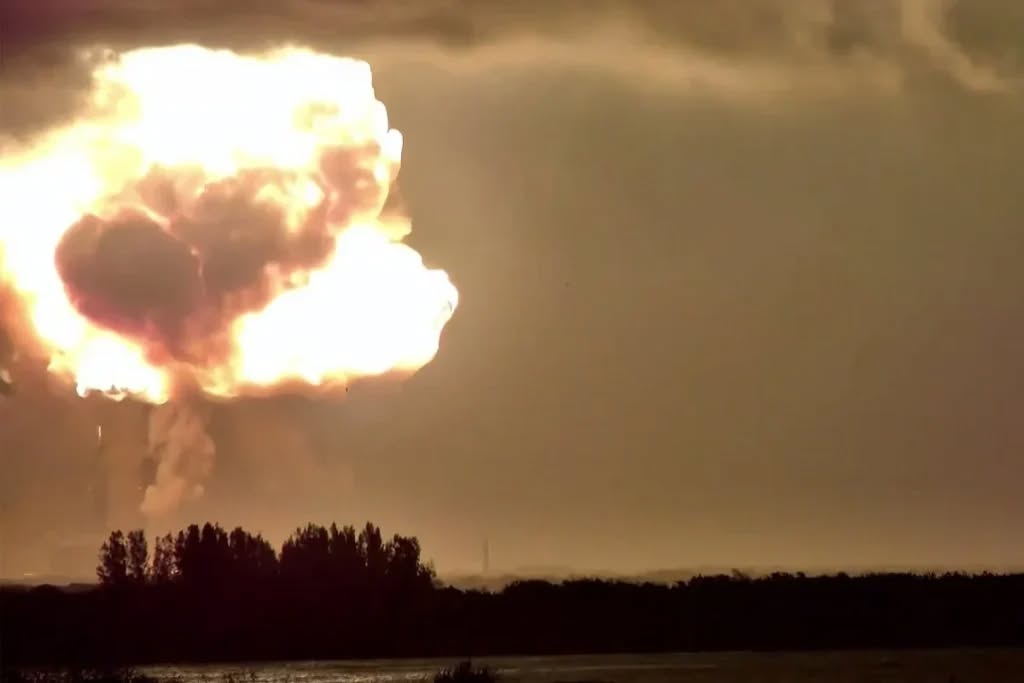
A major setback hit Jeff Bezos-owned aerospace company Blue Origin after its heavy-lift New Glenn rocket exploded during a routine engine test at Cape Canaveral Space Force Station in Florida.
The incident occurred around 9:00 p.m. EDT at Space Launch Complex 36 while engineers were conducting a “hotfire” static test, a procedure in which a rocket’s engines are ignited at full power while the vehicle remains secured to the launchpad.
According to reports and livestream footage, an apparent anomaly triggered a rapid chain of failures shortly after ignition. Flames quickly engulfed the rocket’s first stage before the upper stage reportedly collapsed into the structure, causing a massive explosion fueled by liquid methane and liquid oxygen.
The resulting fireball illuminated the night sky over Cape Canaveral and could reportedly be seen from miles away.
Despite the dramatic explosion, company officials confirmed that no personnel were injured. In a statement released jointly with the U.S. Space Force’s Space Launch Delta 45, Blue Origin said all workers had been safely evacuated from the test area before the operation began.
“All personnel have been accounted for and are safe,” the company stated, adding that no injuries or fatalities were recorded.
However, early assessments indicate that the launch infrastructure suffered extensive damage. Images from the scene showed severe destruction to the launch tower and support structures at the facility, while fires reportedly continued burning on parts of the pad for hours after the blast.
The destroyed rocket had reportedly been scheduled for its fourth mission, which was expected to deploy 48 satellites for Amazon’s Project Kuiper internet constellation. The satellites themselves were not attached to the rocket at the time of the accident, preventing additional losses.
The incident is expected to disrupt Blue Origin’s near-term launch schedule and could complicate timelines tied to commercial and government space missions, including support operations linked to NASA’s Artemis lunar exploration program.
The explosion also intensifies competition pressures in the commercial space industry, where Blue Origin has been seeking to establish itself as a stronger rival to SpaceX, the aerospace company founded by Elon Musk.
Reacting to the incident, Jeff Bezos said the company would recover from the setback.
“It’s a very rough day, but we’ll rebuild whatever needs rebuilding and get back to flying. It’s worth it,” Bezos wrote on social media.
Musk also reacted to the explosion, posting: “Most unfortunate. Rockets are hard. Sorry to see this.”
An investigation involving Blue Origin engineers and federal aerospace regulators is now underway to determine the cause of the failure.


-

 Latest1 day ago
Pastor Chris Oyakhilome announces mother’s passing at 88 [VIDEO]
-

 Football5 days ago
Saka: England still carry World Cup scar
-

 Comments and Issues6 days ago
Sometimes, goodwill finds us through the people we love
-

 Latest3 days ago
Arsenal eye €70-80m move for Real Madrid star
-

 Business6 days ago
CBN reduces MPR by 350bps to 23% in major monetary policy shift
-

 Business1 week ago
Jetour takes T1 adventure SUV experience to Abuja, targets growing Nigerian market
-

 Crime3 days ago
Police arrest suspect, launch manhunt for 2 others over Delta Education Director’s death
-

 Latest2 days ago
How adulterated palm oil, coloured pepper are putting consumers at risk