
Business
Dangote Refinery, weak naira spur Nigeria’s $3.73bn Q1 2025 BOP surplus

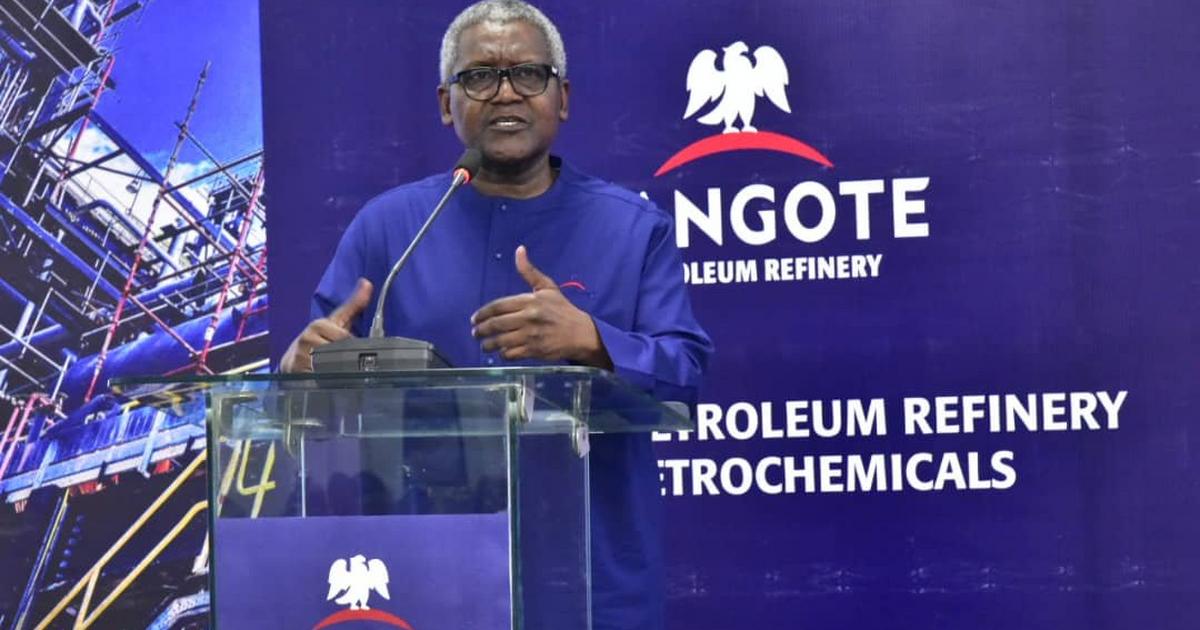
Nigeria recorded a balance of payments (BOP) surplus of $3.73 billion in the first quarter of 2025, with economic experts attributing the positive performance to a combination of naira depreciation and increased domestic fuel production from the Dangote Refinery.
The Central Bank of Nigeria (CBN) disclosed this in its latest report, revealing that the country’s current account surplus stood at $3.73 billion in the first quarter of 2025—slightly lower than the $3.80 billion recorded in the fourth quarter of 2024, but marginally higher than the $3.69 billion reported in the same period of 2024.
Despite the slight quarter-on-quarter dip, the development marks a continuation of Nigeria’s external surplus trend, following the $6.83 billion BOP surplus posted in 2024.
The CBN report highlighted that Nigeria’s goods account balance improved significantly, reaching $4.16 billion in the first quarter of 2025, up from $2.62 billion in the previous quarter.
This was driven largely by an uptick in non-oil exports, which rose by 30.39 per cent to $2.66 billion, and increased gas exports, which jumped from $2.10 billion to $2.66 billion.
Conversely, non-oil imports fell from $7.37 billion to $6.77 billion. Total exports grew by 9.79 per cent to $13.91 billion, while total imports declined to $9.75 billion from $10.05 billion—thanks in large part to reduced fuel and other non-oil imports.
On the financial account side, however, Nigeria recorded a reduced balance of $7.58 billion in the first quarter of 2025, down from $7.82 billion in the fourth quarter of 2024.
READ ALSO: Dangote refinery cuts ₦1.07 trillion fuel costs with direct supply
Commenting on the report, Dr. Muda Yusuf, CEO of the Centre for the Promotion of Private Enterprise (CPPE), said the naira’s depreciation was a major factor behind falling imports, especially of non-oil goods.
“Our largest imports in recent times have been non-oil. Import is dropping because of exchange rate depreciation. Depreciation of the naira makes imports more expensive and harder for importers to sustain,” he said.
Another economist, Dr. Adam Abudu of the Society for Peace building and Economic Advancement, stressed the importance of consistent government support for domestic investors.
“If we say we are prioritising domestic investment, then the policy must reflect that consistently. Dangote has proven what one refinery can do. Imagine what more private refineries can achieve for our balance of payments,” he said.
Dr. Abudu also praised the Tinubu administration’s reform agenda, linking it to consecutive quarters of surplus. “We’ve seen progress, and sustaining these reforms is key to maintaining a healthy balance of payments.”
According to the National Bureau of Statistics (NBS), Nigeria recorded a trade surplus of 5.17 trillion in the first quarter of 2025, up 51.07 per cent from the N3.42 trillion in the fourth quarter of 2024. Total trade reached N36.02 trillion, marking a 6.19 per cent year-on-year increase.


-
 Latest6 days ago
Israel marks 3 years since October 7 Hamas attack amid Gaza strikes, election debate
-

 Energy6 days ago
Fuel Battle: Dangote, marketers and government clash over petrol imports
-
 Energy1 week ago
Petrol, diesel prices rise 86% in 2026 as costs hit fresh highs
-

 Football1 week ago
Nigeria’s World Cup exit under spotlight as FIFA’s DR Congo files emerge
-

 Latest1 day ago
Full List: Meet the 2026 Nobel Prize winners across six categories
-

 Energy1 week ago
Has Iran lost control of the Strait of Hormuz? Oil flows rebound as war disruptions persist
-

 Latest1 week ago
US Court set to rule on release of FBI, DEA records on Tinubu
-

 Business1 week ago
Nigerian investors at a crossroads as fixed-income yields slide