
Business
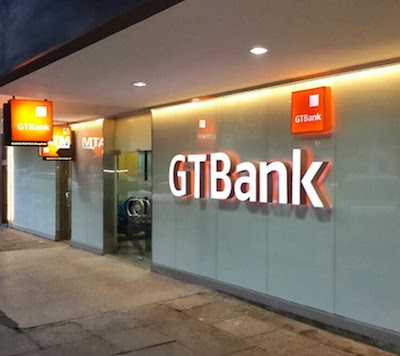
GTbank advocates for right fiscal, economic policies as NPL hits 11.7%

By Odunewu Segun
The non-harmonization and implementation of the right policies in both fiscal and monetary policies have been said to be responsible for the continued crisis rocking Nigeria’s economy as non-performing loans of banks doubled at 11.7 percent in 2017, National Daily has gathered.
In the recently released ‘Macroeconomic and Banking Sector Themes for 2017’, experts at GTbank disclosed that the banking industry has been plagued by declining asset quality in the wake of the decline in crude oil prices, devaluation of the naira and FX scarcity, with ratio of non-performing loans rising to 11.7% from 5.3% in Dec 2015.
“For the purpose of this publication, we consider two (2) scenarios: First Scenario: Oil prices remain circa US$57 pb levels and the successful resolution of the militancy attack on oil facilities in the delta region (best case). Second Scenario: Oil prices crash below US$40 pb and the attacks on oil facilities continues following the inability of government to resolve issues with the militants (worst case).
The analysts at the banks said the oil and gas loans alone account for about 30% of total industry exposure, “an improvement in oil sector receipts as detailed in scenario 1 will provide relief for banks, enhance repayment of obligations and improve asset performance.”
“FX scarcity and epileptic economic activities is further constraining earnings. With the first scenario successfully achieved, the system liquidity will improve and banks will witness better asset performance as customers will be able to meet the repayment of maturing loan obligations which raise earnings. Conversely, scenario 2 will see system illiquidity situation linger further into the year and asset quality deterioration will impact the industry.
On the capitalisation of the banks, the analysts said with banks reeling under the pressure of naira devaluation and earnings challenges, capital adequacy buffers might have been eroded below minimum regulatory requirement level.
“In view of the full compliance to Basel II in the computation of capital adequacy ratio (CAR), and the possibility of further asset quality deterioration occasioned by loan loss provisioning implications, it is not unlikely that banks might have to raise additional capital to stay within the 15% minimum capital requirement of the CBN. There may then be considerations for a reduction in this requirement or forbearance as the current market conditions are unsuitable for a capital raise.”
The bank concluded that despite the beating the Nigerian economy has taken in the last 24 months, one thing is still clear; the fundamentals of the economy, which include the market size, population, enterprise competency of Nigerians, demographic, natural resources etc., are still very strong.
.










-
 Business1 week ago
Dangote Refinery IPO: 70% Subscription claim meets fourfold demand assertion as investors seek clarity
-
 Featured4 days ago
Inside INEC’s race to prepare for Nigeria’s 2027 elections
-

 Latest7 days ago
UCTH faces morgue crisis as 50 unclaimed corpses await mass burial
-

 Featured4 days ago
2027: APC unveils nationwide campaign timetable, Tinubu to rally in 12 states
-

 Business6 days ago
BREAKING: Nigeria’s Inflation Rate Drops to 14.63% in September
-

 Aviation1 week ago
Germany opens online application route for student, EU Blue Card and other long-stay visas
-

 Business6 days ago
President Tinubu and the Low Transport Fares Fiasco
-
 Business4 days ago
Court dismisses ₦170m Trade Fair contract claim, says Zenith Bank was not a party