
Energy
Senate bars NNPC, others from spending money

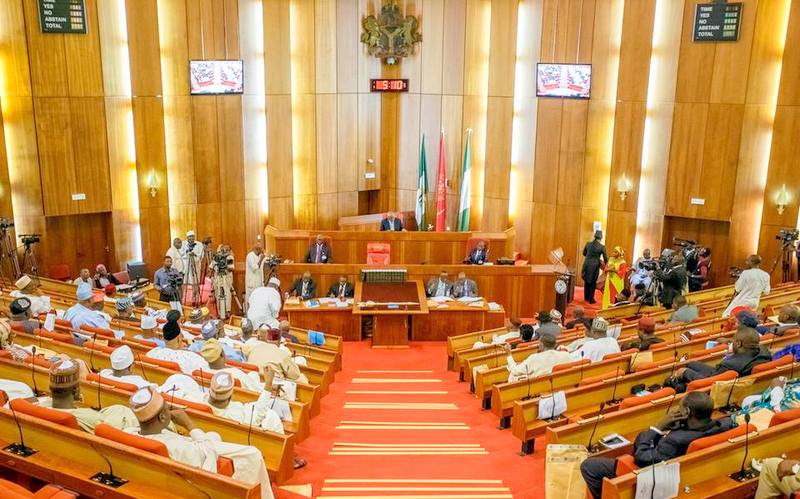
The Senate has directed the Nigerian National Petroleum Corporation (NNPC) and other revenue generating agencies to stop further capital expenditure until they comply with the Fiscal Responsibility Act.
It said that the agencies had violated the Act and gave them two weeks to submit their budgets in accordance with the provisions of Section 21 of the law.
The directive was sequel to a motion on “Non-submission of 2017 Budget by Public Corporations in Violation of the Fiscal Responsibility Act” moved by the Deputy Senate Leader, Bala Na’Allah, at plenary.
He said that the Act stipulated that government’s revenue-generating agencies should submit to their supervising ministers, estimates of revenue and expenditure for three years ahead.
Na’Allah said that the submission of the estimates, as contained in the Act, should be done not later than six months from the commencement of the Act and for every three financial years thereafter.
“It should also not be done later than the end of the second quarter of every year’’.
He said that non-compliance with the provisions of the Act amounted to abuse of power and economic sabotage aimed at frustrating current economic measures being taken by the present administration to revive the economy.
He pointed out that the absence of penalties in the provisions of the Act had emboldened and encouraged the perpetration of infractions on it.
The legislator stated that the Fiscal Responsibility Commission was failing in its responsibility in executing of its mandate, owing to complacency.
In his contribution, Deputy President of the Senate, Mr Ike Ekweremadu, said “we are here talking about responsibility of governance, there cannot be any hard responsibility than Fiscal Responsibility because that is the beginning of all evils.
“We must begin to ensure that we live by the laws we make for ourselves.
“If we say that ministers are supposed to send the estimates of various agencies under them with the Appropriation Act of each year that has to be done.
“I recall in 2016, President Muhammadu Buhari sent to this National Assembly the Appropriation Act for that year together with those estimates.
ALSO SEE: Senate finally approves 21% budget hike
“But, in 2017, the ministers find it impossible to accompany the same Appropriation Bill with those estimates of the agencies under them.
“We cannot be going forte and back. I believe that this is time for us to insist under Section 88 that gives us power of oversight that this has to be done.
“We make laws here for the good governance of this country and that is actually what we have to insist,” he said.
In his remarks, President of the Senate, Dr Bukola Saraki, said that the motion was at the heart of the fight against corruption.
“It is very important that some independent revenue agencies even exceed how much we get from oil revenue.
“So, this is a huge amount to our revenue line. We are talking about looking for money to fund projects, hospitals, education etc; this is where the source of the revenue is.
“And, I cannot see how we can continue in a society where we are fighting corruption, where people will be spending money without approval, without appropriation.
“It must stop; it will stop and is going to stop from now,” Saraki said.




-

 Featured6 days ago
Nigeria’s youth unemployment paradox: Graduates struggle as millions survive in informal jobs
-

 Business6 days ago
Nigerian Banks earn N521.8bn from E-banking, card fees in nine months
-

 Energy6 days ago
Nigeria’s power crisis deepens as ₦639bn unpaid gas debt threatens electricity supply
-

 Latest6 days ago
Dalung claims ‘message from Buhari’s grave’ urges Nigerians to vote Atiku in 2027
-
 Featured5 days ago
Tinubu’s Renewed Hope: Reforms, hardship and the unanswered question of a second term
-

 Business1 week ago
GTCO fashion weekend: As fashion evolves, Nigerian men are rewriting the rules of style
-

 Featured4 days ago
The cost of Renewed Hope: How Nigeria’s economic reforms are reshaping everyday family life
-

 Latest6 days ago
Ondo shuts ponmo processing centre after discovery of human waste